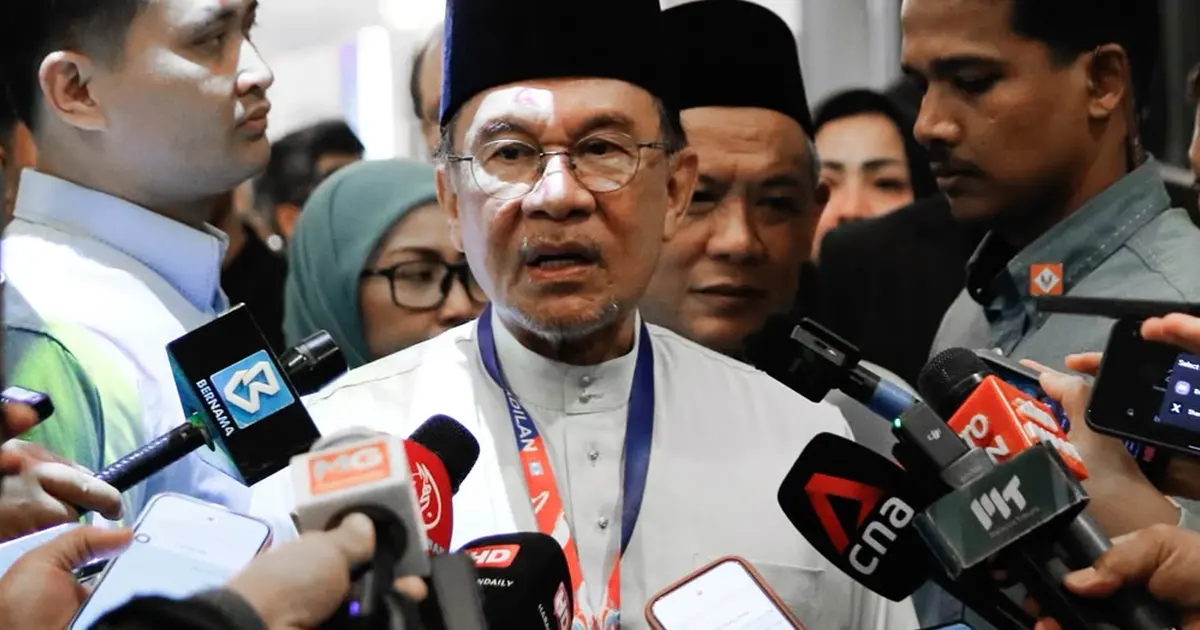
Prime Minister Anwar Ibrahim has moved to quell speculation about friction within Malaysia's top political echelon by publicly distancing himself from recent remarks questioning his relationship with Deputy Prime Minister Zahid Hamidi. Speaking in response to commentary from former Umno Youth chief Khairy Jamaluddin, who aired concerns in a podcast episode, Anwar characterised the concerns as representing KJ's individual perspective rather than any genuine rupture in the government's leadership structure.
The prime minister's intervention comes at a sensitive moment for the Pakatan Harapan-led administration, which relies on continued cooperation with Umno and other coalition partners to maintain its parliamentary majority. Trust between key figures at the apex of government is therefore not merely a matter of personal dynamics but a foundational element upon which the entire political arrangement rests. Any public suggestion of fracture between the prime minister and the deputy prime minister risks destabilising investor confidence and complicating the government's legislative agenda.
Khairy Jamaluddin, who served as Umno Youth chief before stepping back from frontline politics, had used his podcast platform to articulate concerns about the working relationship between Anwar and Zahid. His comments appear to have reflected unease about communication channels and decision-making processes within the cabinet, matters that have periodically surfaced in Malaysian political discourse over the past year. KJ's intervention suggests that such concerns circulate within Umno's broader ecosystem, even if they have not yet crystallised into formal party grievances.
Anwar's response indicates that he and KJ simply interpret governance challenges from different angles. The prime minister's framing suggests that where KJ perceives potential trust deficits, Anwar sees natural policy divergences arising from the coalition's ideological diversity. This interpretation allows the government to acknowledge without accepting the underlying premise, effectively neutralising the criticism by attributing it to perspective rather than substance. Such rhetorical moves are characteristic of crisis management in multi-party coalitions where explicit denials might inadvertently validate the underlying concern.
The clarification assumes particular significance given Zahid Hamidi's position not only as deputy prime minister but also as president of Umno, the largest component of the government coalition. Any sustained deterioration in Anwar's working relationship with Zahid could theoretically trigger broader instability within the ruling alliance, since Zahid commands the votes of Umno's parliamentary contingent. Maintaining the appearance of functional cooperation between these two figures is therefore operationally essential for government stability.
The government's coalition architecture remains inherently fragile, resting on agreement between Pakatan Harapan, Umno, Gabungan Parti Sarawak, and various smaller parties. This arrangement has survived for several years partly because the alternative scenarios appear unattractive to most participants. However, such coalitions are vulnerable to accumulating grievances and personality conflicts, particularly when high-ranking figures air concerns through public channels rather than resolving them through private dialogue. Khairy's podcast appearance may have been intended as a warning signal to the government rather than a direct challenge.
The substance of KJ's concerns, based on available reporting, appears to centre on matters of consultation and mutual respect in the decision-making process. Such concerns, if widespread among Umno's leadership cadre, could gradually erode the coalition's cohesion even absent any dramatic political rupture. The government's ability to deliver on its economic agenda and legislative priorities depends significantly on smooth relationships between coalition partners at all levels. When trust is questioned publicly, it creates pressure on other party leaders to either defend their partners or distance themselves, thereby forcing latent tensions into the open.
Anwar's measured response rather than a sharp rebuttal suggests the prime minister is treating the matter with appropriate seriousness while attempting to contain its political impact. By characterising KJ's comments as a personal perspective, Anwar implicitly invites the former Umno Youth chief and others harbouring similar concerns to address them through private channels rather than public forums. This approach preserves the government's ability to function while signalling that internal disagreements should remain internal.
Looking forward, the incident underscores the ongoing balancing act required of any government dependent on coalition mathematics. Anwar must simultaneously project confidence and stability to the public and international community while managing legitimate concerns within partner parties about their representation in decision-making structures. The government's economic reform agenda, including efforts to attract foreign investment and stabilise public finances, requires the kind of sustained political calm that public disputes between senior figures inevitably disrupts.
The episode also reflects broader dynamics within Umno itself, where multiple factions and personalities compete for influence and position. Khairy's comments, whether intended or not, intersect with these internal party dynamics, where expressions of concern about the government's functioning can serve various strategic purposes. Some Umno figures may genuinely worry about the coalition arrangement's durability, while others may calculate political advantage in appearing to hold the government accountable to the party's interests.
The government will likely move forward with its stated agenda, treating this incident as a minor tremor rather than a structural threat. However, it serves as a reminder that coalition governments depend on constant maintenance of relationships and communication patterns. Public scepticism about the functioning of such arrangements, once voiced by figures with KJ's profile, can gradually accumulate and shift political perceptions. For Malaysian readers observing these dynamics, the message is clear: the government remains functional but requires careful navigation of personalities and interests across multiple political parties.

