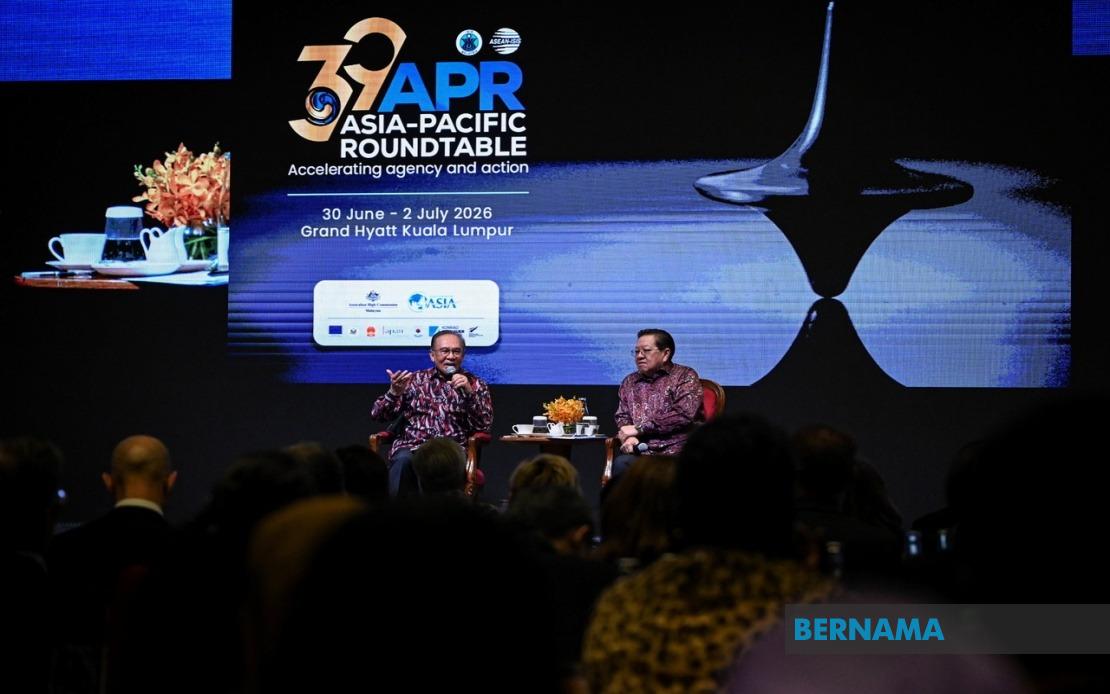
Prime Minister Datuk Seri Anwar Ibrahim has firmly rejected the prevailing notion that military conflict in the South China Sea represents an unavoidable outcome, instead positioning dialogue, mutual confidence and respect for international legal frameworks as the cornerstones of lasting regional stability. Speaking at the 39th Asia-Pacific Roundtable in Kuala Lumpur on Thursday, Anwar presented a measured perspective that challenges the increasingly hawkish rhetoric dominating discussions about the disputed waters, asserting that Malaysia's direct experience with Beijing demonstrates the possibility of managing maritime tensions through constructive engagement.
The Prime Minister's remarks carry particular significance given Malaysia's own maritime claims in the South China Sea and its role as a credible voice within ASEAN on these contentious issues. Anwar's emphasis on meaningful exchanges with Chinese leadership, citing interactions with President Xi Jinping and Premier Li Qiang, underscores Malaysia's commitment to bilateral channels for resolving disagreements rather than allowing disputes to fester or escalate into confrontation. This pragmatic stance reflects a broader Malaysian strategy of balancing relationships with major powers while maintaining the integrity of regional mechanisms designed to manage competing interests.
Central to Anwar's position is his confidence in the efficacy of the United Nations Convention on the Law of the Sea, which provides an established legal framework for resolving maritime boundary questions and resource access rights. He highlighted China's stated support for UNCLOS and its participation in ongoing negotiations on an ASEAN-China Code of Conduct governing behaviour in the South China Sea. These negotiations, though protracted and occasionally frustrating, represent the formal machinery through which claimant states are gradually developing shared rules and expectations about acceptable conduct. The Code of Conduct framework, once finalised, would constitute the most comprehensive regional agreement addressing South China Sea issues since territorial claims became a focal point of geopolitical attention.
Anwar's characterisation of those emphasising military conflict scenarios as driven by "phobia" reflects a deliberate attempt to reframe the South China Sea debate away from worst-case threat analysis towards cost-benefit reasoning centred on the mutual advantages of stability. For Malaysia and other Southeast Asian nations dependent on unimpeded maritime commerce, freedom of navigation, and fishing rights, the economic case for peaceful resolution outweighs the appeal of confrontational posturing. The South China Sea remains one of the world's most important shipping lanes, with trillions of dollars in annual trade transiting its waters, making disruption catastrophic for all regional economies regardless of their political alignment.
The Prime Minister's argument that ASEAN's decades-long achievement in maintaining regional peace stems from the personal relationships and regular communication among its member state leaders identifies a crucial institutional advantage often overlooked in analyses that assume structural conflict is inevitable. Southeast Asian nations have developed a diplomatic culture emphasizing face-to-face engagement, consensus-building, and the quiet resolution of differences before they become public crises. This tradition, rooted partly in ASEAN's founding principles and partly in deeper cultural practices, has enabled the organisation to weather internal tensions and external pressures that might have fractured other regional groupings.
Anwar's confidence in continued dialogue extends beyond the South China Sea to other regional boundary disputes, as evidenced by his welcoming remarks regarding Cambodia and Thailand's commitment to ongoing border negotiations. He contextualised many such disputes as historical legacies of colonial-era administrative arrangements, a framing that encourages parties to view them as inherited complications rather than fundamental incompatibilities between neighbouring peoples. This historical perspective, common among Southeast Asian leaders, helps depoliticise boundary issues and facilitate pragmatic settlements based on contemporary needs rather than grievances rooted in distant history.
The Prime Minister's broader point about advocating for reforms of global multilateral institutions, particularly the United Nations and World Trade Organisation, reveals the interconnection between regional stability and international governance. Malaysia and ASEAN have long advocated for greater voice in international decision-making bodies, arguing that the post-World War II institutional order inadequately represents the interests and perspectives of developing Asian nations. Improvements in these systems, Anwar suggests, would enhance legitimacy and effectiveness while creating conditions more conducive to peaceful dispute resolution at all levels.
Anwar's repeated emphasis on ASEAN's commitment to diplomacy and engagement serves a dual purpose: it reassures ASEAN partners of Malaysia's continued adherence to regional solidarity while simultaneously signalling to external powers that the grouping will not fragment under pressure. This messaging becomes increasingly important as great power competition intensifies, with various external actors attempting to exploit ASEAN divisions or incentivise individual member states to adopt more confrontational stances. Malaysia's articulation of a middle path reflects its strategic position as both a regional stakeholder with direct territorial interests and a responsible bridge-builder capable of facilitating consensus.
The practical implications of Anwar's position extend to resource allocation and military planning within Malaysia itself. By rejecting alarmist narratives and maintaining confidence in diplomatic processes, the government signals that massive military buildups or confrontational posturing need not become policy responses to South China Sea tensions. This allows Malaysia to channel resources towards development priorities and social investment rather than an arms race that no regional player could sustainably win against Chinese military capabilities. The opportunity cost of perpetual military competition is particularly acute for developing Southeast Asian economies seeking to lift citizens out of poverty and build technological capacity.
However, Anwar's optimism must be tempered by recognition of real obstacles to Code of Conduct finalisation and the persistent temptations for individual states to pursue unilateral advantage in maritime areas. Negotiations have proceeded slowly, and significant disagreements remain regarding binding versus non-binding provisions, dispute resolution mechanisms, and the extent to which the Code would constrain the military activities of external powers. China's strategic interest in maintaining ambiguity regarding its claims and capabilities creates genuine complexity that dialogue alone may struggle to overcome completely.
The Prime Minister's remarks ultimately represent a conscious choice to lead rather than follow international anxiety about South China Sea conflict. By articulating confidence in dialogue-based approaches grounded in international law and regional institutions, Anwar attempts to shape regional perceptions and expectations towards paths that avoid self-fulfilling prophecies of conflict. Malaysia's credibility in making this argument derives from its direct experience managing maritime tensions with China through bilateral channels, its membership in ASEAN, and its own considerable strategic interests in regional peace. Whether this constructive engagement approach can withstand mounting great power pressures and nationalist sentiments within regional societies remains an open question, but Anwar's positioning at least establishes clear benchmarks against which Malaysia's commitment to peaceful resolution can be measured.

