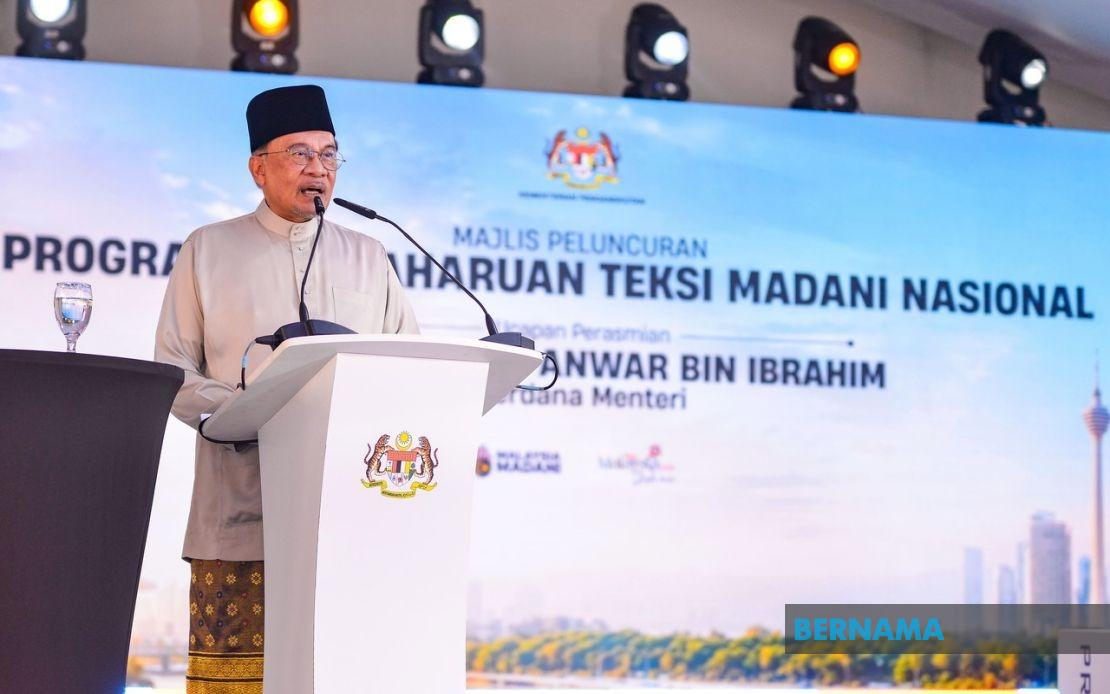
Prime Minister Datuk Seri Anwar Ibrahim has unveiled an additional RM10 million in government funding directed towards helping taxi drivers acquire newer, more reliable vehicles, signalling the administration's strengthened commitment to revitalising a sector that has faced mounting pressure from ride-hailing services and aging vehicle fleets. The fresh allocation comes as the Vehicle Replacement Matching Grant Programme gains traction among operators, demonstrating that policy interventions, when adequately resourced, can meaningfully address industry challenges that have plagued urban transportation for years.
Announcing the measure at Dataran Merdeka during the launch of the National MADANI Taxi Reform Programme, Anwar—who holds the dual portfolio of Prime Minister and Finance Minister—emphasised that the government's decision to inject additional capital reflects the encouraging reception afforded the initial RM10 million earmarked in Budget 2026. The doubling of immediate support within months underscores how rapidly government priorities can shift when real-world feedback demonstrates genuine demand, a lesson often overlooked in lengthy bureaucratic cycles.
The taxi industry has long struggled with structural problems that extend beyond mere vehicle age. Fleet modernisation represents one strand of comprehensive reform, yet it remains crucial because older vehicles impose higher operating costs on drivers through fuel inefficiency and frequent repairs, whilst simultaneously creating negative passenger perceptions about safety, comfort, and reliability. By lowering the financial barriers to vehicle replacement, the government attempts to address these cascading disadvantages that have made taxi driving an increasingly unviable profession for many Malaysians.
Crucially, the government has negotiated a collaborative arrangement with automotive manufacturer Proton and the Transport Ministry to establish a bespoke financing mechanism through which taxi drivers can purchase the Proton S70. This partnership approach acknowledges that capital availability alone proves insufficient; drivers also require affordable credit terms tailored to their actual earning patterns and cash flow realities. Local automotive sector support simultaneously strengthens domestic manufacturing and employment while reducing driver reliance on imported vehicles.
The Proton S70 represents an economical choice for the segment, combining reasonable acquisition costs with maintenance accessibility through Proton's established dealer network across Malaysia. For taxi operators weighing replacement decisions, such financing arrangements fundamentally alter the cost-benefit calculation, transforming what might seem prohibitively expensive into manageable monthly obligations spread across vehicle lifecycles. This represents pragmatic industrial policy that recognises market mechanisms alone cannot solve equity problems in essential service sectors.
Transport Minister Anthony Loke's presence at the programme launch alongside Hannah Yeoh, Minister in the Prime Minister's Department (Federal Territories), and Chief Secretary Tan Sri Shamsul Azri Abu Bakar reflected whole-of-government coordination. Modernising urban taxi fleets requires harmonising multiple policy domains—finance, transportation regulation, manufacturing incentives, and local governance. Such cross-departmental alignment, when visible and sustained, increases implementation likelihood and signals that reform enjoys genuine political backing rather than representing marginal bureaucratic initiatives.
The National MADANI Taxi Reform Programme extends beyond vehicle replacement to encompass broader industry restructuring. As Malaysia's major cities continue rapid development and transportation technologies evolve, traditional taxi models face existential challenges. Ride-hailing platforms have fragmented the market, whilst regulatory frameworks struggle to accommodate hybrid service models. Vehicle modernisation alone cannot reverse declining taxi utilisation, yet it establishes a foundation upon which more comprehensive reforms—potentially including service model innovations, driver training, and fare structure rationalisation—might subsequently build.
For Malaysian taxi drivers, particularly owner-operators in competitive urban markets, the combined effect of matching grants and accessible financing potentially offers breathing room to upgrade fleets without catastrophic debt burdens. This matters considerably in sectors where profit margins compress relentlessly and where aging vehicles transform operational challenges into livelihood threats. Whether these measures ultimately arrest taxi industry decline depends on complementary reforms addressing regulatory barriers and market competitiveness, yet they represent necessary first steps.
Regionally, Malaysia's approach to taxi modernisation through state-facilitated financing and domestic manufacturing partnerships offers a model worth noting. Southeast Asian cities grapple with similar transportation sector pressures, and solutions balancing fiscal prudence with industry sustainability merit study. The initiative demonstrates that governments retain meaningful policy tools beyond simple deregulation when addressing employment and service delivery concerns in transitional industries.
The immediate challenge involves efficient programme implementation and uptake monitoring. Historical experience suggests that well-intentioned grant schemes sometimes underperform due to application complexity, awareness gaps among target beneficiaries, or documentation requirements exceeding typical small operator capabilities. Ensuring that taxi drivers in provincial areas and independent operators access these funds requires deliberate outreach, streamlined application processes, and genuine government commitment to removing administrative friction.
Longer-term success requires moving beyond vehicle replacement alone. Driver income stabilisation, regulatory clarity around competing service models, and potential consolidation of fragmented taxi operations into more sustainable structures merit concurrent attention. The Proton partnership and matching grants represent important but necessarily incomplete responses to systemic challenges. Monitoring how the programme evolves and what additional policy interventions follow will indicate whether the government genuinely intends comprehensive taxi sector reformation or views vehicle replacement as sufficient intervention.

