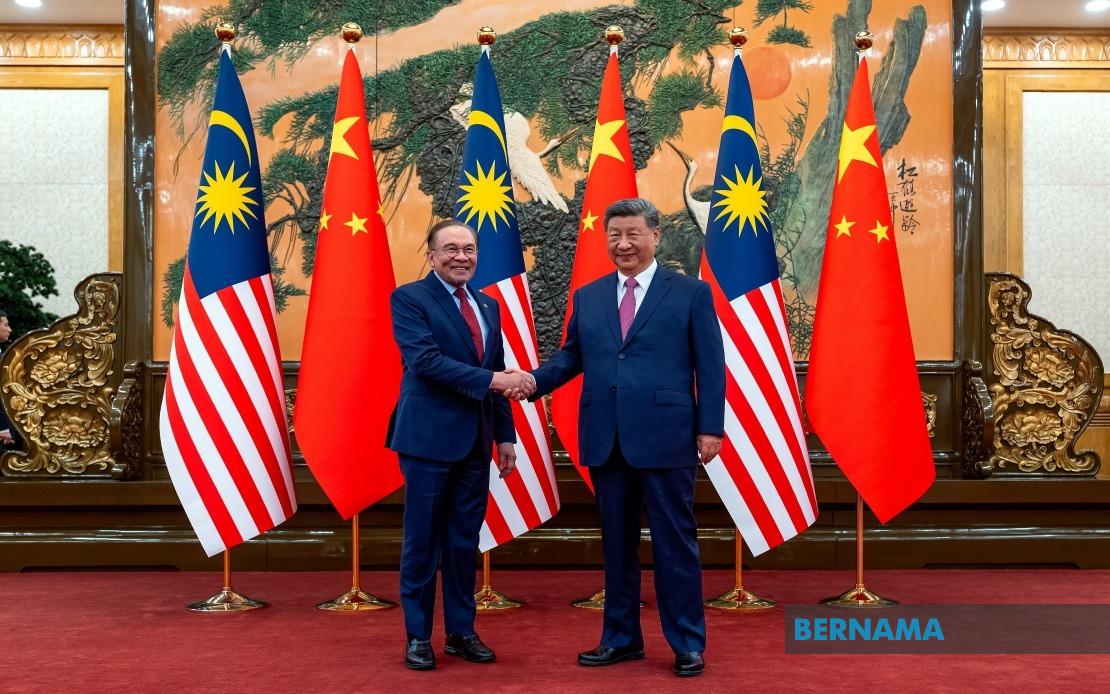
Prime Minister Datuk Seri Anwar Ibrahim has conveyed formal congratulations to the Chinese government on the 105th anniversary of the founding of the Communist Party of China, through a letter addressed directly to Chinese President Xi Jinping. The gesture, announced on Facebook, represents Malaysia's continued diplomatic engagement with Beijing and reflects the longstanding relationship between the two nations across multiple political transitions and regional shifts.
In his message, Anwar expressed appreciation for what he characterized as the transformative role the ruling party has played in shaping China's modern development trajectory. The Prime Minister acknowledged the party's historical significance in drawing upon accumulated civilizational strengths, institutional memory, and cultural values that have accumulated over centuries of Chinese history. This framing reflects a diplomatic approach that seeks to find common ground in historical and cultural narratives rather than focusing on ideological differences between Malaysia's constitutional monarchy and China's single-party system.
A particularly notable element of Anwar's statement was his emphasis on Malaysia's pioneering role in recognizing the People's Republic of China. He specifically recalled the decision made on May 31, 1974, when Malaysia became the first non-communist nation in Southeast Asia to establish formal diplomatic relations with Beijing. This milestone carries substantial symbolic weight in Malaysia's foreign policy history, as it represented a calculated strategic decision made during the Cold War era when most Western-aligned nations maintained recognition of the Republic of China in Taiwan instead.
The 1974 recognition decision reflected Malaysia's pragmatic approach to international relations and its recognition that engaging with China was essential for regional stability and economic opportunity, even as the country remained firmly anchored within Western security arrangements through ASEAN and other frameworks. Anwar's invocation of this moment serves to ground contemporary Malaysia-China ties in decades of tested diplomatic practice, suggesting continuity rather than a sudden shift in bilateral relations. The timing of this commemoration also underscores how Malaysia views its China relationship as a strategic asset that has weathered various regional and global transformations.
Anwar reiterated Malaysia's commitment to expanding and deepening strategic cooperation with China across multiple domains, provided such engagement is conducted on the basis of mutual respect, reciprocal trust, and equitable benefit-sharing arrangements. This formulation, while diplomatically conventional, carries specific implications for how Malaysia approaches the relationship. The emphasis on "shared benefits" suggests Malaysia's determination to ensure that expanded ties do not become one-directional or economically disadvantageous, a concern that resonates across Southeast Asia as Chinese investment and influence have grown substantially over the past two decades.
The Prime Minister's message also positioned enhanced Malaysia-China cooperation as a contribution to broader regional objectives, particularly the maintenance of peace, stability, and sustainable prosperity throughout Southeast Asia. This framing is significant because it presents bilateral engagement not as an end in itself but as a means toward achieving collective regional goods. For Malaysian policymakers, there is value in presenting China ties as complementary to rather than competitive with other regional partnerships, a delicate balance that remains central to ASEAN's non-aligned diplomatic traditions.
The occasion itself—marking 105 years since the founding of the Chinese Communist Party in 1921—is primarily commemorated within China itself, with July 1st being an important date in the Chinese political calendar. International recognition of this anniversary through official channels is selective rather than universal, and Malaysia's decision to mark the occasion through a formal letter from the Prime Minister signals particular diplomatic attention. In contrast to some Western countries that distance themselves from such commemorations, Malaysia's approach reflects its distinct strategic position as a Southeast Asian nation that has consciously developed and maintained substantial economic, cultural, and political ties with China.
From a Southeast Asian perspective, Malaysia's diplomatic gesture is noteworthy because the country continues to navigate complex regional dynamics involving China, the United States, India, and other major powers. Malaysia's balancing act requires maintaining productive relationships with multiple strategic partners while avoiding the perception of exclusive alignment with any single power. The current regional context includes ongoing concerns about the South China Sea, economic competition, technology standards, and ideological questions about democratic governance, making Malaysia's continued emphasis on pragmatic engagement with Beijing a key element of its regional foreign policy strategy.
The reference to Malaysia's historical decision-making also carries implicit lessons for contemporary Southeast Asian statecraft. The 1974 recognition of the People's Republic of China demonstrated Malaysia's willingness to make bold strategic choices when policymakers assessed that such moves served national interests, regardless of prevailing international orthodoxies of that era. As Southeast Asian countries today grapple with how to position themselves amid great-power competition, Malaysia's historical example of principled pragmatism remains relevant to regional discourse about balancing competing interests.
Anwar's diplomatic communication also reflects the personal rapport that has developed between Malaysian and Chinese leadership in recent years. The Prime Minister's individual engagement through a direct letter to President Xi, rather than a generic statement through official channels, suggests the importance Malaysia places on maintaining high-level personal relationships with Chinese decision-makers. Such cultivation of interpersonal connections at the leadership level has long been a feature of Southeast Asian diplomacy and remains relevant to how bilateral relationships are managed and developed.

