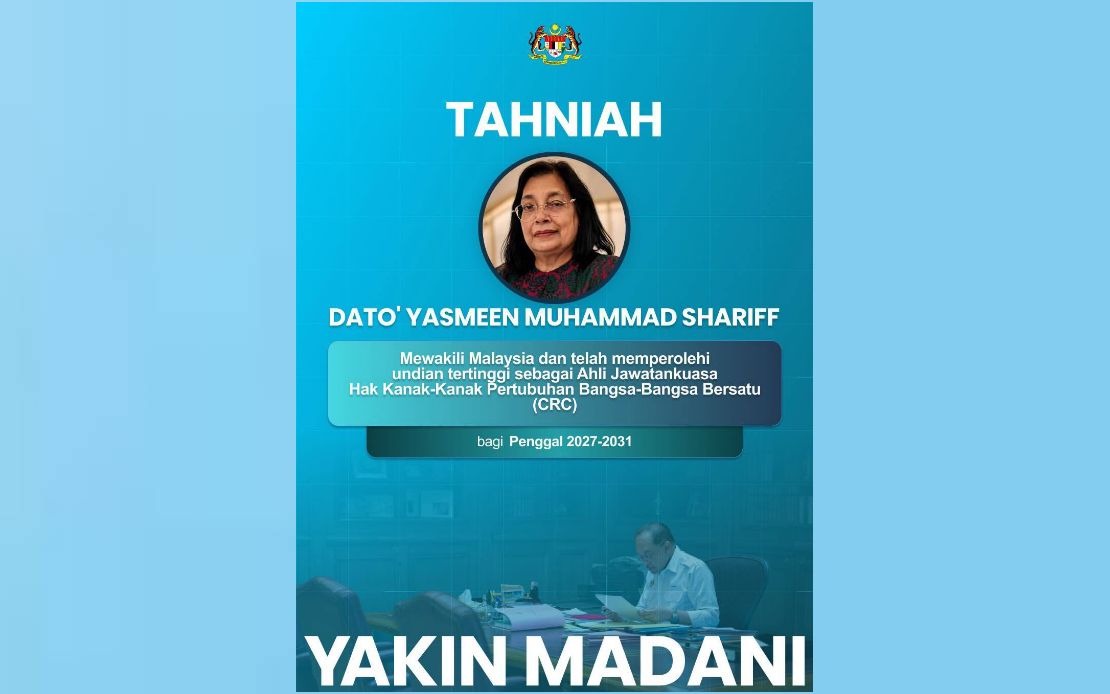
Prime Minister Datuk Seri Anwar Ibrahim has extended his congratulations to Datuk Yasmeen Muhamad Shariff following her successful election to the United Nations Committee on the Rights of the Child, marking a significant diplomatic achievement for Malaysia on the global stage. The appointment carries particular weight given the competitive nature of UN committee selections and reflects the international community's confidence in Malaysian expertise in child welfare and protection matters.
Yasmeen secured 136 votes from the 189 States Parties that participated in voting during the 21st Meeting of States Parties to the Convention on the Rights of the Child held at UN headquarters in New York on Tuesday. This decisive mandate underscores widespread regional and global support for her candidacy, positioning her as a trusted voice among nations committed to advancing children's rights internationally.
The Prime Minister used the occasion to emphasise how such international recognition strengthens Malaysia's broader diplomatic portfolio and reinforces the country's commitment to multilateral engagement on human rights issues. His remarks reflected an understanding that representation on prestigious UN bodies carries implications beyond individual achievement, serving as a platform through which Malaysia can advocate for its values and interests within the global rules-based order.
This marks Yasmeen's second appointment to the committee, having previously served a term from 2013 to 2017. Her reelection demonstrates continuity in Malaysia's engagement with UN child protection mechanisms and suggests that her prior experience and contributions to the committee's work were valued by member states. The Ministry of Women, Family and Community Development emphasised this dual distinction as particularly commendable, noting the rarity of consecutive appointments to such competitive positions.
In her role as a committee member, Yasmeen will operate in a personal capacity as an independent expert rather than as a direct government representative, though her election will inevitably reflect and enhance Malaysia's international profile. This distinction is important within UN culture, as committee members are expected to uphold standards of impartiality while naturally bringing their national contexts and expertise to deliberations on child rights implementation across diverse jurisdictions.
The Ministry of Women, Family and Community Development coordinated Malaysia's candidacy through established diplomatic channels, reflecting the government's strategic prioritisation of this appointment. The portfolio ministry's instrumental role in securing the position suggests deliberate government strategy to strengthen Malaysia's presence within human rights monitoring bodies, particularly those focused on vulnerable populations and social policy implementation.
Yasmeen's appointment arrives at a moment when the UN system faces intensifying scrutiny over implementation gaps between child rights conventions and ground-level realities across member states. Her tenure will coincide with ongoing global discussions about enforcement mechanisms, resource allocation for child protection services, and emerging challenges including digital safety and climate impacts on childhood welfare. Southeast Asian perspectives will prove valuable in these deliberations, as the region faces distinct challenges in harmonising traditional family structures with international child protection standards.
Malaysia's strengthened representation within UN children's rights mechanisms carries domestic implications as well. The visibility of such appointments often catalyses heightened attention to national child protection frameworks, encouraging governments to align domestic legislation with international best practices. For Malaysia, this platform provides opportunity to showcase progress on child welfare initiatives while identifying gaps requiring policy attention, particularly regarding vulnerable groups including migrant children, those in poverty, and youth in conflict with the law.
The achievement also reflects broader Southeast Asian dynamics within the UN system, where representation remains contested and alliances fluid. Malaysia's success in securing consecutive appointments positions the country as a stable participant in international governance processes, contrasting with regional neighbours experiencing diplomatic constraints. This competitive advantage extends beyond the CRC Committee, potentially translating into Malaysian influence on related human rights bodies and agenda-setting initiatives within the wider UN ecosystem.
Anwar's public recognition of this diplomatic win signals government intention to leverage such international engagements for domestic political messaging, particularly around Malaysia's commitment to progressive values and global responsibility. For a government seeking to rebuild international credibility following prior governance challenges, such appointments serve as tangible evidence of Malaysia's rehabilitation as a trusted participant in multilateral institutions.
Looking ahead, Yasmeen's five-year term will encompass significant evolving challenges in child protection, from artificial intelligence and online exploitation to mental health and climate adaptation. Her expertise and advocacy will shape how the CRC Committee guides member state implementation during a period of unprecedented global complexity affecting childhood and adolescence. Malaysia's contribution to these critical global conversations underscores the country's stake in international standards that ultimately filter into domestic policy frameworks affecting millions of children across the region.

