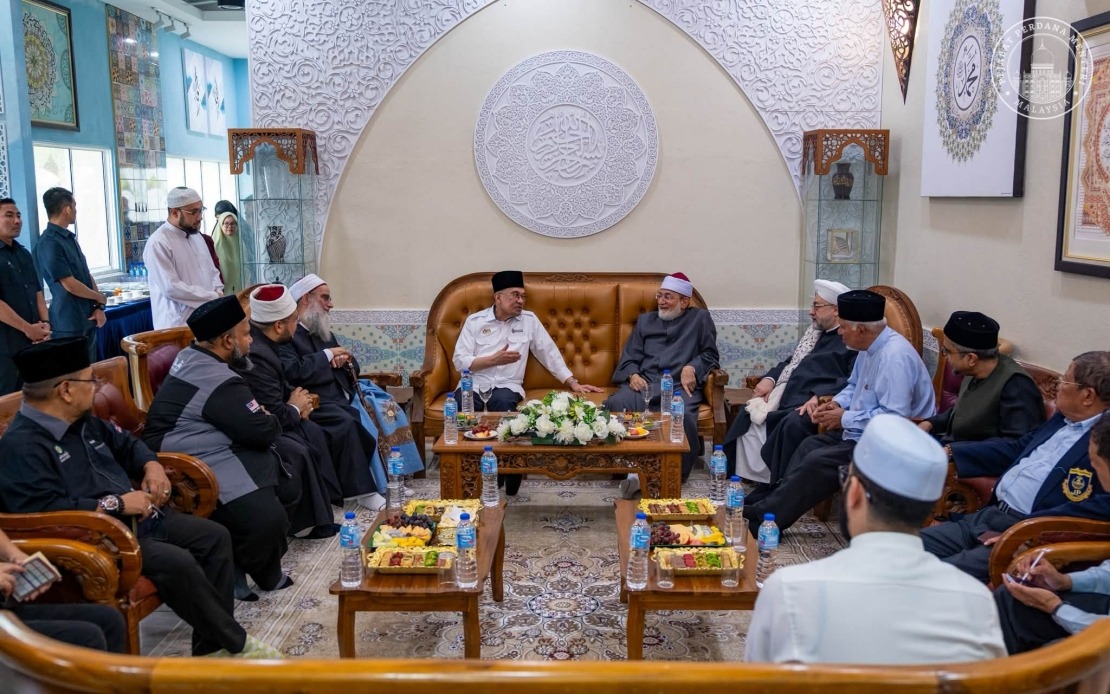
Prime Minister Datuk Seri Anwar Ibrahim recently carved time from his official duties to meet with three distinguished Islamic scholars who are visiting Malaysia. The encounters reflect the government's continued engagement with prominent religious figures and underscore the Prime Minister's commitment to leveraging international Islamic expertise for the benefit of Malaysian communities.
The three scholars receiving Anwar's visit represent different specializations within Islamic learning. Al-Fadhil Al-Allamah Al-Muhaddith Syeikh Dr Mustafa al-Nadwi Al-Hasani brings recognized expertise in hadith scholarship from Egypt, where he has built a considerable reputation over decades of study and teaching. Al-Fadhil Al-Allamah Al-Muqri' Syeikh Dr Ahmad Isa Al-Ma'sarawy is internationally acknowledged for his mastery of Quranic recitation, a discipline requiring years of intense vocal and spiritual training. The third visitor, Al-Fadhil Al-Syeikh Maulana Al-Sayyid Afeefuddin Al-Jailani, serves as the grand custodian overseeing the religious endowments, mosques, and holy sites associated with the legacy of Syeikh Abdul Qadir Al-Jailani, one of Islam's most venerated spiritual figures.
According to a statement posted on social media, Anwar described the meeting as a meaningful interruption to his demanding schedule. The Prime Minister emphasized that he used the opportunity to inquire after the scholars' welfare, a gesture that carries significant cultural weight in Islamic tradition. Beyond courtesies, Anwar sought their guidance and requested their prayers—a practice reflecting how Malaysian political leadership has traditionally valued the blessing and wisdom of respected Islamic teachers.
The visit took place at Nasyrul Quran, an institution focused on Quranic studies and dissemination. The venue choice itself carries symbolic importance, signaling official recognition of institutions dedicated to Islamic education and the promotion of Quranic knowledge within Malaysia's religious landscape. By meeting the scholars at this location, Anwar effectively endorsed the organization's mission while demonstrating the government's support for initiatives that strengthen Islamic learning among Malaysian citizens.
In his statement, Anwar expressed appreciation for the scholars' willingness to travel to Malaysia and contribute their accumulated knowledge and spiritual wisdom to local communities. Their presence in the country represents part of ongoing efforts to enrich Malaysia's religious discourse and educational offerings through international scholarly exchange. Such visits have become increasingly important as Malaysia seeks to maintain its position as a center for Islamic learning in Southeast Asia while countering less constructive interpretations of Islamic teaching.
The Prime Minister articulated his hope that the scholars' visit would generate expanded understanding of Islamic principles and deepen affection for the religion among Malaysians. Beyond individual spiritual benefit, Anwar framed the engagement within a broader vision of building a virtuous, knowledgeable society characterized by social harmony—objectives that have featured prominently in his political messaging since assuming office. The implicit message suggests that exposure to respected international Islamic voices can contribute to national cohesion and the development of a more enlightened Muslim citizenry.
For Malaysia's broader Islamic community, the visit represents validation of the government's approach to religious governance. Rather than restricting Islamic discourse to domestic voices alone, the administration continues to welcome international scholars whose credentials and reputations command respect across Muslim-majority nations. This openness has been central to Malaysia's self-portrayal as a moderate Islamic nation while simultaneously strengthening institutional Islam through knowledge-sharing with globally recognized authorities.
The engagement also reflects pragmatic considerations within Malaysia's religious politics. By publicly meeting prominent scholars and emphasizing consultation with religious authorities, the Prime Minister reinforces his commitment to Islamic principles while managing the complex relationship between political leadership and religious institutions. In Malaysia's constitutional arrangement, Islamic affairs remain largely within state purview, yet the federal government's engagement with respected scholars helps shape national religious discourse and demonstrates sensitivity to Islamic concerns at the highest levels of government.
For the visiting scholars, their presence in Malaysia offers a platform to influence Islamic thought across a significant Muslim population. The public acknowledgment from the Prime Minister amplifies their visibility and lending credibility to their teachings. Malaysian audiences gain direct access to scholars whose reputations have been built through decades of rigorous Islamic study, potentially enriching local religious discourse with perspectives informed by international Islamic traditions and contemporary scholarly debates.
The timing and nature of such visits often respond to broader regional dynamics. Southeast Asia has experienced increased attention from international Islamic actors in recent years, driven by the region's growing economic importance, its strategic geopolitical position, and concerns about the spread of various Islamic movements. Malaysia's government engagement with respected mainstream scholars serves as a counterweight, promoting interpretations of Islam rooted in traditional learning and emphasizing social stability alongside spiritual development.
Moving forward, such scholarly exchanges are likely to remain a feature of Malaysia's approach to religious leadership and governance. The pattern of senior political figures consulting with and hosting prominent Islamic scholars reflects understanding that effective governance of a Muslim-majority nation requires ongoing engagement with the intellectual and spiritual dimensions of Islam. Whether through formal institutions or informal meetings, these interactions help shape the contours of religious discourse in ways that carry implications for Malaysian society's evolution and Southeast Asia's broader Islamic landscape.

