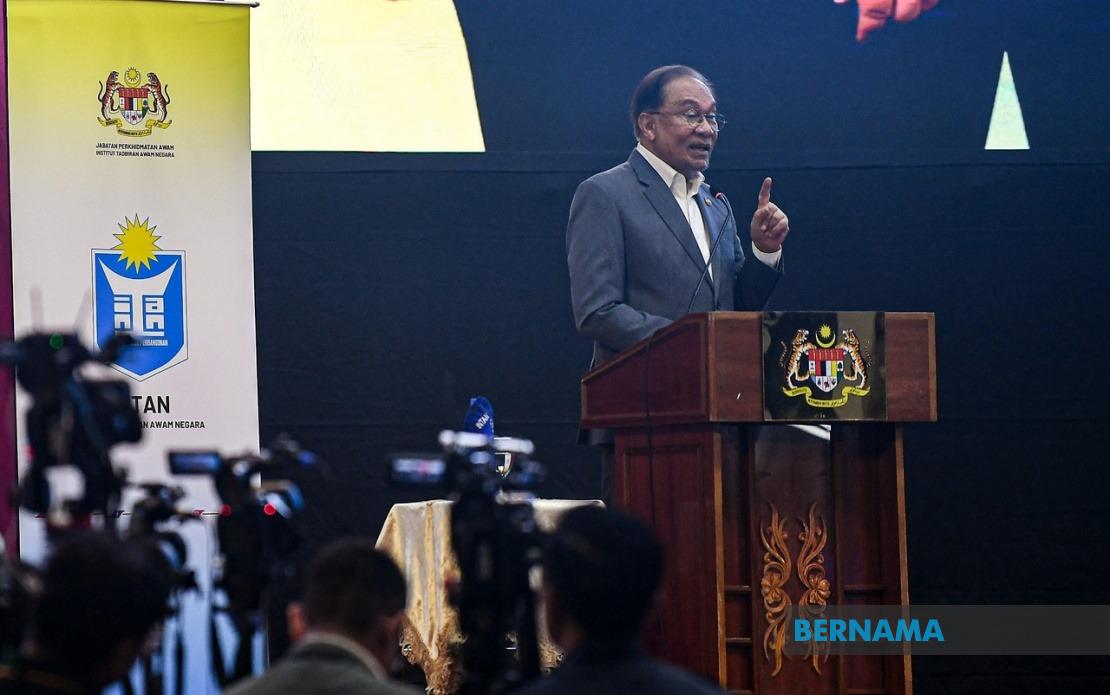
Prime Minister Datuk Seri Anwar Ibrahim has extended an apology to those who may have perceived his robust tone during interactions with the civil service as inappropriately severe, while simultaneously defending the authenticity of his passionate approach to leadership. Speaking through a video message distributed across social media, Anwar acknowledged feedback from members of the public who have counselled him that his role demands a more measured demeanour characterised by restraint and courtesy rather than vigorous assertion.
The Prime Minister's comments came in the aftermath of a gathering held at Universiti Islam Selangor where he addressed civil servants drawn from the Central Zone, an event attended by Chief Secretary to the Government Tan Sri Shamsul Azri Abu Bakar. Anwar's remarks during that engagement appear to have sparked observation about the intensity of his communication style, prompting him to address the matter publicly and provide context for his conduct.
In his video statement, Anwar articulated the tension he experiences between conforming to conventional expectations of prime ministerial composure and remaining true to his visceral responses to matters he considers significant. He acknowledged that observers have counselled him that his elevated voice and forceful expression contradict the dignified bearing expected of someone occupying his office, yet he defended the legitimacy of his emotional investment in the nation's agenda.
The Prime Minister framed his assertiveness as a reflection of how deeply he cares about the substance of governance, particularly regarding the implementation of government policies and the advancement of national development objectives. He contended that his firm manner when addressing the civil service stemmed from recognition of the bureaucracy's pivotal role in translating ministerial intentions into tangible outcomes across all sectors of society.
Anwar's defence of his communication style reveals a deliberate choice to prioritise authenticity over artifice in his leadership presentation. Rather than adopt an entirely polished persona, he has elected to remain transparent about the emotional dimensions of his commitment to public service, even if this occasionally results in a tone that some observers find jarring or inappropriate for his position.
The apology itself carries nuance, framed as conditional rather than unconditional. Anwar expressed regret only if his manner was misunderstood as excessive, while maintaining that his intensity represents a genuine reflection of his values and priorities. This formulation allows him to acknowledge the concerns raised without fully capitulating to suggestions that he fundamentally alter his temperament or communication approach.
For the Malaysian civil service, Anwar's statement carries significant implications. It signals that the Prime Minister views the bureaucracy as a critical vehicle for his government's agenda, and that his demanding tone represents an investment in their performance rather than an arbitrary exercise of power. This perspective positions the civil servants as collaborative partners in nation-building rather than subordinates to be passively directed.
The broader context of this exchange touches on ongoing debates within Malaysian governance circles about leadership style and public expectations of political figures. The tension between authentic expression and professional restraint has long characterised Malaysian politics, with different leaders adopting varying positions along this spectrum. Anwar's willingness to acknowledge criticism while defending his approach suggests confidence in his political standing despite controversy around his demeanour.
From a regional perspective, Anwar's leadership style reflects broader trends across Southeast Asia where leaders increasingly navigate expectations that they balance traditional notions of authority with demands for relatable, emotionally intelligent communication. The Prime Minister's attempt to position his firmness as evidence of commitment rather than arrogance exemplifies efforts by regional political figures to justify unconventional approaches through substantive reasoning.
The incident also underscores the heightened scrutiny that modern political leadership faces, particularly through social media platforms where public reaction to political figures unfolds in real time. Anwar's decision to address criticism directly through video messaging demonstrates awareness of contemporary communication dynamics and an inclination to engage with public sentiment proactively rather than allow interpretations of his conduct to solidify without his input.
Looking forward, Anwar's clarification may influence how observers interpret his future engagements with government institutions and the public sphere. By explicitly connecting his assertiveness to genuine passion for effective governance, he has attempted to reframe what might otherwise be characterised as temperamental excess as instead reflecting principled commitment to national interests.
Ultimately, the Prime Minister's statement represents an effort to reconcile his personal leadership instincts with societal expectations of the office he holds. Rather than pledging fundamental transformation of his approach, he has sought understanding for his method while remaining open to feedback about how his intensity is perceived and received across Malaysian society.

