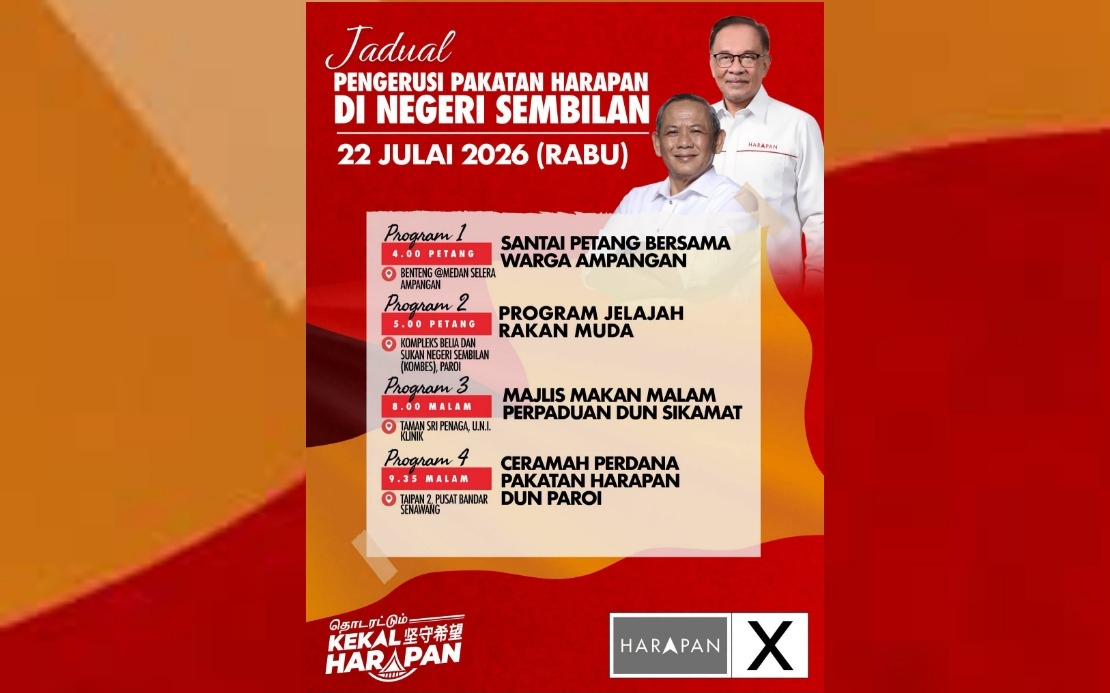
Prime Minister Datuk Seri Anwar Ibrahim is set to lead a significant campaign push across Negeri Sembilan tomorrow, marking his first visit to the state since the launch of campaigning for the 16th Negeri Sembilan State Election. The Pakatan Harapan chairman will execute an ambitious itinerary spanning four locations in Seremban and Paroi, signalling the coalition's determination to consolidate support in a state where every seat carries strategic importance for its wider peninsular political standing.
The campaign visit represents a careful calibration of political messaging, with Anwar's presence designed to energise party machinery and volunteer networks at the grassroots level. As Parti Keadilan Rakyat president, Anwar's personal intervention underscores the significance the coalition places on Negeri Sembilan's electoral outcome. The scheduling of events beginning at 4 pm demonstrates an attempt to capture support during both early evening and peak night-time hours, when voter engagement typically peaks in urban and semi-urban constituencies.
In the evening, Anwar will attend the Sikamat State Legislative Assembly Unity Dinner at Taman Sri Penaga at 8 pm, an event designed to mobilise grassroots supporters and coordinate campaign volunteers. This format—intimate dinners combined with larger rallies—reflects a two-tiered engagement strategy: first consolidating party unity and volunteer enthusiasm through smaller, more focused gatherings, then amplifying momentum through mass rallies that generate media coverage and public visibility.
Following the Sikamat event, Anwar will proceed to the Paroi DUN Pakatan Harapan Grand Rally at Taipan 2, Senawang Town Centre. Grand rallies serve multiple purposes in Malaysian electoral campaigns: they provide visual spectacle for media coverage, create opportunities for speeches addressing multiple constituencies simultaneously, and generate social media content that extends the campaign's reach beyond physical attendees. The Paroi rally's location in a commercial town centre area suggests targeting both established residents and floating voters in developing zones.
The timing of Anwar's visit gains significance within the broader electoral calendar. The Election Commission has scheduled early voting for July 28, followed by general polling on August 1. This means Anwar's campaign push falls squarely within the critical final stretch before voting begins, a period when undecided voters typically crystallise their preferences and campaign intensity reaches maximum levels. The proximity to early voting particularly matters, as it captures mobilised supporters who may vote during the designated early voting period.
Negeri Sembilan's political landscape carries particular relevance for Pakatan Harapan's national positioning. The state's electoral dynamics have traditionally reflected broader peninsular trends, making its results a bellwether for coalition performance. A strong showing would reinforce Anwar's leadership credentials within PH, while demonstrating sustained voter confidence in the coalition's governance record since returning to federal power in 2022. Conversely, setbacks would fuel narratives about coalition vulnerability, potentially emboldening opposition movements.
The state election emerges at a critical juncture for Anwar's administration. His federal government has pursued economic reforms and fiscal consolidation measures that, while intended as long-term stabilisation strategies, have generated short-term consumer pressures. State elections provide voters with opportunities to deliver verdicts on federal policies without directly challenging the central government, making them barometers of public sentiment on economic management and policy direction.
Anwar's decision to personally campaign in multiple locations reflects both confidence in PH's ground organisation and recognition that prime ministerial visibility carries weight in Malaysian electoral contests. His presence generates local media coverage, provides quotable moments for national distribution, and sends signals to wavering supporters that their votes matter sufficiently to command top-tier political attention. This personalisation of the campaign also reinforces the leadership cult that characterises Malaysian politics, where voter decisions often centre on prominent personalities rather than abstract policy platforms.
The four-stop format maximises geographic coverage while maintaining realistic scheduling constraints. By concentrating visits on Seremban and Paroi—constituencies representing the state capital and neighbouring areas—Anwar's campaign targets populations where campaign messaging, voter engagement infrastructure, and media infrastructure are most developed. This concentration strategy enables deeper engagement rather than superficial coverage of geographically dispersed locations, though it also implicitly acknowledges that resource constraints necessitate prioritising areas of highest strategic value.
From a Malaysian perspective, tomorrow's campaign events exemplify how Southeast Asia's largest democracy maintains intense political activity despite substantial governance responsibilities. The logistics of conducting simultaneous government operations and campaign activities illustrate both the demands placed on political leaders and the normalised integration of electoral politics into Malaysian governance culture. For regional observers, such campaigns demonstrate how competitive democratic contestation persists within Malaysia's stable institutional framework, contrasting sharply with authoritarian patterns elsewhere in the region.

