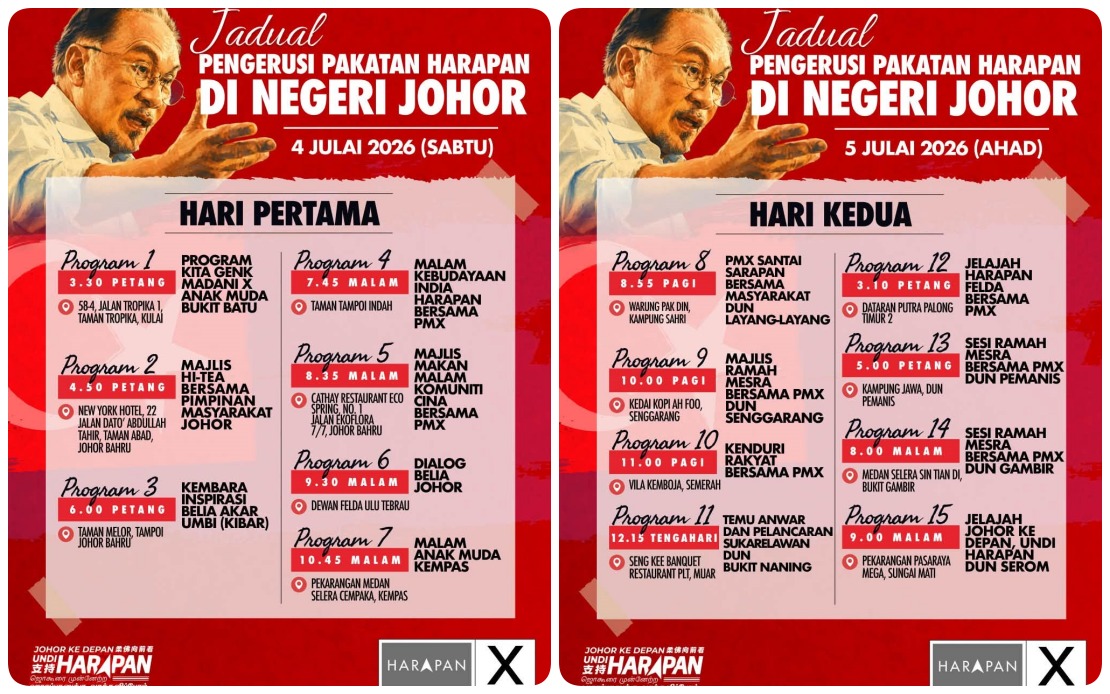
Prime Minister and Pakatan Harapan chairman Datuk Seri Anwar Ibrahim is ramping up the coalition's push in Johor ahead of the upcoming state election with a packed schedule of seven campaign events scheduled for July 4. The coordinated effort signals the importance PH places on retaining control of the state as it heads toward polling day on July 11, with early voting set for July 7.
Anwar's itinerary reflects a deliberate strategy to reach multiple demographic segments within the electorate. The day's activities span from grassroots voter engagement to more formal networking sessions with community figures, demonstrating an effort to build broad-based support across different social strata. This multi-layered approach is typical of major political movements seeking to consolidate power during critical electoral moments.
Central to the Prime Minister's schedule is a high tea reception at a Johor Bahru hotel scheduled for 4.50 pm, where he will interface with leaders from the broader Johor community. Such gatherings serve multiple purposes within electoral campaigns: they allow candidates and senior party figures to hear constituent concerns directly, provide visibility for the party among influential community members, and generate the kind of informal networking that often translates into on-ground support during voting.
Young voters represent a particular focus for the coalition's outreach efforts. Recognising the significant role youth participation plays in determining election outcomes, Anwar's schedule includes a dedicated Johor Youth Dialogue session at the Felda Ulu Tebrau Hall commencing at 9.30 pm. Engaging younger demographics has become increasingly critical for Malaysian political parties, as this cohort demonstrates distinct voting patterns and demands substantive engagement rather than traditional campaign messaging.
The intensity of campaigning is set to continue throughout the following day, with Anwar announcing plans for eight additional programmes on July 5. This sustained engagement underscores the competitive nature of Johor politics and the coalition's determination to maintain momentum across a state that remains strategically significant within Malaysia's political landscape. The extended campaign presence aims to energise the party's machinery and reinforce messaging among both supporters and undecided voters.
Pakatan Harapan is fielding a full slate of 56 candidates across all state assembly seats, divided among the coalition's three component parties. The distribution reflects internal power-sharing arrangements: PKR is contesting 20 seats, Amanah 19 seats, and DAP 17 seats. This composition carries implications for post-election governance and coalition dynamics, as the relative performance of each party will shape both ministerial allocations and policy direction should PH retain control.
The broader electoral contest involves considerably higher numbers, with a total of 172 candidates competing for the 56 state assembly positions. This crowding reflects fragmentation across Malaysia's political landscape, where multiple parties beyond the major coalitions are competing for voter attention. The presence of numerous candidates can influence voting dynamics, particularly in closely contested seats where opposition or independent candidacies might split voter support in unexpected ways.
For Malaysian political observers, the Johor election carries implications extending beyond state-level governance. Johor remains economically significant and politically influential, with outcomes in the state often serving as bellwethers for national political sentiment. Performance in Johor affects not only state-level administration but can influence the confidence investors, civil society, and international observers place in Malaysia's political stability and governance trajectory.
The campaign calendar leading to July 11 provides a compressed window for parties to consolidate their messaging and mobilisation efforts. Early voting on July 7 means that campaigns must peak before the middle of that week, making the intensity of activity in early July critical. For Anwar and Pakatan Harapan, maintaining this vigorous pace is essential to counter any momentum opposition parties may have built and to convert voter interest into actual ballot box support.
From a broader Southeast Asian perspective, Malaysia's state elections provide important data points regarding regional democratic health and political competition. How campaigns are conducted, how parties engage voters, and how electoral processes unfold inform understandings of political maturity across the region. The Johor election therefore carries relevance for observers tracking democratic development across Southeast Asia.
Anwar's personal involvement in the campaign, given his position as Prime Minister, reflects both the significance PH places on the Johor outcome and the considerable demands governing while campaigning places on senior political figures. This balancing act between executive responsibilities and electoral duties remains a characteristic feature of Malaysian politics during election periods, though it raises questions about resource allocation and whether campaign activities might distract from pressing governance matters.

