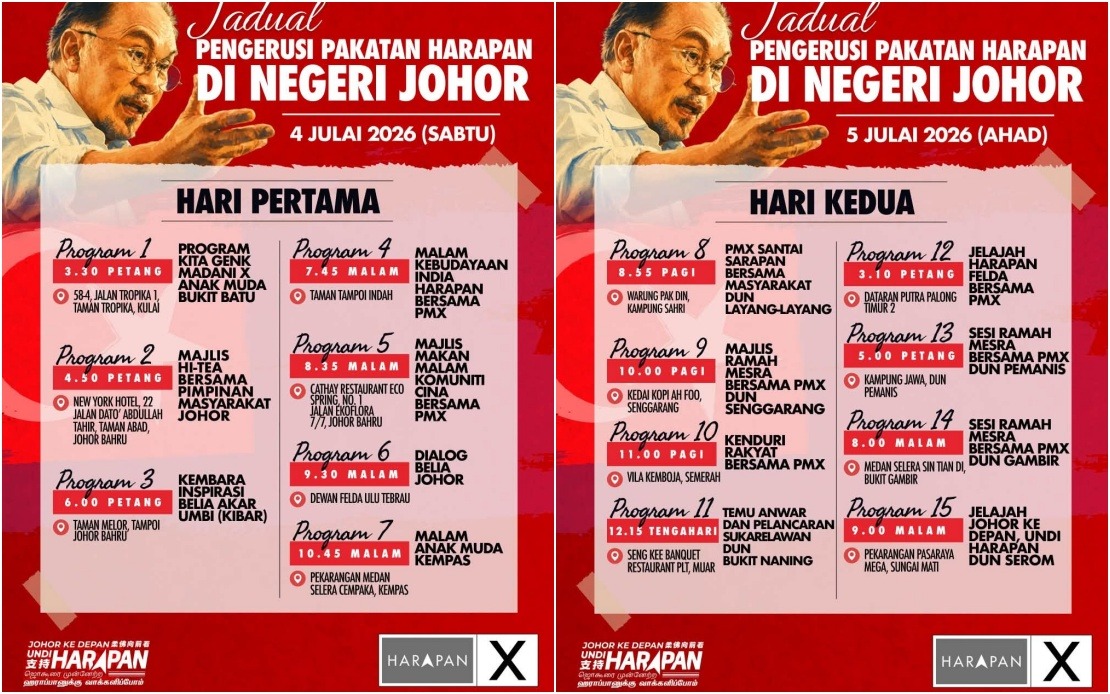
Pakatan Harapan chairman Datuk Seri Anwar Ibrahim is mounting an aggressive ground campaign in Johor, scheduling 15 separate events across Saturday and Sunday to mobilise voter support for 56 coalition candidates ahead of the state election scheduled for July 11. The intensive two-day schedule underscores the strategic importance of Johor to the ruling coalition's political fortunes, particularly given the state's sizeable parliamentary delegations and the competitive nature of the electoral contest shaping up across multiple constituencies.
Anwar's decision to invest such substantial personal effort reflects the high stakes of the Johor contest for Pakatan Harapan. The state has historically served as a bellwether for broader political trends in Malaysia, and maintaining or expanding the coalition's presence in the state assembly carries symbolic and practical consequences for the federal government's stability and legitimacy. Through his Facebook announcement, Anwar extended a public invitation to all Johor voters, framing the campaign events as opportunities for direct engagement between the party machinery and the electorate.
The campaign schedule reveals a sophisticated approach to voter contact, segmented by demographic and geographic considerations. Saturday's itinerary begins with the Kita Genk MADANI programme targeting young voters in Kulai at 3.30 pm, immediately followed by networking with Johor community leaders. This opening sequence sets the tone for an evening focused on ethnic and cultural outreach, with dedicated functions for Indian and Chinese communities scheduled sequentially at Taman Tampoi Indah and a restaurant venue, both featuring Anwar alongside PMX, indicating co-leadership messaging for the campaign.
The evening programme continues with youth-oriented activities that attempt to capture the energy and support of younger voters, crucial for any governing coalition seeking to renew its mandate. The Johor Youth Dialogue scheduled at Dewan Felda Ulu Tebrau at 9.30 pm and the concluding Anak Muda Kempas Night at 10.45 pm demonstrate recognition of youth engagement as central to campaign strategy. Such events typically feature interactive discussion formats, policy explanations, and opportunities for young voters to articulate their concerns directly to senior party figures.
Sunday's programme shifts focus towards grassroots constituent meetings and community engagement in rural and semi-urban areas. Beginning with breakfast sessions in Layang-Layang at Warung Pak Din in Kampung Sahri, the schedule emphasises informal, accessible interactions that humanise political leadership and foster personal connections between party representatives and voters. This approach reflects lessons learned from electoral cycles where community-level engagement and visibility significantly influenced voter decision-making, particularly in constituencies where support margins remain tight.
The mid-morning Meet-and-Greet at Dewan Undangan Negeri Senggarang and the subsequent Kenduri Rakyat gathering in Semerah represent traditional campaign formats that remain effective in Malaysian electoral contexts. These communal eating events facilitate extended conversation and relationship-building, allowing Anwar to address concerns and articulate policy positions in settings where voters feel more relaxed and receptive. The launch of Bukit Naning Volunteers suggests grassroots mobilisation efforts extending beyond the candidate level to organised community activists who will sustain campaign momentum after Anwar's departure.
The afternoon's itinerary encompasses multiple constituency-focused sessions, indicating simultaneous pursuit of several targeted electoral contests. References to Pemanis and Gambir constituencies suggest these represent battleground seats where coalition performance remains uncertain, justifying concentrated leadership attention. The concluding Jelajah Johor Ke Depan programme in Sungai Mati extends the campaign into evening hours, reflecting the gruelling physical and logistical demands of modern intensive electioneering at senior leadership levels.
For Malaysian observers and regional political analysts, Anwar's personal investment in the Johor campaign carries broader implications. His presence validates the Pakatan coalition's commitment to the state despite numerous competing demands on his time as prime minister. The visible mobilisation of resources demonstrates confidence in the party's electoral prospects while simultaneously acknowledging that victory requires sustained grassroots engagement rather than reliance on institutional advantages. The 16 July 11 voting date means the campaign window remains compressed, making efficient voter contact through such concentrated events strategically essential.
The schedule's scope reveals demographic diversity as a central campaign theme. Rather than segregating voters by background, Anwar's programme interspersed ethnic-specific functions with inter-community youth dialogues and general population kenduri events, signalling a coalition narrative that transcends narrow communal boundaries. This approach aligns with Pakatan Harapan's broader positioning and may resonate particularly in mixed constituencies where cross-community coalition-building determines electoral outcomes.
Logistically, such intensive scheduling demands substantial organisational capacity, reflecting the size and resources of the governing coalition's campaign infrastructure. Coordinating 15 venues across Johor within a 30-hour period requires professional scheduling, advance promotion, venue confirmation, and coordination with local party structures. The apparent seamlessness of the itinerary suggests months of preparation, even as specific campaign messaging and responses to opponent attacks evolve during the campaign period itself.
As Johor voters prepare for July 11, Anwar's presence during this critical campaign phase reinforces the state's political salience for the federal coalition. The early voting date of July 7 means that much persuasion must occur before that date, concentrating the campaign period further and elevating the importance of final days mobilisation. Whether this intensive ground campaign translates into electoral gains for the 56 Pakatan candidates will become apparent after voting concludes, but the leadership investment itself signals high-stakes stakes and genuine competitive uncertainty in what remains one of Malaysia's most politically significant states.

