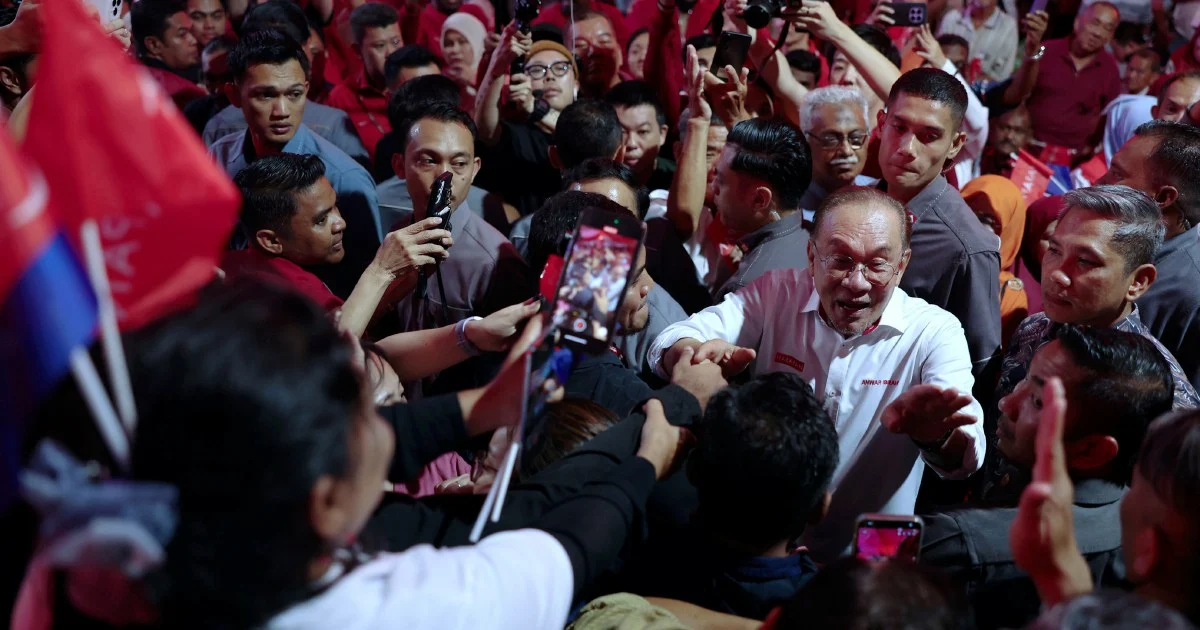
Pakatan Harapan mounted a formal campaign apparatus this week when coalition chairman Datuk Seri Anwar Ibrahim made public the complete roster of 56 candidates contesting the forthcoming Johor state election on July 11. The unveiling ceremony, held in Tangkak, represented a critical organisational milestone as the coalition prepared for one of the peninsula's most economically significant state-level contests.
The announcement underscored the coalition's strategic determination to contest comprehensively across all available state seats in Johor, a state that has historically alternated between ruling coalitions and remains a bellwether for broader peninsular political trends. By fielding a full slate rather than adopting a selective approach, Pakatan Harapan signalled its confidence in mobilising grassroots support across both urban and rural constituencies. The decision to proceed with maximum saturation also reflected the coalition's assessment that the political landscape had shifted sufficiently since previous electoral cycles to warrant aggressive competition across the entire state.
For Malaysian observers, the Johor contest carries weight beyond state politics. The state accounts for a substantial portion of the peninsula's manufacturing base and commercial activity, and its electoral outcome inevitably influences federal coalition dynamics. Johor has traditionally served as either a stronghold or vulnerable flank for whichever federal coalition holds Putrajaya, making its electoral health a barometer of government popularity and organisational effectiveness at the constituency level.
Anwar Ibrahim's personal leadership of the candidate announcement ceremony reflected the coalition's assessment of the election's importance. As both Premier and Pakatan Harapan chairman, his involvement transmitted a message that the coalition regarded the contest as a priority meriting top-tier attention rather than delegating the task to state-level machinery alone. This level of central engagement typically signals that the coalition anticipated a competitive fight and sought to rally supporters through visible demonstration of unified leadership.
The logistics of fielding 56 candidates required months of internal coordination among the coalition's component parties—predominantly the Democratic Action Party, the People's Justice Party, Amanah, and their state allies. Each party negotiated seat allocations, evaluated incumbent performance, and assessed candidate viability in target constituencies. Such negotiations inherently produce tensions as ambitious politicians compete for winnable seats, yet the successful production of a full slate suggested the coalition's internal mechanisms functioned adequately despite inevitable disagreements.
Johor's electoral geography presents distinct challenges. The state encompasses urban centres like Johor Bahru and Iskandar Puteri alongside more rural constituencies in the interior and along the Muar and Batu Pahat regions. Pakatan Harapan's candidate selection therefore required balancing urban professionals with candidates possessing stronger grassroots connections in less developed areas. The coalition's ability to field competitive candidates across this spectrum would substantially determine its overall performance.
The timing of the announcement, preceding the election date by several weeks, allowed the coalition to commence intensive campaigning immediately. Early candidate declaration also permitted supporters to organise ground operations, distribute campaign materials, and schedule candidate-meet-voter events. In Malaysia's information environment, where social media amplifies campaign messaging and voter sentiment crystallises relatively quickly in pre-election phases, early mobilisation carries strategic weight.
For Southeast Asian context, the Johor election reflects broader regional patterns where incumbent federal coalitions face electoral headwinds across state contests. From Thailand's local elections to Indonesia's provincial races, sitting governments frequently experience diminished support at sub-national levels, with voters using state elections to register discontent over national performance. Johor's July 11 contest would test whether Pakatan Harapan had successfully insulated state politics from federal dissatisfaction or whether national grievances would translate into state-level seat losses.
The candidate slate's composition—encompassing incumbent assemblymen seeking re-election, fresh faces parachuted into competitive seats, and established party figures contesting for the first time—reflected typical coalition strategy of blending experience with renewal. Careful distribution of these candidate types across constituencies indicated that Pakatan Harapan's strategists had mapped vote patterns, assessed sitting legislators' popularity, and calculated district-level dynamics with considerable precision.
Beyond Johor's immediate political contest, the election served as a dry run for both ruling and opposition coalitions ahead of a federal election that constitutionally must occur by 2025. Johor would provide genuine data on voter sentiment, campaign methodology effectiveness, digital mobilisation capacity, and whether demographic shifts had altered traditional voting patterns. Both coalitions would scrutinise results carefully for lessons applicable to higher-stakes federal competition.
The unveiling also addressed internal coalition morale. Component parties sought confirmation that seat allocations fairly reflected their contributions and electoral viability. Supporters needed visible evidence that candidates possessed legitimacy and adequate resources. By presenting the complete roster publicly, Pakatan Harapan attempted to generate momentum while satisfying internal stakeholders that the coalition approached the contest with seriousness and strategic preparation.
As Johor moved toward July 11, the presence of this full candidate slate transformed the state from potential battleground into actual contest. The coalition's willingness to compete everywhere rather than conceding constituencies signalled that internal assessments suggested competitive viability across much of the state. Whether that confidence proved justified would become apparent once voting commenced.