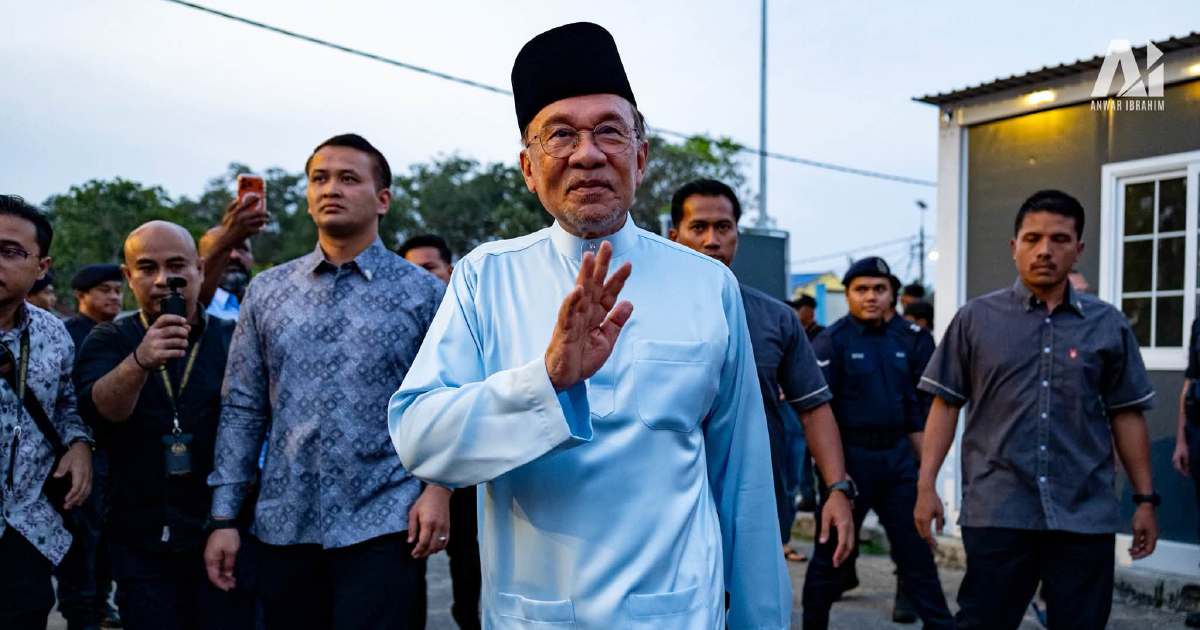
Pakatan Harapan chairman Datuk Seri Anwar Ibrahim made a final push for voter support in Negri Sembilan as the state election campaign entered its closing phase, framing the contest as a choice between continued stability under the unity government or a return to political uncertainty. Speaking in the lead-up to the poll scheduled for the following day, Anwar sought to transcend partisan lines by appealing directly to the electorate's desire for predictable governance and economic progress, positioning the ruling coalition as the safer option.
The timing of Anwar's intervention underscored the national significance of the Negri Sembilan election beyond state boundaries. As Prime Minister and Pakatan Harapan chairman, his personal involvement signalled that federal leadership viewed the outcome as a referendum on the unity government's overall performance since its formation. The framing of the campaign reflected a strategic calculation that voters might be persuaded to prioritize coherence and institutional continuity over the pull of alternative political visions, particularly given the economic headwinds facing Malaysia and the region.
Anwar's appeal for voters to set aside their political differences represented a calculated effort to broaden the coalition's appeal beyond its traditional base. Rather than emphasizing partisan victories or ideological distinctions, the messaging focused on what might be termed "coalition governance"—the idea that a fragmented parliament hampers effective policymaking. This rhetorical approach acknowledged that some Negri Sembilan voters may harbour reservations about Pakatan Harapan, yet sought to make the case that political division carries material costs.
The unity government framework itself has been a defining feature of Malaysian politics since 2020, when the collapse of the Sheraton Move prompted the formation of a broad coalition spanning Pakatan Harapan, Barisan Nasional, and other parties. In Negri Sembilan specifically, the local political dynamics would determine whether this federal model could secure electoral validation. The state has historically shown its own political rhythms, and a strong result would reinforce Anwar's narrative that voters across diverse constituencies recognise the value of coalition governance.
For ordinary Malaysians observing state elections, the implications extend to federal stability and budget allocation. A commanding mandate in Negri Sembilan would provide the federal government with stronger political capital to pursue its policy agenda, potentially affecting infrastructure spending, civil service morale, and the government's ability to pass legislation without constant bargaining with reluctant partners. Conversely, a disappointing showing might embolden opposition factions or internal coalition critics to recalibrate their support arrangements.
The election campaign itself reflected broader tensions in Malaysian politics between calls for pragmatism and demands for principled political competition. Anwar's stability-focused messaging competed against opposition narratives that emphasised change, accountability, or alternative governance visions. Negri Sembilan voters would ultimately decide whether they preferred continuity or disruption, though the framing of this choice as merely a matter of "setting aside differences" glossed over substantive policy disagreements that nonetheless divided the political landscape.
Economically, the timing mattered. Malaysia's growth trajectory, inflation management, and employment figures heading into the election season all influenced voter sentiment. A government that could claim credit for economic stewardship had inherent advantages, though responsibility for unemployment or rising costs could also weigh against incumbents. Anwar's emphasis on stability implicitly promised that the unity government's continued tenure would deliver the institutional consistency needed for sustained economic performance.
Regional considerations also coloured the election narrative. Southeast Asia's evolving geopolitical environment—involving great power competition, supply chain reconfiguration, and shifting security alignments—placed a premium on governments perceived as stable and capable of executing long-term strategies. A fractured or weakened Malaysian government might struggle to navigate these complexities, a point Anwar could reasonably invoke without explicitly mentioning specific threats.
The closing phase of campaigning saw intensified messaging from all contenders. Pakatan Harapan marshalled its grassroots machinery and media resources to reinforce Anwar's appeal for continuity, while opposition parties mounted their own campaigns to challenge the government's record and offer alternative visions. The volume and tone of competing messages would shape final voter impressions heading into polling day.
For Southeast Asian observers, the Negri Sembilan election offered a window into Malaysian electoral behaviour and the viability of coalition governance models in the region. If such broad-based coalitions could sustain themselves and win voter endorsement, it might influence how other democracies in Southeast Asia considered their own governance arrangements. Conversely, if cracks emerged or voters rejected continuity, it would signal that voters ultimately prefer clearer ideological choices even if they introduce political uncertainty.
Anwar's final campaign message ultimately crystallised into a simple proposition: that the unity government deserved another term to complete its work and that political coherence served voter interests better than partisan conflict. Whether Negri Sembilan voters accepted this framing would become clear once ballots were counted, with implications reverberating through federal politics and shaping the government's trajectory in the months ahead.

