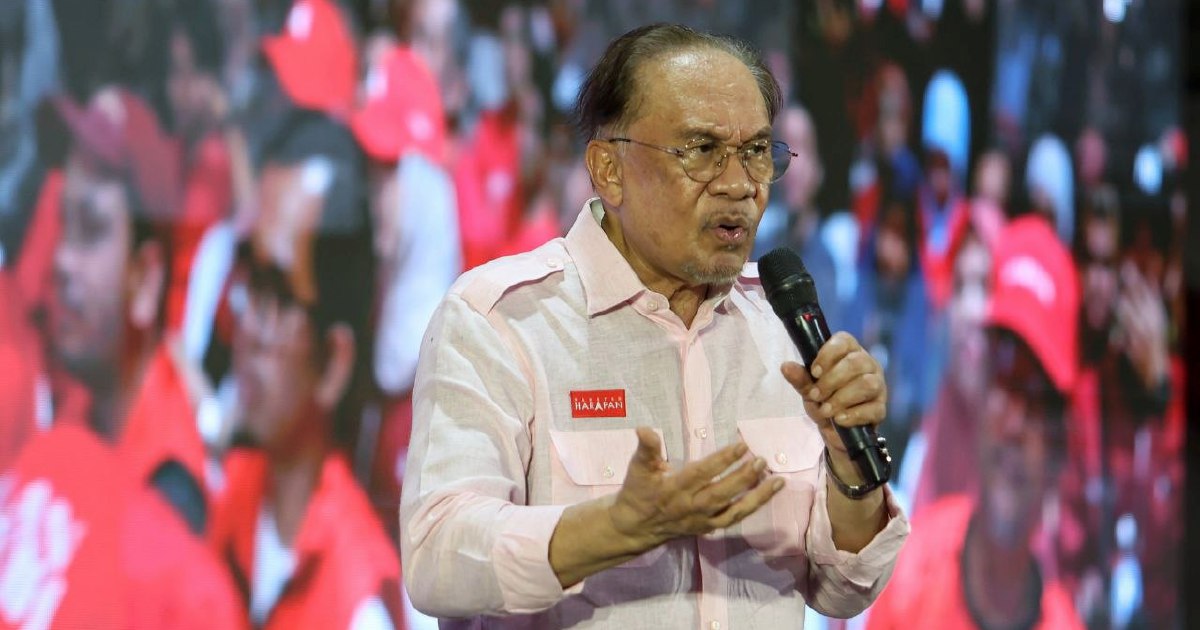
Prime Minister Datuk Seri Anwar Ibrahim has reiterated his determination to uphold the structural integrity of Malaysia's unity government at the federal level, a reassurance that carries particular weight given the imminent electoral competition between his coalition and Barisan Nasional in the Negri Sembilan state poll.
The prime minister's statement, delivered in Seremban, signals a deliberate separation between national governance frameworks and state-level political contests. This distinction underscores a pragmatic approach to managing Malaysia's complex political architecture, where competing coalitions may contest elections at the state level whilst maintaining collaborative federal arrangements. Such compartmentalisation has become essential to how Malaysia's coalition politics functions, particularly following the 2022 general election, which produced no clear majority and necessitated cross-coalition cooperation at the centre.
The assertion comes at a sensitive juncture for Malaysian politics. The unity government—formed between Pakatan Harapan, Barisan Nasional, and other supporting parties—represents an unprecedented arrangement in modern Malaysian history. Its survival has depended substantially on the restraint and political maturity of participating factions, who have agreed to contest elections separately whilst maintaining consensus on critical governance matters. Anwar's reiteration of this commitment addresses potential anxieties about whether state-level electoral rivalry might fracture federal arrangements.
Negri Sembilan holds strategic significance within this equation. The state represents terrain where multiple political coalitions possess realistic prospects of victory, making it a genuine contest rather than a foregone conclusion. Barisan Nasional's historical dominance in the state creates a natural focal point for competition, and both sides will deploy substantial resources to emerge victorious. For Anwar's government, the stakes extend beyond state seats; electoral performance influences narratives about national momentum and coalition viability.
The prime minister's positioning reflects lessons learned from previous episodes of Malaysian political turbulence. Historical tensions between federal and state administrations have occasionally destabilised governments, and Anwar appears intent on preventing such dynamics from undermining the delicate equilibrium at Putrajaya. By explicitly separating electoral competition from governmental cooperation, he seeks to establish ground rules that prevent state campaigns from becoming existential threats to federal stability.
For Malaysian voters and observers, this approach presents both opportunities and uncertainties. The unity government has enabled some policy continuity and reduced the legislative paralysis that might otherwise have accompanied the absence of a clear parliamentary majority. Simultaneously, the arrangement has constrained the government's ideological coherence and sometimes resulted in compromises that satisfy neither coalition partner entirely. Voters in Negri Sembilan will make their own calculations about whether state-level voting patterns should reward or punish federal coalition partners.
The timing of Anwar's statement also merits attention. Coming from the prime minister personally, rather than through party machinery, it elevates the message and suggests that preserving federal unity ranks among his highest priorities. This reflects an understanding that Malaysia's governance system depends fundamentally on the goodwill and political maturity of coalition leaders. Should such commitment dissipate, the cascading consequences could unravel not merely the unity government but potentially undermine institutional stability across multiple spheres.
Regionally, Malaysia's experiment with unity government attracts scrutiny from neighbouring countries grappling with their own coalition politics. Thailand, Indonesia, and the Philippines all maintain close interest in how Malaysian political actors manage the tension between electoral competition and institutional cooperation. Success in this endeavour could provide valuable lessons for other democracies navigating complex multi-party environments; failure conversely might demonstrate the inherent fragility of such arrangements.
Barisan Nasional's position adds another layer of complexity. The coalition, which dominated Malaysian politics for decades before electoral setbacks beginning in 2018, has found a seat at the federal table within the unity government structure. For BN, maintaining the unity arrangement whilst competing aggressively in Negri Sembilan allows it to rehabilitate its electoral viability whilst exercising federal influence. Anwar's statement indirectly acknowledges this balancing act, signalling that federal doors remain open to BN regardless of state election outcomes.
Looking forward, the success or failure of this governance model will likely influence Malaysian politics for years. Should the unity government weather electoral cycles without fracturing, it may establish a template for future Malaysian governments to follow when faced with fragmented parliamentary landscapes. Conversely, should state elections trigger federal instability, future coalition builders may prove more cautious about embracing such architecturally complex arrangements.
The Negri Sembilan state election therefore transcends merely determining who governs the state. It represents a practical test of whether Malaysia's political actors can maintain institutional commitments even whilst engaging in robust electoral competition. Anwar's pledge reflects confidence that they can. Whether subsequent events validate this confidence remains an open question that will occupy Malaysian political observers closely.

