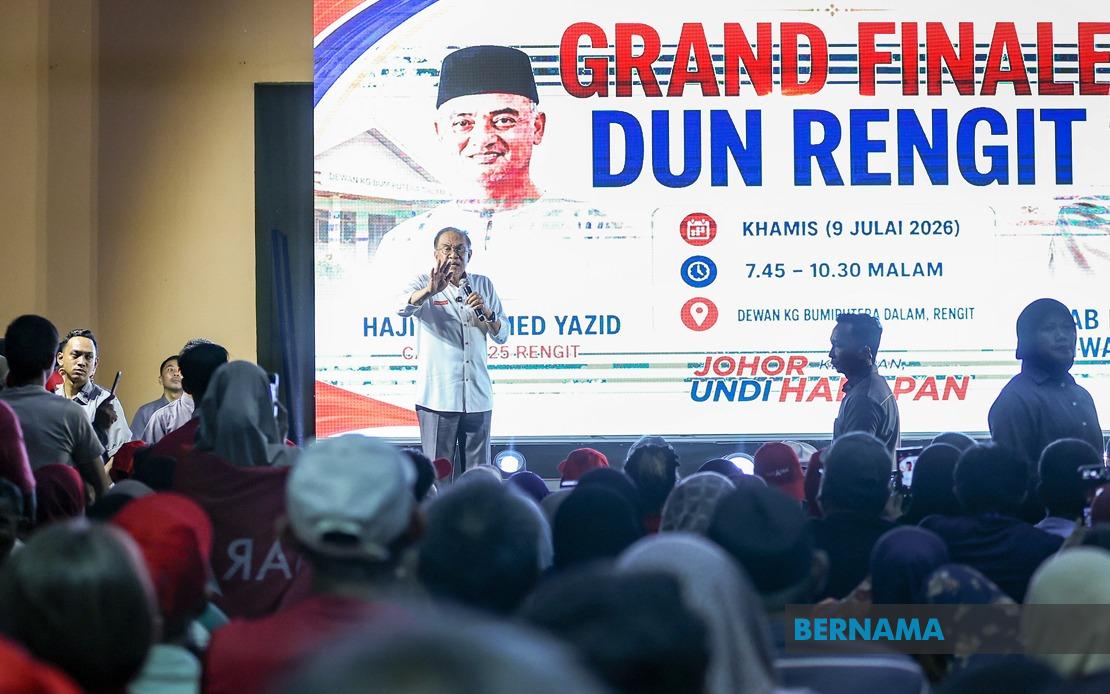
Prime Minister Datuk Seri Anwar Ibrahim has committed to tackling the infrastructure crisis plaguing Rengit, where residents have endured years of inadequate healthcare facilities and water supply disruptions. Speaking at a Pakatan Harapan campaign rally in Batu Pahat on Thursday evening, Anwar framed the resolution of these basic service failures as essential to maintaining Johor's standing as a developed state, signalling that infrastructure deficiencies cannot be tolerated in a region with such economic ambitions.
The prime minister's remarks underscored a broader assertion that access to clean water and functional healthcare represents a fundamental entitlement rather than a luxury, and that any government neglecting these essentials falls short of its primary obligation to citizens. His pointed observation that clinics should heal patients rather than exemplify decay served as both a critique of the current state of facilities in the constituency and a reminder of the gravity of deferred maintenance across public health infrastructure.
Anwar's pledge comes as Pakatan Harapan mounts an aggressive campaign across Johor ahead of Saturday's 16th state election. The visit to Rengit was the second of three campaign stops the prime minister made throughout the state that evening, each designed to mobilise support among party machinery and reinforce the coalition's electoral message across multiple constituencies. This intensive schedule reflects the high stakes involved for the ruling federal coalition, which seeks to consolidate its influence at the state level.
Among those alongside Anwar at the 'Serumpun Kasih Sejiwa Harmoni Grand Finale' event were Sri Gading MP Aminolhuda Hassan, who chairs the Johor chapter of Parti Amanah Negara, and Yazid Abu Bakar, the PH candidate contesting the Rengit seat. The presence of established party figures and local candidates underscored the coordinated nature of the campaign, linking federal leadership with grassroots electoral efforts.
Beyond infrastructure concerns, Anwar stressed that water provision, housing, education, and healthcare must collectively anchor the government's priority framework. This enumeration of interconnected services reflects recognition that public satisfaction depends not on isolated improvements but on a comprehensive approach to living standards. The breadth of issues invoked suggests that PH's campaign strategy embraces systemic concerns rather than concentrating narrowly on a single policy domain.
Anwar also addressed the conduct of public officials and community leaders, instructing them to perform their duties with integrity and explicitly warning against the misuse of positions for personal enrichment. This emphasis on ethical governance carries particular weight in Malaysian electoral politics, where perception of corruption and patronage has historically influenced voter behaviour. By foregrounding integrity alongside service delivery, the prime minister attempted to position PH as the party of both competence and honourable stewardship.
The campaign message explicitly encouraged voters to select representatives who would align with the Federal Government, framing this alignment as instrumental to efficient implementation of development programmes. This argument presupposes that coordination between state and federal authorities accelerates project execution—a claim that resonates with practical concerns about bureaucratic gridlock when opposing parties control different governmental tiers, yet one that may carry less weight among voters sceptical of centralised authority.
Pakatan Harapan is fielding candidates across all 56 state seats, with the 20 PKR representatives, 19 from Amanah, and 17 from DAP distributed to reflect each party's negotiated position within the coalition. This tripartite division highlights both the coalition's breadth and the delicate balance required to maintain unity among ideologically distinct partners. The distribution also suggests that PKR, the prime minister's own party, holds a marginal advantage in seat allocation—a positioning that may reflect both its size and Anwar's factional strength within PH.
With 172 candidates competing across the 56 constituencies, the election presents a densely contested field. The candidate density indicates competitive races in numerous seats, potentially narrowing margins and elevating the significance of localised campaign efforts. For constituencies like Rengit, where the prime minister himself appeared, the direct engagement signifies particular importance to PH's overall strategy, whether due to competitive vulnerability or strategic opportunity.
The attention devoted to Rengit's water and healthcare deficiencies also reflects broader regional patterns across Johor, where infrastructure maintenance has lagged behind economic development in certain areas. These challenges extend beyond single constituencies, suggesting that PH perceives significant electoral potential in promising systematic remediation of such visible public service failures. The prominence of such pledges in campaign messaging indicates that voters in towns like Rengit remain receptive to concrete commitments addressing daily hardships.

