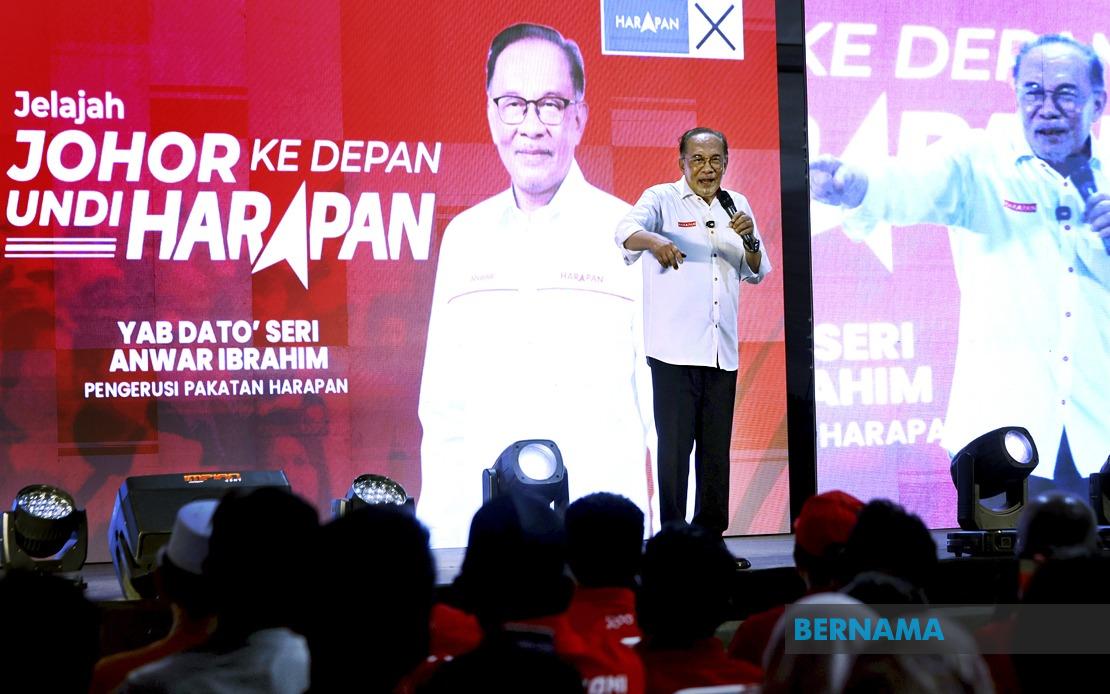
Prime Minister Datuk Seri Anwar Ibrahim has declared an unequivocal end to what he terms the "culture of plunder" that characterised previous administrations, announcing that his MADANI Government will tolerate neither systemic corruption nor the practice of using state power to enrich personal networks. Speaking at a campaign event in Sungai Mati during Johor's ongoing state election campaign, Anwar positioned clean governance as both a moral imperative and a prerequisite for Malaysia's continued economic development and international standing.
The Prime Minister's remarks represent a direct assault on entrenched patronage networks that have long characterised Malaysian politics. He explicitly rejected the normalisation of power as a vehicle for personal enrichment, framing the historical pattern of awarding lucrative government contracts to family members and cronies as incompatible with a functioning state apparatus. By naming these practices directly, Anwar has attempted to shift the terms of political discourse from abstract appeals to stability toward concrete accusations about how previous administrations deployed public resources.
Anwar's insistence on merit-based leadership transcending racial categories offers a counternarrative to opposition rhetoric that he argues exploits communal anxieties to obscure histories of individual corruption. His statement that he welcomes "Malays who are good, honest and not corrupt" as leaders alongside equally principled Chinese leaders deliberately dismantles the false dichotomy between integrity on one hand and ethnic representation on the other. This rhetorical move attempts to reframe debates about governance away from identity politics toward questions of personal character and financial accountability.
The Prime Minister's pledge that no individual will receive government protection from corruption charges during his tenure carries particular weight given Malaysia's documented history of selective prosecution and political immunity. Such assurances are meaningful primarily to the extent that they are enforced through independent institutions, yet Anwar's explicit articulation of this principle signals an attempt to establish clear boundaries for executive power. For Malaysian voters accustomed to seeing high-ranking officials escape accountability through political patronage, such declarations address a fundamental grievance about inequitable justice.
Anwar's comments arrive amid a broader MADANI Government effort to position itself as a departure from what he characterises as corrupt administrative practice. By repeatedly invoking the need to "clean up" Malaysia's governmental systems of embedded corrupt practices, he frames the current administration not merely as a different political coalition but as a fundamentally distinct approach to state management. This framing proves essential for coalition cohesion, as the pakatan encompasses parties with divergent interests that require unification around shared anti-corruption messaging.
The timing of these remarks within the Johor State Election campaign carries strategic significance for the coalition's electoral prospects in a state that has historically tilted toward opposition-aligned parties. Johor voters are being asked to validate Anwar's governance philosophy through their selection of state representatives, effectively serving as a referendum on whether the public accepts the MADANI Government's anti-corruption narrative. The campaign's intensity—with Anwar completing fifteen engagements across two days—underscores the political stakes involved in retaining Johor as a coalition stronghold.
Anwar's assertion that opposition attempts to create political pressure stem from personal agendas to regain federal control introduces a counter-accusation of self-serving politics. Rather than engaging substantive critiques on governance grounds, the Prime Minister redirects attention toward opposition motivations, suggesting that their criticism lacks principled foundation. This rhetorical strategy attempts to delegitimise opposition voices by positioning them as driven by power-seeking rather than genuine governance concerns, though such claims remain contested among political analysts and civil society observers.
The broader context of these statements involves Malaysia's complex relationship with political reform and institutional accountability. Despite numerous commitments to anti-corruption measures across multiple administrations, systemic change has proven elusive, with independent institutions often constrained by political pressure and institutional dependencies. Anwar's rhetorical commitment to zero tolerance for corruption will ultimately be measured against concrete outcomes in prosecutions, institutional independence, and measurable reductions in rent-seeking behaviour across government.
For Southeast Asian observers, Anwar's anti-corruption messaging reflects broader regional conversations about governance legitimacy and state capacity. Malaysia's experiences navigating high-profile corruption scandals and attempting institutional reform parallel challenges across the region, where citizens increasingly demand accountability from political leadership. The success or failure of the MADANI Government's anti-corruption agenda will carry implications not only for Malaysia's domestic political trajectory but also for regional perceptions regarding whether democratic systems can effectively constrain executive power and protect public resources.
The 56-seat Johor State Election, scheduled for July 11 with early voting on July 7, will feature 172 candidates competing across constituencies. This electoral contest serves as an important barometer for assessing public receptivity to the MADANI Government's governance philosophy and anti-corruption commitments. Results in Johor will provide early indication of whether voters credit the current administration with substantive departures from past practice or remain sceptical of claims regarding governmental transformation, offering valuable data for understanding Malaysian political trajectories heading into subsequent electoral contests.

