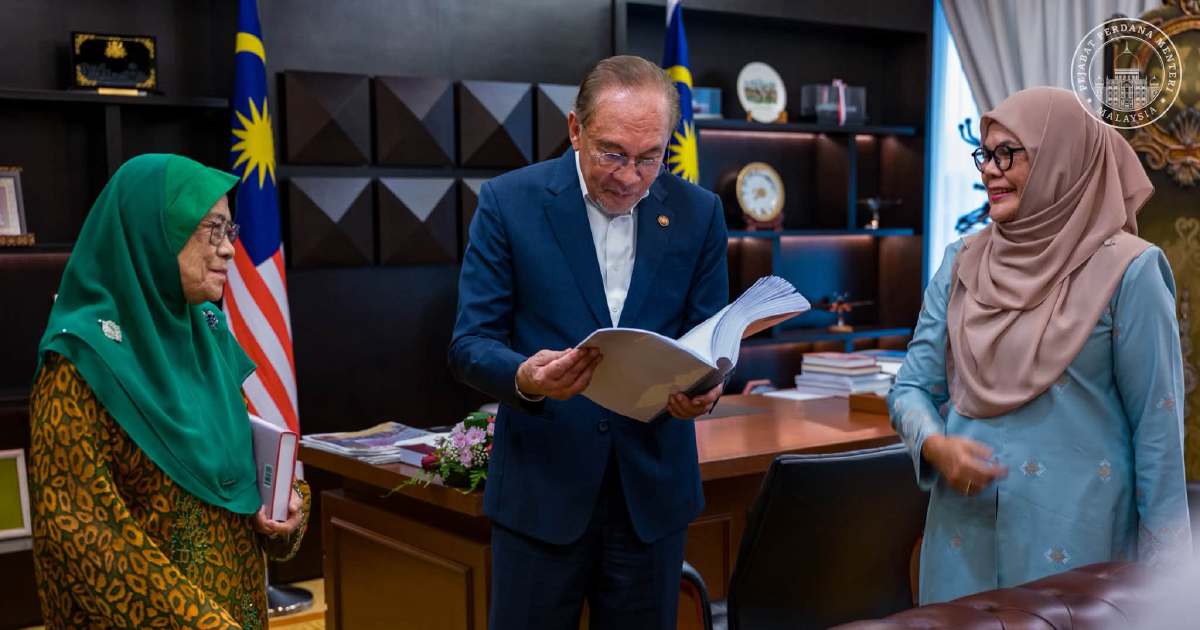
Prime Minister Datuk Seri Anwar Ibrahim has unveiled a comprehensive book drawing together his accumulated wisdom on governance, culture, and national development, envisioning it as a lasting intellectual foundation for generations to come. Titled Gagasan Anwar Ibrahim Dalam Peradaban Budaya Bangsa—translating roughly to "Anwar Ibrahim's Vision in National Cultural Civilisation"—the publication consolidates decades of the premier's political thought, personal reflections, and conceptual frameworks that have shaped his approach to leading Malaysia.
The release of this work represents a significant moment in Anwar's long political trajectory. Throughout a career spanning multiple decades, marked by periods of high office, imprisonment, and return to power, the Prime Minister has developed an expansive body of ideas touching on everything from Islamic economics to democratic governance. By formalising these concepts within a single comprehensive volume, Anwar is effectively creating an institutional record of his thinking that transcends the temporal constraints of his current tenure.
The emphasis on future generations reflects a deliberate strategy to embed his philosophical approach into Malaysia's intellectual and political culture. Rather than allowing his ideas to dissipate after his eventual departure from office, the book seeks to establish a permanent reference point for policymakers, scholars, and national leaders who will shape Malaysia's trajectory long after his retirement. This approach acknowledges a fundamental truth about Malaysian politics: the personal philosophies of dominant leaders often profoundly influence national direction, and documenting these explicitly creates continuity across administrations.
The focus on nation-building resonates particularly with Malaysia's ongoing challenges around social cohesion and institutional reform. Since assuming office, Anwar has positioned himself as an agent of democratic renewal and inclusive governance. The book appears designed to articulate the intellectual underpinnings of these efforts, offering prospective leaders a roadmap for balancing competing interests while maintaining Malaysia's constitutional framework and multicultural character. This matters significantly in a nation where questions about collective identity, economic justice, and the relationship between government and citizens remain contested.
Character development—the second pillar Anwar emphasises—signals an intention to move beyond technical policy discussion toward moral leadership. In Malaysian context, this takes on added weight given ongoing debates about institutional integrity, corruption, and whether leaders should model specific ethical standards. By framing character development as central to his compiled wisdom, Anwar positions moral leadership as foundational rather than supplementary to effective governance. This distinction carries implications for how future politicians and bureaucrats conceive their roles and responsibilities.
The timing of the publication warrants consideration. Anwar assumed office in late 2022 following the contentious 2022 general election and subsequent coalition negotiations. That his book emerges during this relatively early phase of his premiership suggests confidence that his intellectual framework deserves documentation before the inevitable political evolution that occurs during any government's tenure. It also allows him to shape the historical narrative around his leadership while still actively governing.
For Malaysian readers interested in political philosophy and governance, the book offers direct access to ideas that have otherwise been scattered across speeches, essays, and policy documents. Rather than reconstructing Anwar's thinking from disparate sources, this consolidated volume presents his vision systematically. This accessibility could broaden his intellectual influence beyond political insiders to students, academics, and citizens interested in understanding the conceptual foundations of contemporary Malaysian governance.
The compilation also serves a practical function within Malaysia's political ecosystem. As opposition parties develop alternative policy platforms and competing political figures articulate their own visions for the nation's future, having a definitive articulation of the incumbent Prime Minister's thinking provides a clear benchmark. Supporters can reference it when defending government positions; critics can analyse its consistency against actual implementation; scholars can measure the gap between philosophical intention and political reality.
From a Southeast Asian perspective, Anwar's thought has always possessed regional significance. His background in Islamic economics, his intellectual engagement with democracy and development, and his evolution as a political figure spanning different eras have made him influential beyond Malaysia's borders. A published compilation of his ideas becomes a resource not just for Malaysian leadership succession, but for policymakers and thinkers across the region grappling with similar questions about democratic governance in multi-religious societies, inclusive economic development, and cultural preservation amid globalisation.
The book's emphasis on cultural civilisation reflects Anwar's long-standing interest in the relationship between material development and spiritual or moral progress. This mirrors intellectual currents in Islamic thought that he has engaged with throughout his career, suggesting the volume likely explores how Malaysia can achieve economic advancement while maintaining distinctive cultural and moral anchors. Such questions resonate throughout Southeast Asia as nations balance modernisation with cultural continuity.
By positioning this work as a reference for future generations, Anwar implicitly acknowledges that his ideas should transcend personal political fortune. Whether readers ultimately agree with his vision or not, the act of systematising and publishing his thinking demonstrates commitment to enriching Malaysia's public intellectual tradition. The volume thus becomes part of the permanent record through which Malaysians can understand how their nation was governed during this era, what values animated decision-making, and what frameworks guided attempts to address the country's complex challenges.
The success of this initiative will depend substantially on the book's reception among scholars, students, and opinion-leaders. If it gains currency as a serious reference work, it could establish Anwar's ideas as foundational texts within Malaysian governance discourse. If it remains confined to political circles or sympathetic audiences, its impact will be narrower. Either way, the publication signals Anwar's confidence that his accumulated experience and reflection merit preservation and careful study by those who will guide Malaysia's future.

