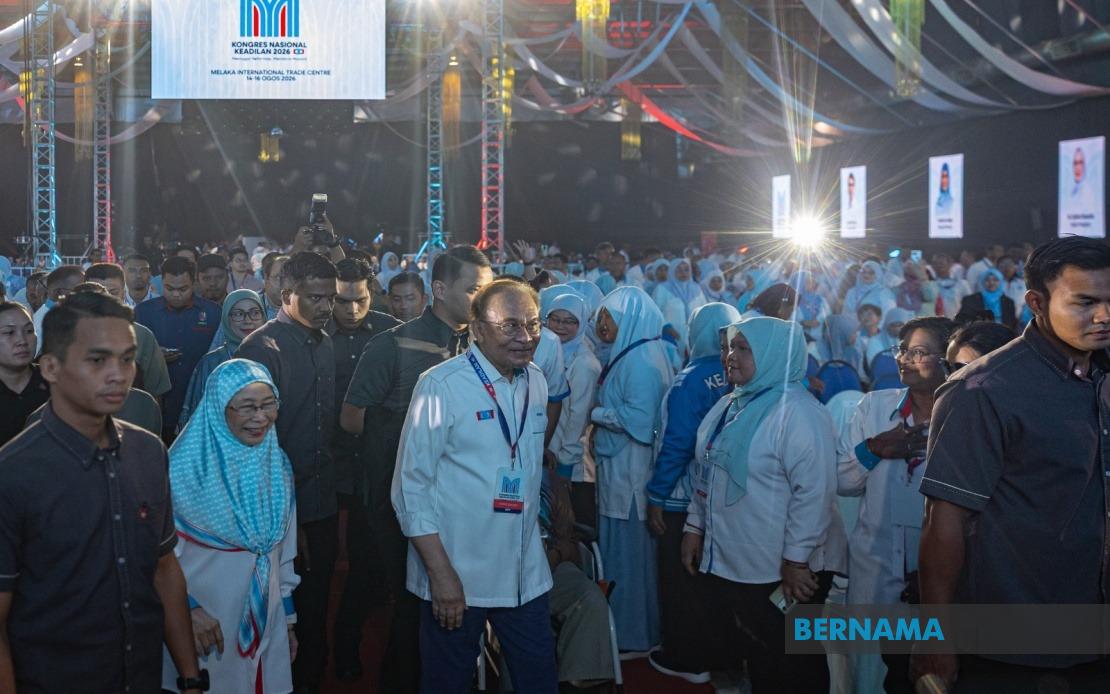
Prime Minister Datuk Seri Anwar Ibrahim has moved to quell speculation about the Unity Government's sustainability by explicitly reaffirming his administration's intention to maintain working relations with UMNO and Barisan Nasional at the federal level. Speaking during the closing address at the Parti Keadilan Rakyat National Congress 2026 in Melaka, Anwar struck a notably conciliatory tone, suggesting that recent events had prompted questions about the coalition's durability but that his government would not allow such pressures to derail collaborative efforts.
The prime minister's emphasis on rational decision-making signals an attempt to steer Malaysian politics away from what he characterises as emotion-driven governance. By framing the choice to continue UMNO-BN cooperation as a deliberate prioritisation of national welfare, Anwar positioned his government as guided by pragmatism rather than partisan advantage or personal grievance. This rhetorical shift carries weight in a political environment where coalition instability has periodically threatened legislative agendas and investor confidence.
Anwar's insistence that political decisions should eschew personal interests and anger speaks to ongoing internal tensions within the ruling bloc. The Unity Government comprises ideologically diverse parties—from PKR's social-democratic orientation to UMNO's traditional conservatism—whose cooperation has required repeated calibration and compromise. By publicly elevating principle above personality, Anwar attempted to model the restraint he expects from coalition partners and party members.
The timing of these remarks, delivered at a major party congress, underscores their significance as a formal policy position rather than casual commentary. The PKR National Congress serves as the party's principal gathering, allowing Anwar to communicate directly with grassroots activists who may harbour reservations about collaboration with UMNO, historically the opposition in Malaysian politics before the 2020 restructuring. Such audiences often push for stronger partisan positioning, making his emphasis on stability a subtle but firm assertion of executive prerogative.
For Malaysian investors and regional observers, Anwar's commitment to federal-level cooperation with UMNO-BN provides reassurance about governance continuity. Political coalitions in Malaysia have historically fragmented with little warning, disrupting legislative schedules and policy implementation. A clear statement favouring stability helps insulate against sudden parliamentary arithmetic changes that could paralyse government functions or reverse previous commitments.
The linkage Anwar drew between political stability and economic growth reflects orthodox development economics but gains particular urgency in Malaysia's current context. The nation faces inflationary pressures, competitive regional dynamics, and demands for infrastructure investment that require sustained policy execution. Coalition dysfunction would impede progress on these fronts, potentially widening Malaysia's competitiveness gap relative to regional peers like Vietnam and Thailand.
The prime minister's rhetorical framing of cooperation as a choice—not an inevitability—carries subtle implications. By presenting continued partnership as a deliberate decision grounded in national interest rather than electoral necessity or structural constraint, Anwar asserted agency and moral authority. This positioning becomes significant should the coalition face future stress; it establishes that any dissolution would represent a departure from a consciously held principle.
UMNO's positioning within federal governance has itself been contentious, with the party oscillating between government and opposition roles across recent electoral cycles. Anwar's public endorsement of ongoing cooperation signals confidence in managing potential intra-coalition friction and may be intended to reassure UMNO that it remains valued within the federal arrangement despite periodic tensions between the parties on policy matters.
Such statements also function as boundary-setting for backbenchers and party operatives who might otherwise test coalition limits through parliamentary manoeuvres or public statements. When a prime minister clearly articulates the coalition framework as non-negotiable, it reduces the scope for ambitious individuals to gain attention by challenging it. This disciplinary function helps maintain coalition discipline without resort to formal sanctions.
The broader context of Anwar's remarks involves questions about Malaysia's medium-term governance model. The Unity Government emerged from specific electoral and political circumstances following the 2020 general election, and commentators periodically speculate about its durability. Anwar's reaffirmation that cooperation remains both preferable and intentional counters narratives suggesting the arrangement is merely temporary or fragile.
Regionally, Malaysia's political stability carries implications beyond its borders. A government perceived as coherent and durable attracts foreign investment, facilitates trade relationships, and enables participation in multilateral initiatives. Conversely, periods of political uncertainty typically correlate with capital flight and reduced regional influence. Anwar's public commitment to coalition stability thus addresses audiences well beyond Malaysian parliamentary politics.
Looking forward, Anwar faces the ongoing challenge of maintaining coalition cohesion while delivering on governance promises that satisfy diverse constituencies. His emphasis on people's prosperity and economic growth as guiding principles establishes benchmarks against which his government will be measured. Should economic indicators deteriorate or growth targets become unattainable, political pressure on the coalition will intensify regardless of rhetorical commitments to stability.

