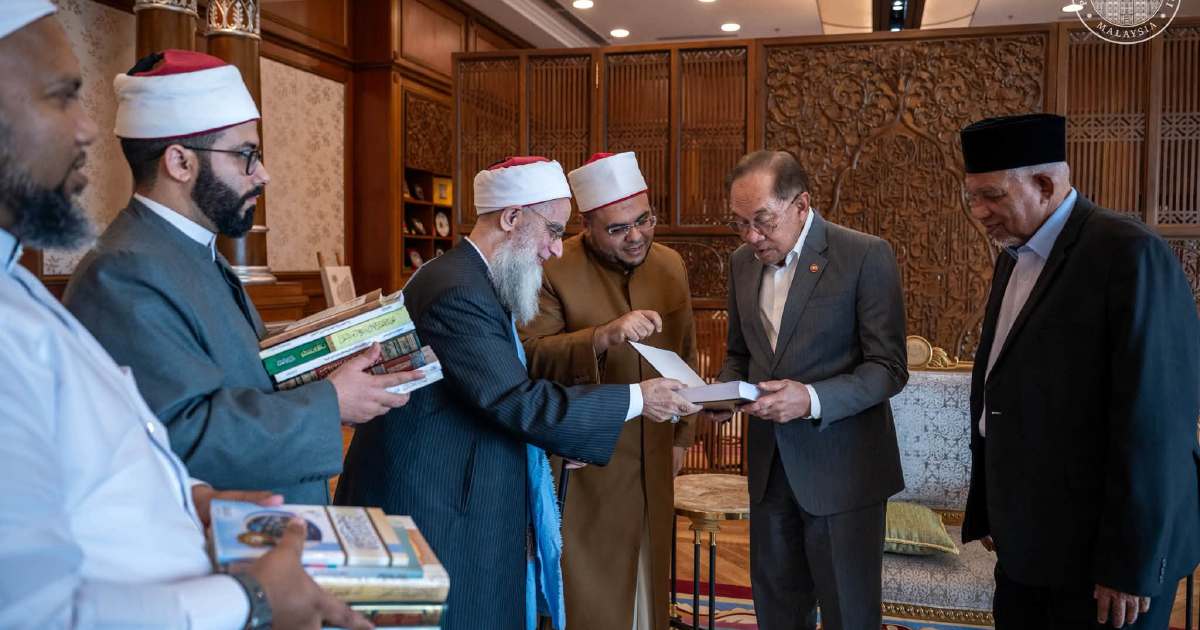
Prime Minister Datuk Seri Anwar Ibrahim received renowned Egyptian Islamic scholar Sheikh Dr Mustafa An-Nadwi Al-Hasani Mansurah at his official residence in Putrajaya, reflecting Malaysia's sustained commitment to building bridges with leading Islamic thinkers across the Muslim world. The meeting underscores the nation's strategic positioning as a forum for intellectual exchange among scholars and policymakers from the Arab world and beyond.
Sheikh Dr Mustafa An-Nadwi represents a significant intellectual lineage within contemporary Islamic thought. His presence in Malaysia demonstrates the country's appeal as a destination for prominent religious and academic figures seeking to engage with Southeast Asian perspectives on Islamic scholarship and practice. The meeting comes amid growing emphasis by the Malaysian government on fostering dialogue between different schools of Islamic jurisprudence and promoting moderate interpretations of Islamic teachings across the region.
Anwar Ibrahim's reception of such distinguished visitors aligns with his broader diplomatic agenda of positioning Malaysia as a bridge between the Arab Islamic world and Asian Muslim-majority nations. By hosting figures of Sheikh Dr Mustafa's stature, Malaysia signals its aspirations to contribute meaningfully to contemporary debates on Islamic reform, education, and social development that resonate across the broader Muslim diaspora. Such engagements also serve to elevate Malaysia's profile in international Islamic circles, particularly among academic and clerical establishments in Egypt and the broader Middle East.
The visit reflects deeper strategic interests beyond ceremonial diplomacy. Malaysia has invested considerably in Islamic education and institutional development over recent decades, positioning itself as a hub for Islamic thought that bridges traditional scholarship with modern governance. Hosting respected scholars from Al-Azhar's intellectual tradition, where many prominent Egyptian academics are trained, reinforces Malaysia's commitment to maintaining these institutional relationships. Such connections prove valuable for knowledge exchange on matters ranging from Islamic finance to interfaith dialogue.
Egyptian scholars carry particular weight within the Islamic world, given Egypt's historical role as a centre of Islamic learning and its influence on Islamic movements across Asia, Africa, and the Middle East. Al-Azhar University, where many Egyptian ulama are educated, has shaped Islamic thought for over a millennium. When prominent Egyptian scholars visit Malaysia, it signals recognition of the country's developing role as an important venue for Islamic intellectual discourse, particularly within the ASEAN region where Islam intersects with diverse secular legal systems and plural societies.
The timing of this meeting carries additional significance given Malaysia's ongoing efforts to position itself as a leading voice in moderate Islamic discourse. International conversations on Islamic thought increasingly centre on how Muslim-majority nations can reconcile religious principles with secular governance, protect minority rights, and foster economic development. Malaysia's experience navigating these tensions makes it an important case study, and visits from Arab intellectuals provide opportunities to share these experiences and learn from different approaches adopted elsewhere.
Anwar Ibrahim's personal background as an Islamic intellectual and political figure adds particular weight to such meetings. His own writings and public statements on Islam and governance have attracted attention throughout the Muslim world. Receiving scholars of Sheikh Dr Mustafa's calibre reinforces Anwar's positioning as a serious interlocutor on Islamic matters, not merely a political administrator. This personal dimension strengthens Malaysia's ability to influence regional conversations about Islam's contemporary relevance.
Malaysia's education sector stands to benefit from such institutional connections. Universities and Islamic educational institutions across Malaysia increasingly seek partnerships with Al-Azhar and other leading centres of Islamic learning to enhance academic programmes, facilitate faculty exchanges, and develop comparative research on Islamic jurisprudence. Visits by prominent scholars often pave the way for formal academic partnerships that yield long-term intellectual dividends.
From a broader geopolitical perspective, Malaysia's active engagement with Arab Islamic intellectuals serves to balance its regional relationships within ASEAN and its international posture towards Western nations. As Malaysia navigates complex diplomatic terrain involving various great powers and regional actors, maintaining robust ties with influential figures in the Arab world provides strategic flexibility and demonstrated commitment to the broader Muslim ummah. Such meetings generate goodwill and reinforce Malaysia's credentials as a voice for Muslim interests in multilateral forums.
The reception of Sheikh Dr Mustafa also highlights how Malaysia's diplomatic establishment understands the importance of soft power and intellectual capital. In an era where influence increasingly flows through networks of scholars, educators, and thought leaders rather than military might alone, hosting distinguished visitors from prestigious institutions represents a form of strategic engagement that carries real consequences for Malaysia's international standing and ability to shape narratives about Islam and modernity.

