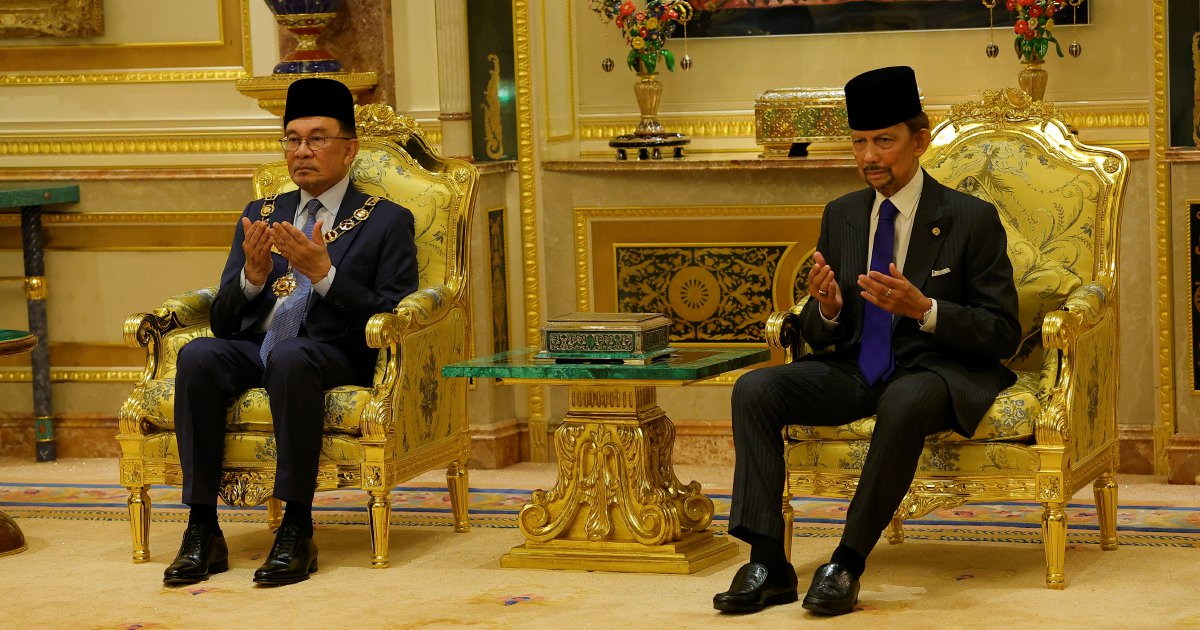
Prime Minister Datuk Seri Anwar Ibrahim has received the Darjah Kerabat Laila Utama Yang Amat Dihormati (D.K.), one of Brunei's highest royal honours, bestowed by Sultan Hassanal Bolkiah during a ceremony in Bandar Seri Begawan. The award underscores the deep diplomatic and cultural connections binding Malaysia and Brunei, two neighbouring monarchies with centuries of shared heritage and ongoing strategic partnership in Southeast Asia.
The conferment of such an elevated honour to Malaysia's head of government reflects the strong personal and institutional relationship between Anwar and Sultan Hassanal Bolkiah. Royal decorations of this calibre are typically reserved for foreign dignitaries and leaders whose contributions to bilateral relations and regional stability are deemed significant by the conferring nation. The timing and nature of this award demonstrate Brunei's continued commitment to strengthening ties with its larger neighbour across the South China Sea.
Malaysia and Brunei maintain a complex relationship rooted in geographical proximity, shared Islamic heritage, and economic interdependence. Both nations are members of the Association of Southeast Asian Nations (ASEAN) and collaborate on maritime security, environmental conservation, and regional peace initiatives. The sultanate, despite its smaller size and population, punches above its weight in regional diplomacy and remains an important stabilising force in the greater Borneo region alongside Sarawak and Sabah.
Anwar's elevation through this royal honour carries symbolic weight beyond ceremonial gesture. It signals international recognition of his leadership during a particularly consequential period for Malaysia, marked by economic reforms, enhanced regional diplomacy, and efforts to position the country as a bridge-builder in a fractious geopolitical environment. The recognition from a fellow Muslim-majority monarchy suggests alignment on core governance and strategic priorities shared across the region.
The Darjah Kerabat Laila Utama represents one of Brunei's established orders of chivalry within its comprehensive honours system. Such awards have historically been extended to sitting heads of government, senior statesmen, and foreign officials who have demonstrated exceptional service or contribution to bilateral relations. The honour places Anwar alongside other regional and international leaders who have received similar recognition from the Sultan of Brunei over decades of the sultanate's independent governance.
From a Malaysian perspective, this recognition carries implications for deepening economic cooperation. Brunei remains a significant trading partner and investor in regional energy markets, and elevated diplomatic rapport can facilitate smoother negotiations on joint ventures, maritime boundary issues, and trade agreements. The award may provide tailwind for ongoing discussions on energy security, particularly as both nations navigate the region's transition toward renewable sources while maintaining hydrocarbon interests.
The sultanate under Sultan Hassanal Bolkiah has traditionally used its honours system as a tool of soft power and relationship-building with neighbouring states. By honouring Malaysia's sitting Prime Minister with a prestigious award, Brunei reinforces its commitment to regional harmony and demonstrates that smaller nations can exercise significant diplomatic influence through judicious use of formal protocols and ceremonial recognition. This approach proves particularly valuable in a region sometimes marked by tensions and competing interests.
Anwar's receipt of this honour also reflects broader ASEAN dynamics, where member states frequently exchange formal recognitions and honours to affirm solidarity and cooperation. Such gestures contribute to the emotional and institutional fabric holding the ten-nation bloc together, particularly during periods when external powers vie for influence or when internal disagreements threaten cohesion. Malaysia, as one of ASEAN's founding members and influential economies, occupies a central position in these networks of mutual recognition and respect.
Looking forward, this award may facilitate enhanced collaboration on pressing regional challenges. Both Malaysia and Brunei face identical concerns regarding maritime security in the South China Sea, environmental conservation in tropical forests and marine ecosystems, and promoting stability amid great power competition. The personal goodwill generated through such high-level honours can translate into pragmatic cooperation when addressing transboundary issues affecting both populations.
The conferment also carries cultural significance within both nations' respective political traditions. Malaysia's constitutional monarchy and Brunei's absolute sultanate represent different governance models, yet both systems accord significant ceremonial importance to royal honours and state recognition. For Malaysian audiences, the award affirms their country's standing within the region and demonstrates that Anwar's government maintains strong diplomatic relationships with immediate neighbours, a crucial factor in any nation's foreign policy calculus.
Bilateral visits and ceremonial exchanges between Malaysian and Bruneian leadership have grown more frequent in recent years, reflecting renewed emphasis on strengthening ties at the highest levels. Such engagements provide opportunities not only for formal honours ceremonies but also for substantive discussions on policy alignment, joint initiatives, and regional challenges requiring coordinated responses. The personal rapport developed during such occasions often proves invaluable when sensitive diplomatic issues require delicate handling.
This recognition from Sultan Hassanal Bolkiah arrives at a moment when Malaysia is positioning itself as a responsible regional stakeholder committed to multilateralism and cooperative frameworks. Anwar's government has invested significantly in regional diplomacy and peace-building efforts, particularly concerning long-standing territorial disputes and maritime tensions. The award thus acknowledges these efforts and provides external validation of Malaysia's approach to regional engagement.

