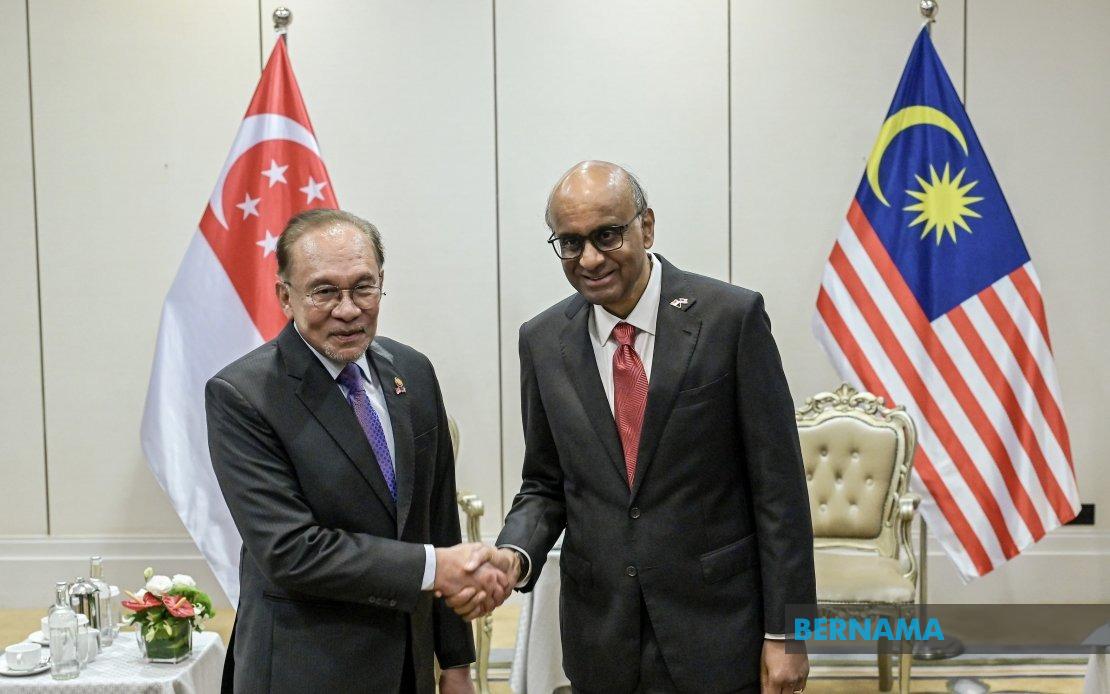
Prime Minister Datuk Seri Anwar Ibrahim held talks with Singapore President Tharman Shanmugaratnam on Monday as part of the latter's three-day state visit to Malaysia, underscoring the continued importance of bilateral relations between the two neighbouring economies. The 40-minute meeting, held in Kuala Lumpur, brought together a high-level delegation that included Foreign Minister Datuk Seri Mohamad Hasan, Investment, Trade and Industry Minister Datuk Seri Johari Abdul Ghani, and Entrepreneur and Cooperatives Development Minister Steven Sim Chee Keong, alongside senior government officials from both sides. The engagement reflects the depth of Malaysia-Singapore ties at the highest levels of government.
President Tharman's visit, which runs from July 13 to 15, began with a formal state reception at Istana Negara, where Yang di-Pertuan Agong Sultan Ibrahim accorded him the full ceremonial welcome befitting a head of state. This three-day programme represents a reciprocal gesture, following His Majesty's own state visit to Singapore in early May 2024, demonstrating the mutual respect and diplomatic courtesies that characterise relations between the two nations. Such ceremonial exchanges reinforce the symbolic importance of the Malaysia-Singapore relationship, which extends far beyond economic transactions to encompass broader political and cultural dimensions.
The economic dimension of the visit proves particularly significant. Singapore stands as Malaysia's second-largest trading partner globally and assumes an even more prominent position within Southeast Asia, functioning as the nation's largest trading partner among ASEAN member states. This economic interdependence has only deepened in recent years, reflecting complementary economic structures and geographic proximity that facilitate seamless commercial integration.
Bilateral trade figures paint a picture of robust economic engagement between the two countries. In 2025, total merchandise and services trade reached RM402.35 billion, equivalent to approximately US$93.97 billion, representing a year-on-year growth of 1.5 per cent compared with the previous year. More encouragingly, the first five months of 2025 demonstrated stronger momentum, with bilateral trade expanding by 14.5 per cent to reach RM189.90 billion, or US$47.87 billion, when measured against the same period in 2024 when the value stood at RM165.93 billion or US$37.65 billion. This acceleration in the early months of the year suggests strengthening business confidence and expanding commercial opportunities across multiple sectors.
For Malaysian policymakers and businesses, Singapore's role transcends simple trade statistics. The city-state functions as a crucial gateway to global financial markets, serves as a hub for regional corporate headquarters, and provides access to sophisticated supply chains that feed into broader Asian production networks. Many Malaysian companies use Singapore as a platform for regional operations, while Singapore-based firms frequently establish manufacturing or regional distribution capabilities in Malaysia, taking advantage of competitive costs and access to larger land areas necessary for industrial facilities.
The timing of President Tharman's visit assumes particular relevance given the evolving regional economic landscape. Southeast Asia faces mounting pressures from geopolitical tensions, supply chain vulnerabilities exposed by recent global disruptions, and the imperative to transition toward sustainable development. Malaysia and Singapore, despite their differences in economic structure and development trajectory, share common interests in maintaining regional stability, promoting free trade, and positioning themselves advantageously within emerging Asian economic architecture.
The presence of trade and investment ministers in the courtesy call indicates that commercial matters feature prominently in bilateral discussions. Both nations have long-standing mechanisms for economic cooperation, including regular meetings of bilateral committees addressing trade, investment, maritime affairs, and infrastructure development. The strengthened trade growth in early 2025 provides a constructive backdrop for these conversations, offering both countries opportunity to identify new areas for collaboration and address any structural impediments to further economic integration.
For Malaysian stakeholders, the visit carries implications across multiple domains. Financial sector professionals benefit from Singapore's role as a regional financial centre offering advanced banking, capital markets, and investment management services. Manufacturing firms operating in Malaysia's industrial zones find value in using Singapore for logistics, consolidation, and distribution functions. Technology companies pursue regional expansion strategies that frequently pivot through Singapore before accessing broader markets. The state visit, therefore, serves not merely ceremonial purposes but reinforces the policy frameworks and bilateral relationships that underpin these concrete commercial ties.
Regionally, the Malaysia-Singapore relationship serves as a barometer for broader ASEAN cohesion. As the two most advanced economies within the bloc, their strong bilateral engagement sends positive signals about the vitality of Southeast Asian integration efforts. The visit also occurs amid ongoing discussions about regional trade agreements, supply chain resilience initiatives, and coordinated responses to external geopolitical pressures, making the timing opportune for renewed commitment to deepening the partnership.
Looking forward, the expanded trade growth evident in early 2025 creates momentum for identifying new collaboration frontiers. Potential areas worthy of attention include green technology transfer, digital economy partnerships, fintech innovation, and labour mobility arrangements that address skill shortages in both economies. The state visit provides an appropriate platform for such forward-looking discussions, allowing senior officials to chart strategic directions that extend beyond immediate commercial considerations.
The three-day visit structure also permits President Tharman to engage with Malaysian stakeholders beyond government circles, potentially including business leaders, academic institutions, and civil society organisations. Such broader engagement enriches the visit beyond bilateral government-to-government relations, fostering people-to-people connections that contribute to long-term relationship stability and mutual understanding. These informal networks often prove instrumental in resolving future disagreements and identifying unexpected collaborative opportunities.

