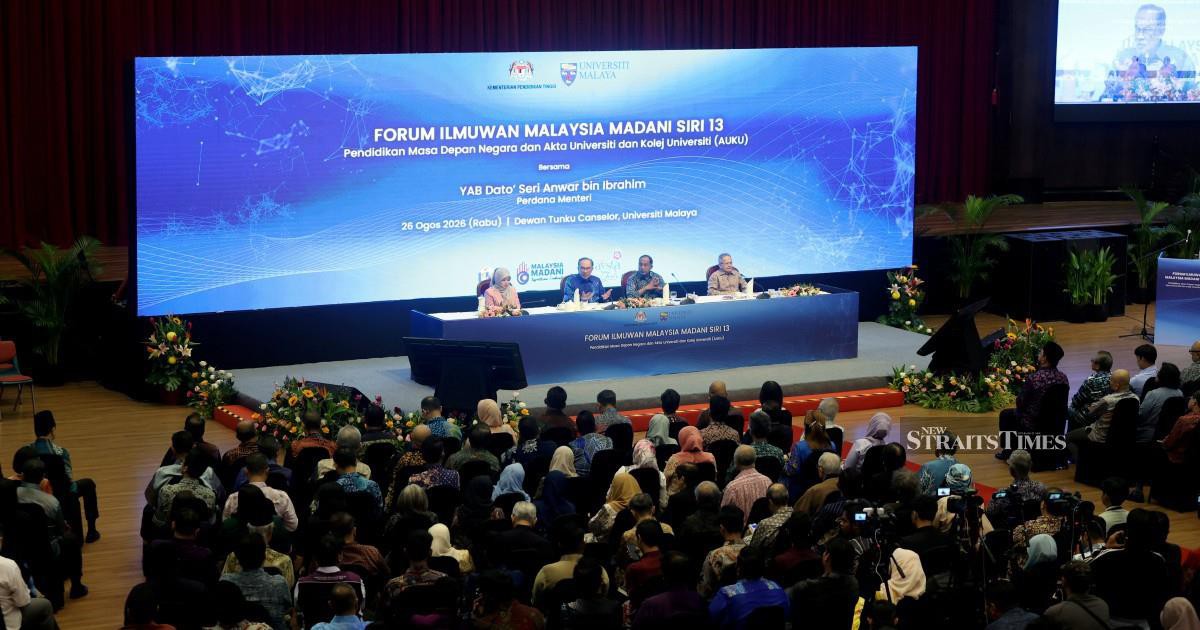
Prime Minister Datuk Seri Anwar Ibrahim has appealed to university students and other stakeholders to have confidence in the government's roadmap for reforming Malaysia's restrictive university autonomy legislation, urging patience as authorities work through the complex process of substantive legal and institutional change.
The remarks come as continued pressure mounts on the administration to deliver on longstanding pledges to repeal or significantly amend the Universities and University Colleges Act (AUKU), which has long been criticised by academics, student groups, and human rights organisations for severely curtailing campus freedoms and political participation. The law, enacted decades ago, prohibits students from engaging in political activities and imposes strict regulations on assembly and expression within university premises, measures that educational advocates argue are incompatible with democratic principles and intellectual development.
Anwar's call for time and space reflects the delicate political and bureaucratic terrain the government must navigate in addressing what has become a defining issue for Malaysia's younger generation. While the administration has signalled commitment to reform, the actual mechanics of amending or repealing such entrenched legislation involves coordination across multiple ministries, consultations with public and private universities, and potentially contentious debates within Parliament about the appropriate boundaries of student conduct and institutional governance.
The AUKU debate holds particular resonance in Malaysia's political landscape because university campuses have historically served as incubators for political awakening and youth activism. Restrictions on campus political activity have been viewed by reformers as symptoms of a broader democratic deficit, while government and institutional authorities have traditionally argued that such constraints are necessary to maintain order and academic focus. The tension between these perspectives has persisted across multiple administrations.
For Malaysian universities seeking to enhance their international standing and competitiveness, the AUKU restrictions present a significant obstacle. Leading global institutions pride themselves on fostering environments where students and faculty can engage freely in intellectual discourse and civic participation. When Malaysian universities are perceived as operating under constraints that limit such engagement, their attractiveness to top international talent and their capacity to produce graduates prepared for democratic participation may suffer comparative disadvantage.
Anwar's emphasis on comprehensive improvement measures suggests the government is contemplating not merely a straightforward repeal but a more nuanced approach that might involve replacing the AUKU with new legislative frameworks designed to balance institutional stability with enhanced freedoms. This could include revised conduct codes, clearer definitions of permissible activities, and mechanisms for student representation in university governance that would address underlying concerns without creating a regulatory vacuum.
The request for trust from students and stakeholders carries particular weight given the historical scepticism many campus activists harbour toward government commitments on civil liberties. Previous administrations have made reform pledges that languished without implementation, creating a credibility gap that the current leadership must actively work to bridge through tangible progress and demonstrated urgency in advancing legislative changes.
Regionally, Malaysia's approach to university governance and student freedoms carries implications for Southeast Asia's broader trajectory on democratic development and human rights. As nations in the region grapple with balancing social stability and individual liberties, decisions made regarding campus autonomy become touchstones for assessing commitment to democratic principles. Reform of the AUKU would signal Malaysia's willingness to expand spaces for youthful political participation and intellectual freedom, potentially influencing discussions in neighbouring countries facing similar governance questions.
The timeline for AUKU reform remains ambiguous, though Anwar's request for patience suggests the process may extend beyond the immediate term. Administrative and legislative pathways typically require multiple stages of consultation, policy formulation, and Parliamentary procedure, each of which can introduce delays or dilute original reform intentions. Managing expectations while maintaining momentum presents a communication challenge for officials seeking to demonstrate progress without overpromising on timelines.
For Malaysia's university sector, the period of uncertainty surrounding AUKU's future status creates operational challenges, as institutions struggle to interpret existing rules while anticipating potential regulatory shifts. Clarity on the government's specific reform objectives would enable universities to begin aligning their policies and campus cultures toward enhanced autonomy frameworks, reducing the jarring transition that sudden repeal might otherwise impose.
The outcome of AUKU reform will likely become a measure by which Anwar's administration is assessed by younger voters and civil society organisations invested in expanding democratic space. Successfully navigating this issue requires demonstrating that genuine reform is possible within Malaysia's constitutional and political frameworks, a demonstration that could rebuild public confidence in institutional responsiveness to demands for expanded freedoms and institutional independence.

