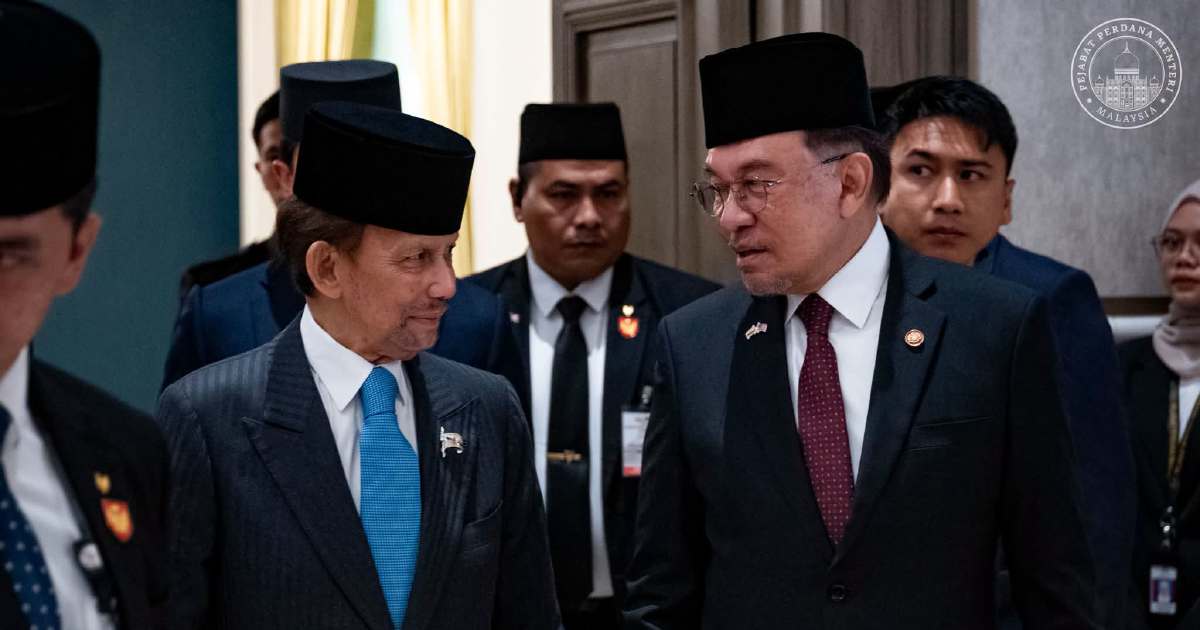
Prime Minister Datuk Seri Anwar Ibrahim is set to travel to Bandar Seri Begawan next week for high-level discussions with Brunei Sultan Hassanal Bolkiah, marking the continuation of an established diplomatic tradition between the two Southeast Asian nations. The meeting will constitute the 27th iteration of the Annual Leaders' Consultation, a bilateral format that has served as a cornerstone of Malaysia-Brunei relations for nearly three decades.
The Leaders' Consultation represents one of the most regularised diplomatic engagements in the region, reflecting the depth and consistency of ties between Malaysia and Brunei despite their considerable differences in size, population, and economic capacity. This institutionalised dialogue has evolved into a mechanism through which both governments address shared interests, coordinate regional positions, and manage any issues that may arise between them. The format allows for candid exchanges at the highest level without the formality constraints of multilateral forums.
Malaysia and Brunei share extensive historical, cultural, and religious connections, with both nations part of the broader Malay-Muslim world and active members of regional organisations including ASEAN. Their strategic geography along critical maritime routes in Southeast Asia lends additional importance to maintaining strong bilateral understanding. Brunei, despite its small size and population of around 450,000, commands attention due to its energy wealth and strategic location on the island of Borneo, which Malaysia also occupies as a co-sharer of that landmass.
The timing of this consultation comes as Southeast Asia continues to navigate complex regional dynamics involving major powers, territorial disputes, and economic integration challenges. Both Malaysia and Brunei have stakes in various regional initiatives and may use such bilateral platforms to coordinate their approaches to multilateral discussions, particularly within ASEAN frameworks where consensus-building remains essential. The consultation likely provides an opportunity to discuss matters of mutual concern that might not receive sufficient attention in larger regional gatherings.
Bilateral economic relations form a natural topic for such high-level engagement. While Malaysia's economy vastly outstrips Brunei's in absolute terms, Brunei's energy sector remains significant to regional markets, and Malaysia maintains investments and commercial interests throughout Brunei. Trade in goods and services, investment flows, and labour mobility represent ongoing practical considerations for both governments. Additionally, cooperation in sectors ranging from agriculture to tourism to defence may be evaluated during such consultations.
The Leaders' Consultation format also addresses governance and institutional matters affecting both nations. Maritime boundary issues, shared Bornean resources, and coordination on environmental matters affecting the island represent substantive areas where bilateral discussion proves valuable. Brunei and Malaysia must coordinate their positions on matters ranging from forest conservation to shared river systems, particularly given the transboundary nature of environmental challenges in Southeast Asia.
From Malaysia's perspective, maintaining robust ties with Brunei reflects the importance of strengthening relationships with all ASEAN neighbours, however small they may be. Such engagement demonstrates commitment to regional diplomacy and reinforces Malaysia's credentials as a nation that values partnership across its immediate neighbourhood. For Brunei, regular consultation with a larger neighbour provides reassurance that its interests receive consideration and that its voice remains heard despite its limited demographic and military capacity.
The consistency of the Leaders' Consultation demonstrates both nations' commitment to peaceful, institutionalised engagement. In an era of shifting global alignments and rising geopolitical tensions, the stability provided by such long-standing bilateral mechanisms offers a model for constructive regional relations. The dialogue serves not merely to address problems but to prevent their emergence through regular communication and mutual understanding at the highest political level.
Regional observers will likely view this consultation as part of the broader context of ASEAN cohesion and Southeast Asian stability. As the association navigates challenges ranging from the Myanmar situation to tensions in the South China Sea, bilateral strengthening between member states reinforces the foundations upon which regional cooperation rests. Malaysia's engagement with Brunei, though less immediately visible than its interactions with larger neighbours, contributes to the overall architecture of Southeast Asian diplomacy and helps maintain the consensus-based decision-making processes that define ASEAN's approach to regional governance.

