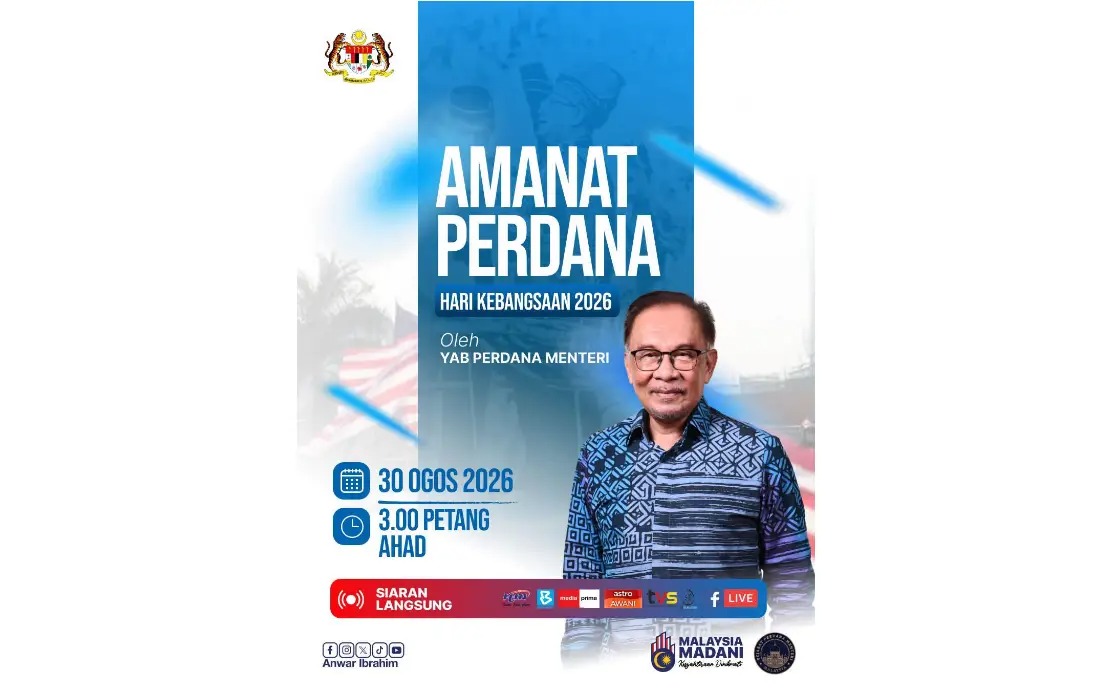
Prime Minister Datuk Seri Anwar Ibrahim will take the national stage tomorrow afternoon at the Putrajaya International Convention Centre (PICC) to announce a series of key initiatives during Malaysia's National Day address. The speech represents a significant moment for the government to articulate its vision for the nation at a time when Malaysians reflect on their shared heritage and future direction.
In remarks shared on Facebook, Anwar signalled that his address would traverse multiple dimensions affecting Malaysians—from immediate household concerns to broader philosophical questions about nationhood. The Prime Minister appears intent on using the platform not merely for ceremonial pronouncements but to connect tangible governance priorities with the deeper meaning of independence, drawing a through-line between past sacrifices and present-day obligations.
The timing carries particular resonance as Malaysia approaches nearly seven decades since achieving independence. Anwar's framing emphasises historical consciousness, explicitly acknowledging the struggles and sacrifices of preceding generations whose efforts, characterised by hardship and personal cost, created the foundation upon which modern Malaysia rests. This historical perspective serves to contextualise contemporary challenges within a longer narrative of nation-building, suggesting that current initiatives must honour those foundational efforts.
Central to the Prime Minister's messaging is a call for the current generation to shoulder responsibility for sustaining and enriching what independence has delivered. Rather than treating independence as a settled achievement, Anwar's formulation posits it as an ongoing project requiring active stewardship. This rhetorical positioning carries implications for how the government frames its policy agenda—not as technocratic adjustments but as expressions of national purpose that connect citizens to their collective story.
Beyond policy specifics, Anwar has explicitly urged Malaysians to harness National Day as an opportunity to reinforce social cohesion. His emphasis on strengthening the spirit of unity speaks to persistent anxieties about communal harmony in a diverse, multi-religious, and multi-ethnic society. By framing unity not as an abstract ideal but as essential to preserving peace and citizen well-being, the Prime Minister articulates a pragmatic case for intercommunal cooperation grounded in mutual interest.
The call to reject incitement that fuels hatred among different communities addresses a real challenge within Malaysia's information ecosystem. In an era of digital communication and polarised discourse, government figures frequently warn against inflammatory rhetoric. Anwar's plea carries added weight coming from the nation's highest executive office, signalling that fostering social harmony ranks among governmental priorities and that citizens bear responsibility for maintaining that harmony through their own conduct and choices.
For Malaysian readers, the impending speech matters because it will likely signal the government's near-term policy directions and priorities. National Day addresses typically serve double duty—honouring national tradition while simultaneously providing platforms for major policy announcements. The confluence of both functions suggests that Anwar intends to position his government's initiatives not as disconnected administrative measures but as expressions of national values and long-term vision.
The emphasis on generational responsibility carries particular salience for younger Malaysians who came of age after democratisation processes and increasingly expect governments to address climate change, economic opportunity, and social mobility. How Anwar frames the relationship between inherited national responsibilities and new challenges facing contemporary Malaysians will indicate the government's readiness to engage with evolving citizen expectations.
Regionally, Malaysia's National Day address receives attention from Southeast Asian observers monitoring how ASEAN's second-largest economy articulates its direction. Anwar's emphasis on unity and peace has implications for regional stability and Malaysia's role within ASEAN frameworks, suggesting that internal cohesion ranks high among governmental concerns—a posture with consequences for how Malaysia engages multilaterally.
The government's pre-announcement messaging also reflects broader communication strategy. By previewing core themes before the formal address, the administration builds anticipation and frames the interpretive context for subsequent announcements. Citizens, media, and analysts will watch for what specific initiatives Anwar unveils and how comprehensively they address the daily-life issues he has flagged.
Looking forward, the National Day address will provide crucial indicators of governmental priorities as Malaysia navigates post-pandemic recovery, manages inflation concerns, and addresses infrastructure and education challenges. The intellectual and moral framework Anwar constructs around these issues—whether rooted in historical continuity, generational stewardship, or communal harmony—will influence how Malaysians perceive and evaluate government performance in coming months.

