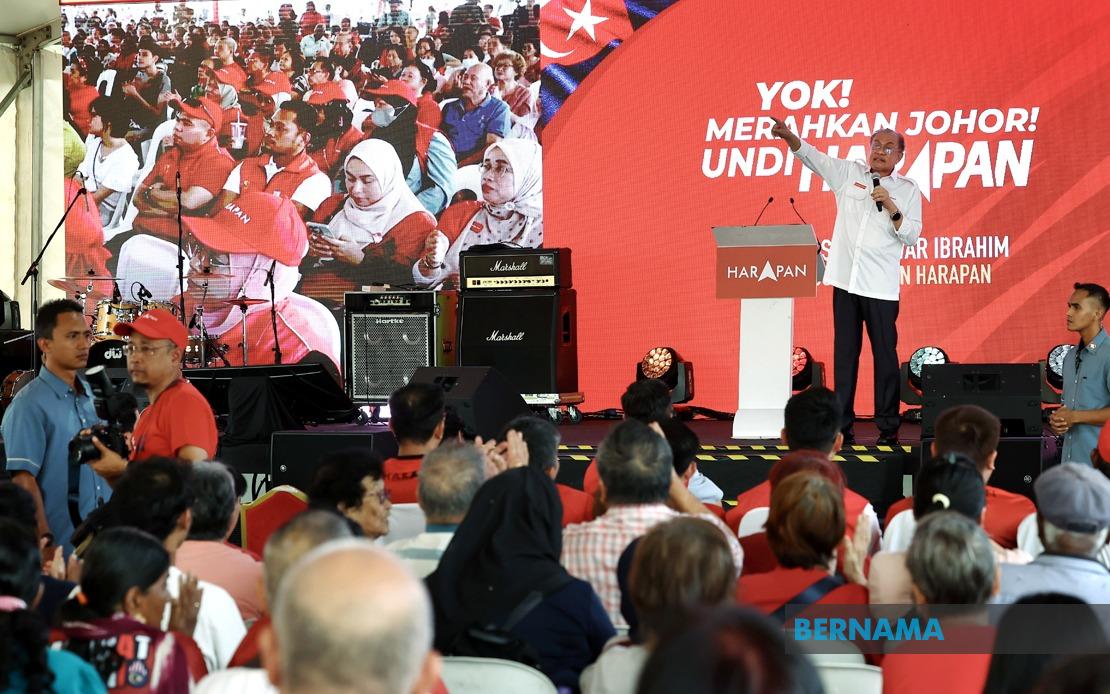
Prime Minister Datuk Seri Anwar Ibrahim has stepped into the heated Johor state election campaign to draw a line under what has become an increasingly fractious debate, calling on all contesting parties to abandon the matter of Datuk Seri Najib Razak's imprisonment as electoral ammunition. Speaking at a Pakatan Harapan campaign event in Kulai, Anwar emphasised that with the former prime minister currently incarcerated, further politicisation of his case serves no constructive purpose and distracts from the genuine challenges facing ordinary Malaysians.
The remarks reflect growing concern within the government that the Najib question has begun to dominate discourse in what should be a forward-looking electoral battle centred on governance, economic stewardship, and the delivery of public services. By framing the issue as a distraction, Anwar is attempting to shift the conversation away from the judicial processes that have ensnared his predecessor and towards the broader policy priorities that his administration believes deserve voter attention during the crucial Johor contest.
Anwar's comments carry particular weight given the sensitive nature of the Najib case and its ongoing shadow over Malaysian politics. The former premier remains imprisoned following his conviction in connection with the massive 1MDB scandal, a governance failure that fundamentally shook public confidence in institutional integrity. Yet Anwar's intervention suggests that continued relitigating of Najib's fate through campaign rhetoric has become counterproductive, both politically and practically, for the government's electoral prospects in Johor.
The Prime Minister pivoted instead to what he framed as the material consequences of the 1MDB misadventure, a framing that transforms the issue from one of personal accountability to one of national economic burden. The government currently shoulders RM51 billion in 1MDB-related debt, a staggering sum that represents opportunity cost on a scale difficult for ordinary citizens to grasp. Had these funds not been diverted through corrupt channels, Anwar stressed, that capital could have flowed directly into schools, hospitals, roads, and social welfare programmes across the nation.
This rhetorical strategy allows Anwar to acknowledge the Najib scandal's significance while simultaneously insisting that dwelling on his imprisonment wastes precious political oxygen. By translating the scandal into concrete economic metrics, he transforms an abstract question of justice into a tangible question about resource allocation and public welfare. When voters hear that hospitals lack beds and schools lack resources, the connection to a RM51 billion debt becomes harder to ignore, regardless of whether they are reminded daily that Najib is behind bars.
The event itself demonstrated the coalition of forces supporting Anwar's position. Youth and Sports Minister Mohammed Taufiq Johari, Deputy Investment, Trade and Industry Minister Sim Tze Tzin, PKR Youth chief Muhammad Kamil Abdul Munim, and Pakatan Harapan candidate for Bukit Batu Arthur Chiong Sen Sern all gathered to amplify the message that Johor voters should think about the future rather than relitigating the past. The breadth of the lineup underscores that this represents a coordinated government position rather than Anwar's personal opinion.
For Malaysian voters, particularly those in Johor, Anwar's intervention offers a form of permission to move beyond what has become an exhausting debate. The constant references to Najib's incarceration, whether deployed defensively by former allies seeking to rally UMNO supporters or offensively by opposition figures seeking to delegitimise the Barisan Nasional, has threatened to obscure substantive questions about education, healthcare, infrastructure investment, and employment creation. A campaign that focuses predominantly on the fate of a former premier, even if he is currently in prison, risks losing sight of the quotidian concerns that determine electoral outcomes.
However, Anwar's appeal faces a substantial challenge in the current Malaysian political environment. The Najib question remains deeply embedded in factional disputes within both UMNO and the broader Barisan Nasional. Some within UMNO continue to view Najib as a political prisoner and have mobilised supporters around the demand for his release or sentence reduction. For these constituencies, Anwar's plea to abandon the issue carries little weight, as they see continued campaigning on his behalf as a matter of party loyalty and political principle rather than crude opportunism.
The RM51 billion debt figure itself deserves scrutiny as a tool of political persuasion. While the magnitude is real and the opportunity cost is genuine, the framing suggests that debt repayment is a straightforward trade-off against current spending. In reality, debt servicing and development investment are not entirely zero-sum propositions, though they do exist in tension. Anwar's rhetorical choice to present them as directly competing for the same resources serves his immediate campaign purpose but oversimplifies complex fiscal realities that extend across multiple administrations and budget cycles.
The Johor state election itself holds strategic importance for Anwar's broader political consolidation. As the peninsula's second-largest state by population and a traditional UMNO stronghold, Johor outcomes will influence momentum heading into the next federal election cycle. A Pakatan Harapan victory or substantial gains would signal that the coalition has successfully moved beyond its earlier internal fractures and can convincingly challenge Barisan Nasional's dominance outside Sarawak and Sabah. The last thing Anwar needs during this crucial window is for campaign narratives to centre on issues over which he has limited control and which activate opposition constituencies.
Regionally, Anwar's intervention reflects a broader pattern across Southeast Asia where former leaders remain politically contested long after leaving office. Whether through imprisonment, exile, or other means, the question of how to handle predecessors who have become symbols of institutional failure or corruption troubles democracies throughout the region. Malaysia's approach, still being negotiated through judicial processes and political rhetoric, offers both a cautionary tale and a live demonstration of how historical reckoning and forward momentum remain fundamentally in tension.
Ultimately, Anwar's call for a campaign moratorium on the Najib question represents an attempt to ring-fence the judiciary from electoral politics. By insisting that Najib's case is closed, his fate determined, and further discussion unhelpful, the Prime Minister is trying to establish a boundary between the sphere of criminal justice and the sphere of electoral competition. Whether such boundaries can hold in a political culture where the two spheres remain intimately entangled remains to be seen when voters actually cast their ballots in Johor.

