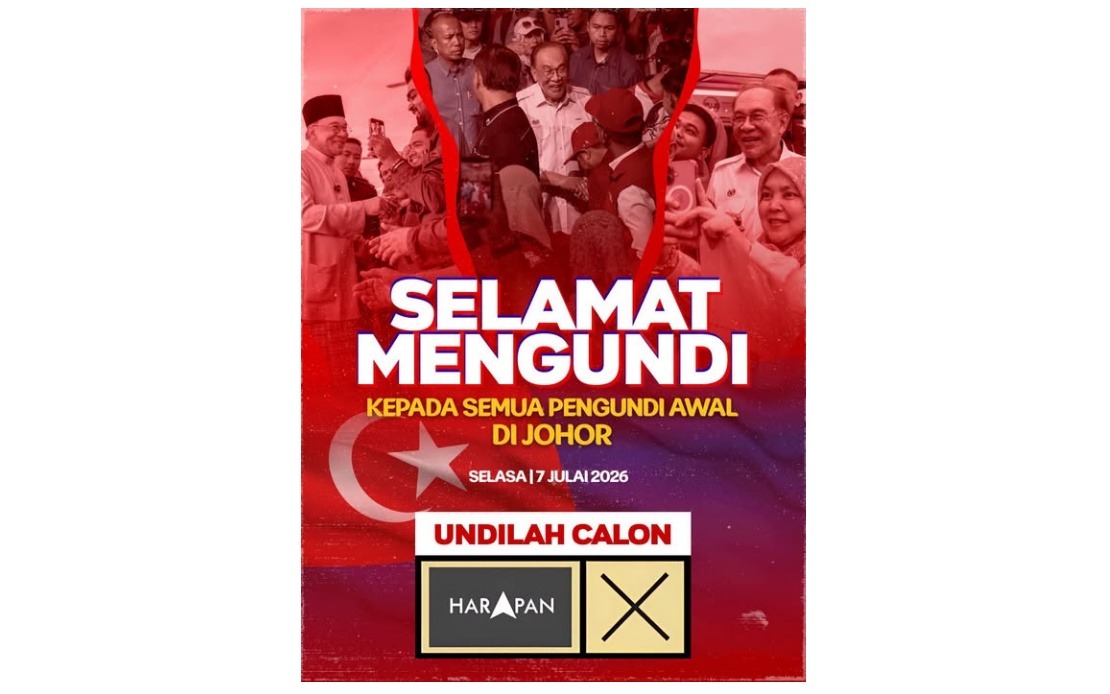
Prime Minister Datuk Seri Anwar Ibrahim has made a direct appeal to early voters in the 16th Johor state election, using his social media platform to encourage eligible citizens to support Pakatan Harapan candidates and help secure a better future for the southern state. Speaking through a Facebook post released on July 7, the Pakatan Harapan chairman explicitly called on voters to choose coalition candidates, framing the election as a pivotal moment for Johor's development and governance.
The appeal came as nearly 25,000 eligible early voters prepared to cast their ballots across 64 polling centres throughout Johor. This early voting window is specifically designed to accommodate members of the security forces and their families, who are unable to vote on the main polling day due to their operational duties. The convenience of early voting ensures that these essential personnel do not lose their right to participate in the democratic process, a practice that has become standard in Malaysian elections to maintain security force readiness.
Among the early voters, 12,041 represented Malaysian Armed Forces personnel and their spouses, while the remaining 12,710 consisted of Royal Malaysia Police and General Operations Force members and their families. The distribution of 53 early polling centres dedicated to police and 11 for military personnel across the state reflected careful logistical planning to minimise disruption while maximising accessibility. These centres operated on a staggered schedule, opening at 8 am with closing times varying between noon and 6 pm depending on voter numbers and location-specific arrangements.
Pakatan Harapan's confidence in the Johor contest is evident in its decision to field a full slate of candidates across all 56 state seats. The coalition's composition reflects its established partnership model, with PKR contesting 20 seats, Amanah fielding 19 candidates, and DAP competing in 17 constituencies. This distribution aims to balance representation among coalition partners while maintaining competitive viability in constituencies where each party holds traditional strongholds or demographic advantages. The strategy underscores the coalition's commitment to presenting a united front to voters after years of navigating post-2018 coalition dynamics and internal tensions.
The broader election context reveals significant competition, with a total of 172 candidates vying for the 56 available seats. This candidate density indicates contested races across most constituencies, suggesting that voters will have meaningful choices between rival parties and independent contenders. The competition itself reflects Johor's political significance as one of Malaysia's largest and most economically important states, making it a barometer of national political sentiment and a crucial arena for both the ruling coalition and opposition forces.
With 2.7 million registered voters across Johor, the electorate represents a substantial portion of Malaysia's voting population. The Saturday polling day promises to be closely watched, not merely for what it reveals about Johor's governance preferences but for its broader implications for federal politics. State-level elections often serve as testing grounds for political messaging, campaign strategies, and voter sentiment between general elections, offering insights into shifting allegiances and emerging issues that resonate with ordinary Malaysians.
Anwar's direct intervention in the campaign through his social media address highlights the Prime Minister's personal stake in Johor's outcome. As PH chairman, his public endorsement of the coalition's candidates carries weight beyond ceremonial significance. His emphasis on choosing Harapan candidates for a better future attempted to frame the election as a choice between competing visions of governance and development, rather than merely a competition between individuals or local personalities.
The timing of early voting also reveals something about electoral management in Malaysia. By accommodating security force voting several days before the main election, authorities demonstrate commitment to inclusive democratic participation while ensuring these personnel remain available for election day security duties. This administrative arrangement has become increasingly important as Malaysian elections have grown more complex, with multiple-state contests occasionally held simultaneously, requiring substantial police and military deployment.
For Johor specifically, the election outcome will determine the state's direction on crucial matters including economic development, infrastructure investment, education provision, and social service delivery. The state has historically served as a bellwether for Malaysian politics, and its preference for particular political coalitions has sometimes influenced subsequent national political developments. Understanding what drives Johor voters therefore provides important clues about broader Malaysian political currents and the concerns that animate electoral behaviour across the country.

