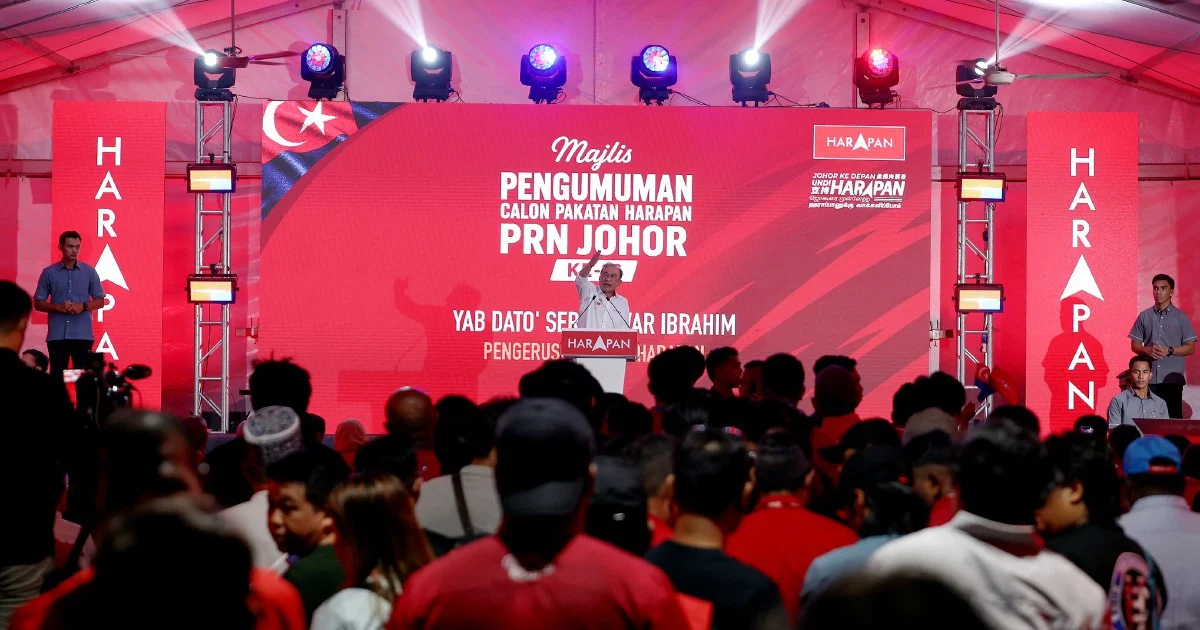
Pakatan Harapan chairman Datuk Seri Anwar Ibrahim has drawn a firm line on how the upcoming Johor state election should proceed, insisting that the contest remain strictly within the realm of political rivalry and that institutions connected to the Malay Rulers should play no role in the process. Speaking during a campaign stop in Tangkak, Anwar articulated a position that reflects broader sensitivities in Malaysia regarding the proper boundaries between electoral politics and constitutional monarchy.
The statement carries significant weight coming from the Prime Minister, as it addresses concerns about the intersection of state politics and royal institutions—a sensitive matter in Malaysian governance. Anwar's intervention suggests that questions may have emerged during campaign activities about the appropriate scope of involvement by various stakeholders in the election. By clarifying that Johor's electoral outcome should be determined purely through democratic political competition, he emphasises a principle that many political observers regard as essential to maintaining institutional integrity.
Johor's position within Malaysia's political landscape makes this statement particularly consequential. As a state with a long monarchical tradition and a reigning Sultan who holds significant constitutional authority, Johor requires careful navigation of relationships between political actors and royal institutions. The Premier's call for clarity on this boundary helps establish expectations for how all political parties should conduct themselves throughout the campaign period and the transition that follows the election results.
For Malaysian voters, Anwar's message underscores a commitment to separating electoral politics from the unique institutional role that the Malay Rulers occupy within Malaysia's constitutional framework. This distinction becomes important when Johor has historically witnessed intense political competition, with various coalitions seeking to establish dominance in the state assembly. The involvement of royal institutions in the mechanics of how elections are contested or decided could potentially blur lines that parliamentary democracy depends upon to function effectively.
The context of state elections in Malaysia has frequently involved questions about the relationships between winning coalitions and state rulers, particularly regarding the formation of state governments following polling day. Anwar's statement appears designed to reinforce the principle that while Rulers possess constitutional prerogatives in areas such as appointing chief ministers, the election itself and the political campaign leading to it should remain autonomous spaces for political parties to contest for voter support.
For Southeast Asian observers, Malaysia's approach to balancing democratic electoral systems with constitutional monarchy presents an instructive case. Many regional democracies grapple with similar questions about institutional roles and political competition. Anwar's emphasis on preserving the integrity of electoral politics while respecting royal institutions reflects a sophisticated understanding of how these elements can coexist without one encroaching on the other's proper domain.
The timing of such a statement also merits consideration. Campaign periods can sometimes generate tensions between political camps regarding propriety and boundaries. By articulating a clear position early, Anwar establishes a standard against which all parties' conduct during the Johor campaign can be measured. This approach serves to elevate the conversation beyond partisan advantage, framing it instead as a matter of constitutional principle that transcends any single election or political formation.
Johor's particular significance within the Malaysian federation means that how its election is conducted carries implications beyond the state itself. The state has historically served as a bellwether for broader political trends across the country. An election conducted with clear separation between political competition and royal institutional involvement can set a positive precedent for how other state elections and potentially federal electoral processes maintain necessary boundaries.
The statement also reflects evolving understandings within Malaysia about institutional roles in the post-2018 political era. The country's electoral and political landscape has shifted considerably in recent years, with various actors reassessing how different institutions should function within a democratic framework. Anwar's position contributes to an ongoing conversation about appropriate checks and balances, the sanctity of democratic processes, and the unique but properly bounded role of constitutional monarchy in a parliamentary system.
Political analysts view such clarity as beneficial for all participants in the electoral process. When expectations about institutional involvement are vague, misunderstandings can arise that potentially lead to disputes or controversy surrounding election outcomes. By establishing transparent principles about what should and should not occur during campaigns and vote-counting, political actors can conduct themselves with greater confidence that their actions align with broadly accepted norms.
For voters in Johor, Anwar's message carries reassurance that their democratic choice will be respected as a political decision, made through the mechanisms of representative government rather than being intertwined with other institutional frameworks. This separation of spheres strengthens public confidence in both electoral integrity and the proper functioning of constitutional monarchy, neither of which should be compromised by inappropriate entanglement with the other.