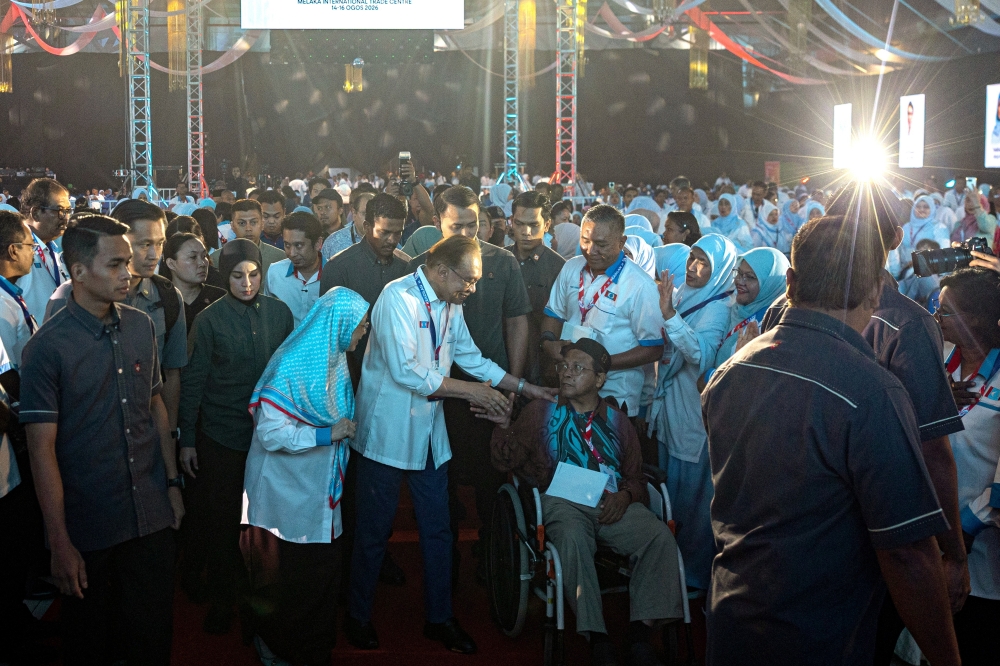
Prime Minister Datuk Seri Anwar Ibrahim has delivered a carefully calibrated message to his PKR party delegates, stressing that any major political decisions involving Umno must be anchored in the welfare of the Malaysian people rather than emotional responses to past grievances. Speaking at a gathering in Melaka, the PKR president signalled a pragmatic approach to the fractious relationship between the ruling coalition and the opposition, suggesting that the government's actions should be driven by rational calculation of public benefit rather than retribution.
The statement carries particular weight given Malaysia's volatile political climate, where coalitional arrangements have repeatedly shifted and personal animosities between political figures have threatened government stability. Since assuming office, Anwar has navigated a delicate balance between maintaining the Pakatan Harapan coalition with DAP and Amanah while managing an uneasy cooperation with Umno-led component parties in the broader Perikatan Nasional arrangement. His comments suggest he recognises the temptation within his party to pursue adversarial positions against Umno, historically PKR's most formidable rival, but is counselling restraint.
This emphasis on people-centric policymaking rather than point-scoring reflects a maturation in Malaysian political discourse that has been notably absent in recent years. The 2018 defeat of the Najib-era Umno government created considerable appetite within opposition parties for accountability measures and investigations, sentiments that have sometimes threatened to overshadow substantive governance priorities. By invoking the language of public welfare, Anwar is effectively repositioning political maturity as a hallmark of his administration—a subtle distinction that may prove electorally significant in the lead-up to the next general election.
The context of this message is crucial for understanding Malaysian political currents. Umno, despite losing federal power in 2018 and enduring a period of organisational turmoil, remains a formidable electoral force, particularly in rural Peninsular Malaysia and among Malay-Muslim voters. The coalition government's arithmetic depends on maintaining parliamentary stability, which requires at least implicit cooperation from Umno MPs even when the party nominally sits in opposition. Any reckless confrontation risks destabilising the fragile majority that currently supports the government.
Anwar's warning also addresses internal PKR dynamics, where younger members and those who suffered persecution under previous Umno administrations harbour residual resentment. The party contains figures who have endured imprisonment, professional blacklisting, and family separation as a result of conflicts during the Mahathir era, creating a reservoir of legitimate grievance that occasionally manifests in calls for aggressive accountability measures. By explicitly cautioning against anger-driven decisions, Anwar is attempting to channel this sentiment into constructive directions rather than allowing it to dictate policy.
The emphasis on rational governance carries implications extending beyond Umno relations. It suggests an administration conscious of the public's fatigue with political theatrics and increasingly demanding tangible improvements in living standards, particularly regarding cost of living pressures and employment prospects. Malaysian voters, especially younger demographics and urban professionals, have demonstrated reduced patience with parties that appear more focused on internecine political struggles than on addressing bread-and-butter concerns. Anwar's framing aligns his government's positioning with voter expectations for substance over spectacle.
Regionally, Malaysia's political stability holds significance for Southeast Asian equilibrium. The nation's coalition government carries weight in Asean deliberations and regional economic arrangements, and any internal political turbulence that undermines decisive governance has spillover effects on Malaysia's regional standing. Countries monitoring Malaysian politics as a barometer of Southeast Asian stability would regard Anwar's calls for measured governance as reassuring signals of commitment to institutional continuity rather than revolutionary disruption.
The statement also implicitly acknowledges a strategic calculation: that indefinite confrontation with Umno offers diminishing returns for PKR and its coalition partners. Elections are won not merely by defeating opponents but by demonstrating superior capacity to govern and deliver. A government consumed by adversarial positioning against Umno risks appearing perpetually defensive rather than forward-looking, a vulnerability that opposition parties could exploit in any electoral contest. Anwar's emphasis on people-centric decision-making inverts this dynamic, positioning his administration as future-oriented and focused on substantive outcomes.
Looking forward, this messaging establishes parameters for how subsequent political developments involving Umno will be evaluated and explained to the public. Should the government pursue investigations into Umno-era governance failures, such actions will now be framed as responding to popular demands for accountability and systemic reform rather than partisan revenge. Conversely, if political considerations lead the government to adopt more conciliatory approaches toward Umno, the public discourse has been prepared to interpret such moves as pragmatic prioritisation of national interests over factional interests.
The speech ultimately reflects an evolving understanding within Malaysia's governing structures that political legitimacy increasingly derives from demonstrable competence and public-oriented policymaking rather than from victory narratives or organisational dominance. For a prime minister who has experienced both remarkable political resurrection and periods of profound isolation, such emphasis on measured rationality may represent hard-won wisdom about sustainable governance in deeply polarised societies.

