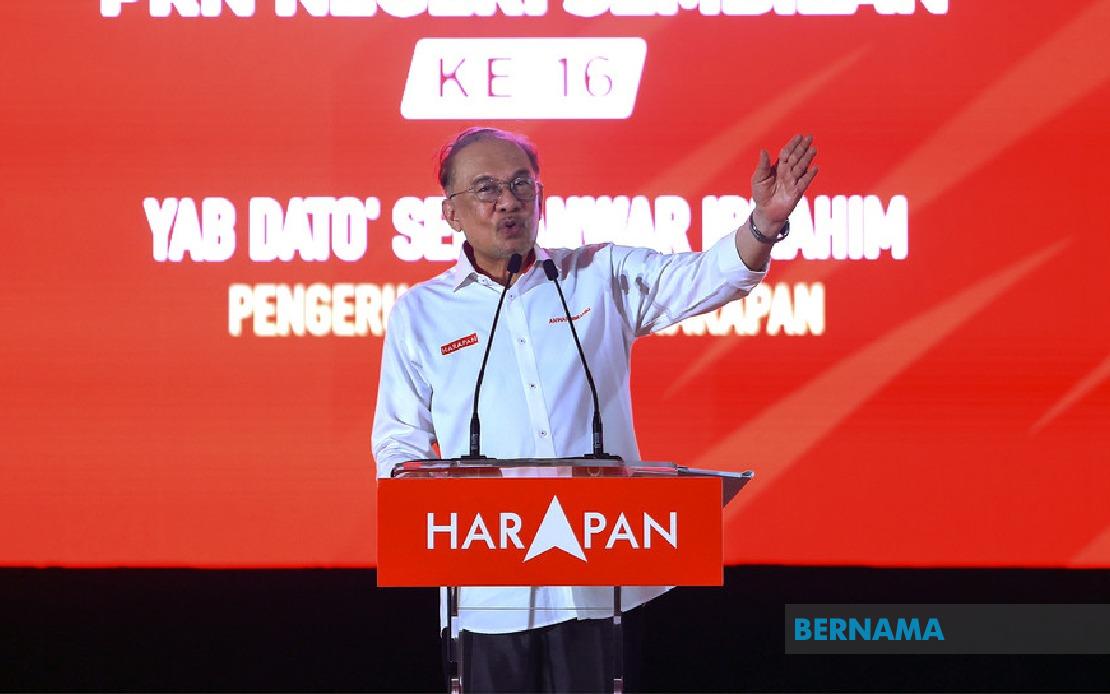
Prime Minister Datuk Seri Anwar Ibrahim is making a direct appeal to voters in Negeri Sembilan to maintain their political support for Pakatan Harapan, arguing that electoral continuity is essential for the state to complete its development agenda. Speaking through social media ahead of the 16th Negeri Sembilan state election, Anwar stressed that the partnership between Putrajaya and Kuala Lumpur's state administration has yielded tangible benefits that risk being derailed if the coalition loses power at the ballot box.
The Prime Minister's intervention underscores the high stakes facing PH in Negeri Sembilan, a state that has served as a proving ground for the ruling coalition's governance model since 2018. Anwar's explicit endorsement of the current administration signals that federal leadership views the state election as a critical test of PH's ability to retain ground-level support, particularly given the fractious political environment Malaysia has experienced since the coalition's 2022 return to office. For Negeri Sembilan specifically, state elections carry weight beyond the peninsula's geographic boundaries, as performance here often signals broader voter sentiment toward incumbent coalitions.
Menteri Besar Datuk Seri Aminuddin Harun, whom Anwar affectionately refers to as Tok Min, has governed Negeri Sembilan for six years under PH's banner. The Prime Minister credited Aminuddin with bringing integrity and administrative stability to the state portfolio, qualities that Anwar framed as essential bulwarks against what he implicitly suggested would be misgovernance under alternative leadership. By personalising his appeal around the Menteri Besar's leadership qualities, Anwar attempted to shift voter focus from national-level political controversy to the track record of state-level administration, a tactical approach designed to neutralise criticism of federal governance while rewarding local performance.
Central to Anwar's message is the argument that development projects currently underway depend upon continued PH control of both the state and federal governments. He emphasised that the coordination between Putrajaya and the Negeri Sembilan state administration has unlocked resources and facilitated initiatives that would be jeopardised by a change in state-level control. This framing implicitly acknowledges that Malaysian voters often view state and federal elections as separate contests, and Anwar sought to create linkage between the two levels of governance in voters' minds. The suggestion that progress could halt if voters change their allegiances is a standard but nonetheless potent electoral argument, particularly in states where visible infrastructure development remains a priority.
The Negeri Sembilan election comes at a moment when PH faces scrutiny across multiple fronts. While the coalition returned to federal power in 2022 after a hiatus, it has struggled to consolidate support in several state governments and has faced internal tensions between member parties. For Anwar, a strong showing in Negeri Sembilan would provide momentum and a counter-narrative to persistent questions about PH's electoral viability and internal cohesion. Conversely, a setback in the state would reinforce doubts about the coalition's ability to perform in state-level contests, where local grievances and community-specific issues often overshadow federal considerations.
The election calendar for Negeri Sembilan reflects standard protocols for Malaysian state elections. Nominations take place on Saturday, with early voting scheduled for July 28 and general polling day set for August 1. This compressed timeline means campaigns must move swiftly, and Anwar's early public mobilisation represents an attempt to capture momentum during the critical nomination phase. The presence of the Prime Minister's voice in state-level campaigning signals that PH intends to prosecute this election seriously, deploying federal-level political capital to influence state outcomes.
Anwar's appeal also carries implicit acknowledgment that voter fatigue and competing political narratives pose challenges to PH's electoral strategy. By framing the election as a choice between stability and progress on one hand, and the risk of reversal on the other, Anwar attempted to create a binary choice that privileges the incumbent. This approach mirrors campaign strategies deployed globally by sitting coalitions seeking to retain power by emphasising continuity and warning against disruption. However, in the Malaysian context, such appeals must contend with volatile electoral preferences and the reality that local issues often determine voting behaviour more decisively than grand narratives about national development.
The broader political landscape in which this election occurs matters considerably for interpreting Anwar's intervention. The opposition coalition, led by Perikatan Nasional and elements of the Barisan Nasional, has been actively campaigning in state contests and has achieved mixed results in recent elections. Negeri Sembilan's outcome will provide data about voter preference between these competing political formations, data that will inform strategy for future contests. For PH, retaining the state would represent a successful defence of incumbent advantage; for the opposition, a breakthrough would suggest capacity to challenge PH's political position more broadly.
Anwar's closing reference to Islamic invocation and expressions of hope reflects the cultural and religious dimensions that feature in Malaysian political discourse. By invoking divine support for PH's vision, Anwar sought to imbue the electoral choice with moral weight and appeal to voters for whom religious framework influences political judgment. This rhetorical strategy is common in Malaysian politics, where appeals to faith and spirituality frequently accompany substantive political arguments. The combination of development outcomes, administrative integrity, and religious endorsement represents Anwar's comprehensive case for voter support.
For Malaysian readers and the broader Southeast Asian political landscape, the Negeri Sembilan election matters because it tests whether PH can consolidate state-level power and whether the coalition's narrative about development and stability resonates with voters. The state's outcome will reverberate across the Malaysian federation, potentially shaping calculations about future elections and the durability of PH's return to government. Anwar's personal appeal reflects the stakes involved and his recognition that elections at every level contribute to the overall trajectory of Malaysian democracy and governance.

