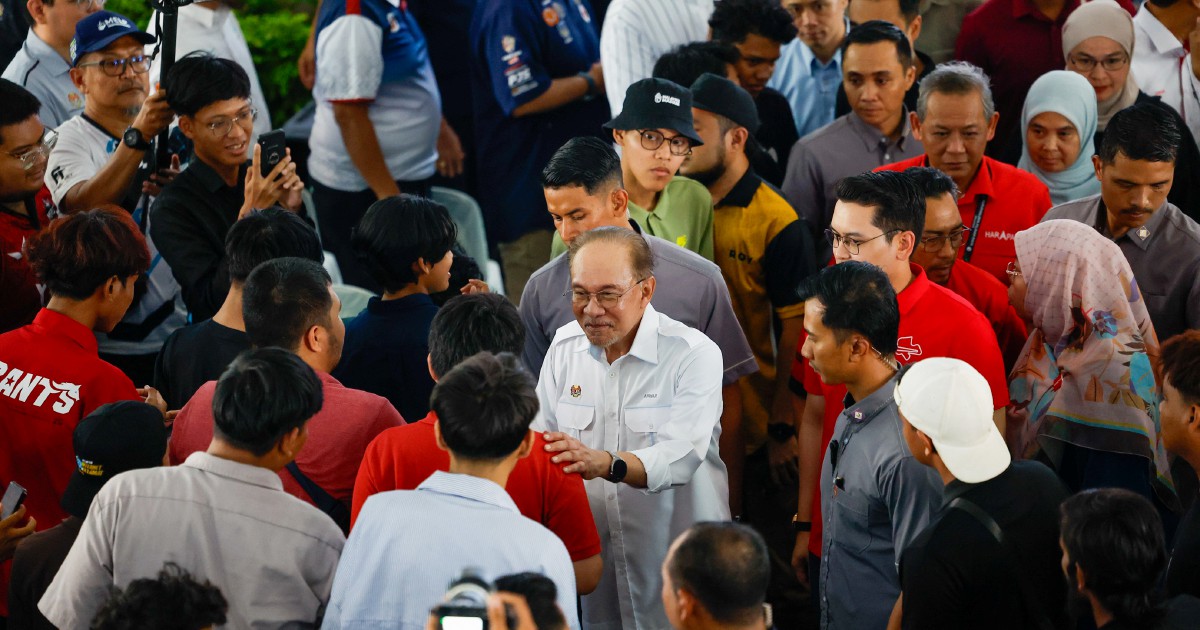
Prime Minister Datuk Seri Anwar Ibrahim has moved to redirect Pakatan Harapan's strategic focus in the final hours before the Negri Sembilan state election, cautioning the coalition's campaign machinery against becoming preoccupied with election forecasts and survey projections. Speaking in Port Dickson, Anwar emphasised that the remaining campaign period should be devoted to intensive ground-level activities rather than monitoring the various predictions circulating about likely electoral outcomes. His intervention reflects a pragmatic assessment of what actually influences voter behaviour in the critical final stretch of any election campaign.
This directive carries particular weight coming from Malaysia's top political leader, who heads the coalition government at the federal level. Anwar's message essentially reframes the coalition's priorities away from quantitative analysis and towards the human element of campaigning. By discouraging excessive reliance on survey data, the Prime Minister is signalling that the effectiveness of grassroots organising—doorstep conversations, community engagement, and mobilising the party faithful—ultimately matters more than statistical predictions about voting intentions. The distinction between these two approaches reflects a broader debate within political circles about whether election outcomes are primarily shaped by pre-existing voter sentiment, as surveys might suggest, or whether intensive late-stage campaigning can still move the needle.
For Pakatan Harapan, operating as a coalition spanning multiple parties and demographic constituencies, ground-level work takes on added significance. The coalition must coordinate messaging across its various components while maintaining distinct party identities, a balancing act that requires constant engagement with voters rather than remote analysis. Different communities within Negri Sembilan may respond to different messaging, and only continuous direct interaction with voters allows campaign teams to adjust their approach in real time. Surveys, by contrast, provide a snapshot rather than guidance for immediate tactical adjustments.
Anwar's emphasis on campaigning over polling also reflects awareness of how survey information can become demoralising to party activists if results appear unfavourable. When campaigns become fixated on tracking numbers, morale can fluctuate based on each new data point, potentially sapping the energy required for sustained grassroots effort. By explicitly downplaying the significance of survey projections, the Prime Minister is seeking to maintain campaign momentum and volunteer enthusiasm regardless of what opinion polls might be suggesting about PH's prospects in the state.
The Negri Sembilan election carries implications beyond the state itself for Malaysia's broader political landscape. As a state that has traditionally been competitive between major political blocs, the outcome will be watched closely as an indicator of shifting voter preferences and coalition performance. For Pakatan Harapan, maintaining or expanding support in traditionally mixed-leaning states like Negri Sembilan is crucial for demonstrating broader electoral viability. A strong showing would reinforce the coalition's claim to be the natural governing force at federal level, while a disappointing result could invite internal questioning about party discipline and campaign effectiveness.
The directive also underscores the importance of old-fashioned campaign mechanics that require human presence and organisation. In the age of social media and digital marketing, political campaigns can sometimes become overly reliant on online strategies and data analytics. Anwar's intervention represents a push back towards the fundamentals—getting volunteers on the ground, ensuring high voter turnout among party supporters, and maintaining visible party presence in key communities. These activities cannot be fully automated or reduced to algorithmic targeting; they require sustained human effort and coordination.
Pakatan Harapan's coalition structure itself demands this intensive local engagement. The coalition brings together parties that may have distinct voter bases and different messaging priorities. Without sustained ground-level coordination, these different components could work at cross-purposes or fail to turn out their respective supporters effectively. The Prime Minister's call for focused campaign work is essentially a call for tighter coalition discipline and coordination during the final crucial hours.
From a Southeast Asian perspective, Malaysia's approach to political campaigning—balancing quantitative data analysis with grassroots organising—reflects broader regional patterns. While election prediction and polling have become increasingly sophisticated across the region, ground-level political organising remains vital in many electoral contests. In Malaysia's context, where community networks, patron-client relationships, and local political structures still exert considerable influence over voting behaviour, the kind of intensive ground work Anwar is advocating continues to yield tangible results.
The Negri Sembilan contest also carries symbolic weight as a test of incumbent coalition performance. Pakatan Harapan has been in federal government, and voter expectations about state-level governance often reflect satisfaction or dissatisfaction with national performance. Ground campaigning provides an opportunity for PH activists to directly address voter concerns and connect local issues to the coalition's broader agenda. Surveys might indicate whether voters are satisfied or dissatisfied, but only direct engagement allows campaigners to explain their vision and potentially shift voter calculations.
Anwar's emphasis on execution over analysis also reflects his understanding of his own role as Prime Minister. His presence in Port Dickson for campaign activities demonstrates personal commitment to the Negri Sembilan election and sends a signal about the importance of state-level contests for federal coalition politics. When the nation's top leader is actively campaigning on the ground rather than simply issuing strategic directives, it reinforces the message that winning votes requires sustained effort and engagement. The implicit message to PH activists is clear: if the Prime Minister is investing his time in ground-level campaigning, so must everyone else in the party machinery.

