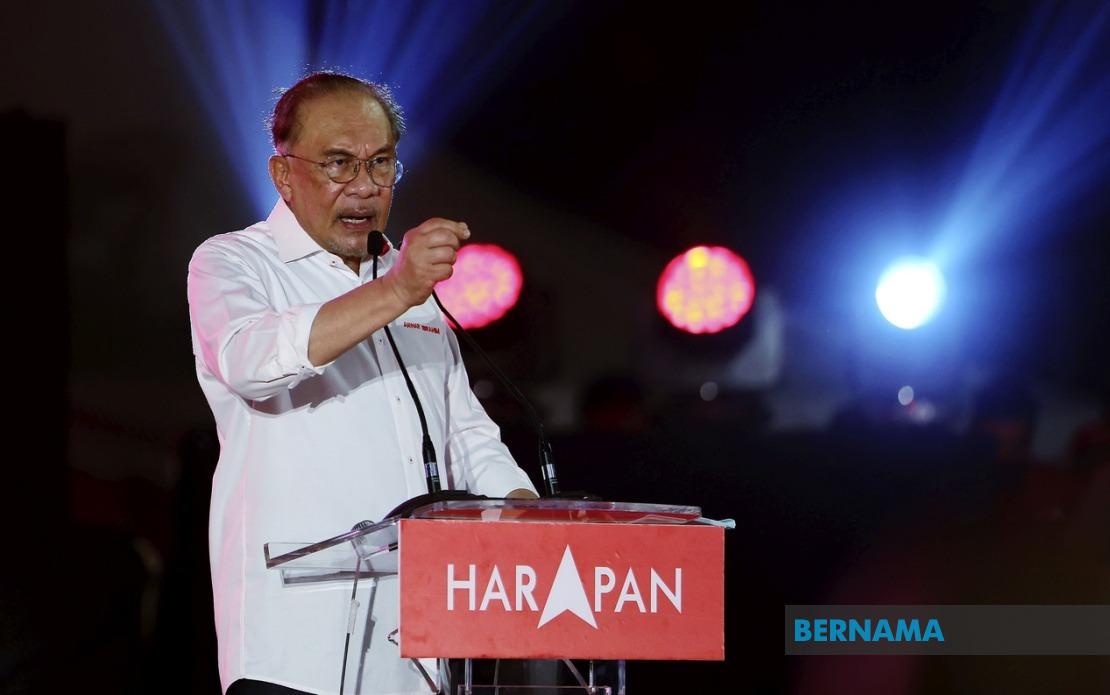
Prime Minister Datuk Seri Anwar Ibrahim has delivered a forceful message to political parties involved in the forthcoming 16th Negeri Sembilan State Election, instructing them to exercise restraint when discussing matters involving the monarchy and constitutional foundations. Speaking at the Pakatan Harapan candidate announcement ceremony in Kuala Pilah on July 14, the PH chairman drew a clear distinction between vigorous political debate and tactics that risk destabilising national institutions.
Anwar's intervention reflects growing concerns within the federal government about campaign conduct at the state level. While acknowledging that political competition constitutes a fundamental element of democratic governance, he stressed that such contests must operate within boundaries that protect institutional integrity. His remarks suggest an awareness that state elections can occasionally become vehicles for testing divisive messaging strategies that might undermine respect for constitutionally protected institutions, including the royalty system that remains central to Malaysia's political identity.
The Prime Minister articulated a vision of political engagement where opposing viewpoints coexist without descending into character assassination or community-fragmenting rhetoric. This framing positions PH as the custodian of responsible governance, a strategic positioning that seeks to distinguish coalition campaigns from competitors who might resort to more inflammatory tactics. By elevating the discourse around institutional protection, Anwar attempted to set parameters that would limit certain attack lines while maintaining room for substantive policy disagreement.
Anwar's confidence in incumbent Menteri Besar Datuk Seri Aminuddin Harun underscores PH's investment in maintaining state-level control. Characterising Aminuddin as cooperative and effective, the Prime Minister signalled that continuity with the current administration would serve Negeri Sembilan's development interests. This endorsement carries weight given Anwar's position as federal leader and suggests coordination between state and federal PH machinery to present a unified front to voters.
The candidate slate announced at the ceremony comprised 36 contenders representing a deliberate blend of institutional experience and fresh political blood. The inclusion of DAP secretary-general Anthony Loke contesting the Chennah state seat alongside Aminuddin's re-nomination for Linggi demonstrates how PH component parties—PKR, DAP, and Amanah—are distributing electoral opportunities across the coalition. This distribution mechanism reflects ongoing negotiations within the broader PH structure regarding resource allocation and representation priorities.
Presence of senior coalition figures at the event, including Amanah president Datuk Seri Mohamad Sabu, PH Communications Director Datuk Seri Fahmi Fadzil, and PH Election director Datuk Seri Amirudin Shari, underscored the significance PH attaches to this state contest. Their attendance signalled organisational commitment and helped amplify messaging around responsible political conduct. Such gatherings serve multiple functions simultaneously: they facilitate candidate selection validation, demonstrate coalition cohesion to party members, and project unified messaging to the broader electorate.
For Malaysian voters, particularly those in Negeri Sembilan, Anwar's intervention raises important questions about campaign expectations in the contemporary political landscape. The explicit warning against institutional criticism reflects anxieties that electoral competition might escalate into challenges against constitutional arrangements and the monarchy—territories that remain politically sensitive in Malaysia's federal system. By preemptively establishing this boundary, the federal leadership sought to shape the permissible parameters of state-level political discourse.
The emphasis on clean leadership and integrity speaks to broader concerns about governance quality that resonate beyond Negeri Sembilan's borders. Malaysians across the country have witnessed multiple state elections since PH's 2018 comeback, with varying results regarding both the quality of political engagement and the durability of coalition partnerships. Negeri Sembilan therefore becomes a test case for whether PH can simultaneously pursue ambitious development agendas while maintaining elevated standards of political conduct.
Anwar's assertion that Negeri Sembilan must not be left behind in national development represents an implicit contrast with potential opposition-led governance, which might distance the state from federal resources and priorities. This framing suggests that state election outcomes carry implications for access to development funding and infrastructure projects—a calculation that shapes voter cost-benefit analyses. The inter-dependency between state and federal administrations, particularly when the same coalition controls both levels, creates incentive structures that Anwar sought to emphasize.
The broader context of coalition politics in Malaysia illuminates why these institutional boundaries matter. PH comprises parties with different constituencies, ideological emphases, and regional bases. DAP's predominantly non-Muslim composition contrasts with PKR and Amanah's Malay-Muslim membership, creating natural tensions around how aggressively to challenge traditional power structures. By establishing protective guardrails around royal institutions and constitutional matters, Anwar sought to maintain coalition cohesion while allowing component parties sufficient latitude for their respective political strategies.
For Southeast Asian observers monitoring Malaysian political developments, this intervention exemplifies how established democracies navigate tensions between institutional stability and democratic contestation. Unlike some regional peers where electoral competition has destabilised foundational institutions, Malaysia's major political players have generally maintained red lines protecting the constitutional monarchy. Anwar's reaffirmation of these boundaries suggests they retain force even amid competitive elections, though enforcement mechanisms remain primarily organizational rather than legal.
Looking forward, the Negeri Sembilan election outcome will indicate whether PH's emphasis on institutional restraint resonates with voters or whether opposition forces mobilise alternative constituencies by challenging these implicit agreements. The state's electoral trajectory also carries implications for federal coalition stability, as disappointing results could trigger internal recriminations regarding campaign strategy and candidate selection. Conversely, a commanding victory would validate both Anwar's leadership approach and his assertion that responsible political conduct and electoral success remain compatible objectives.

