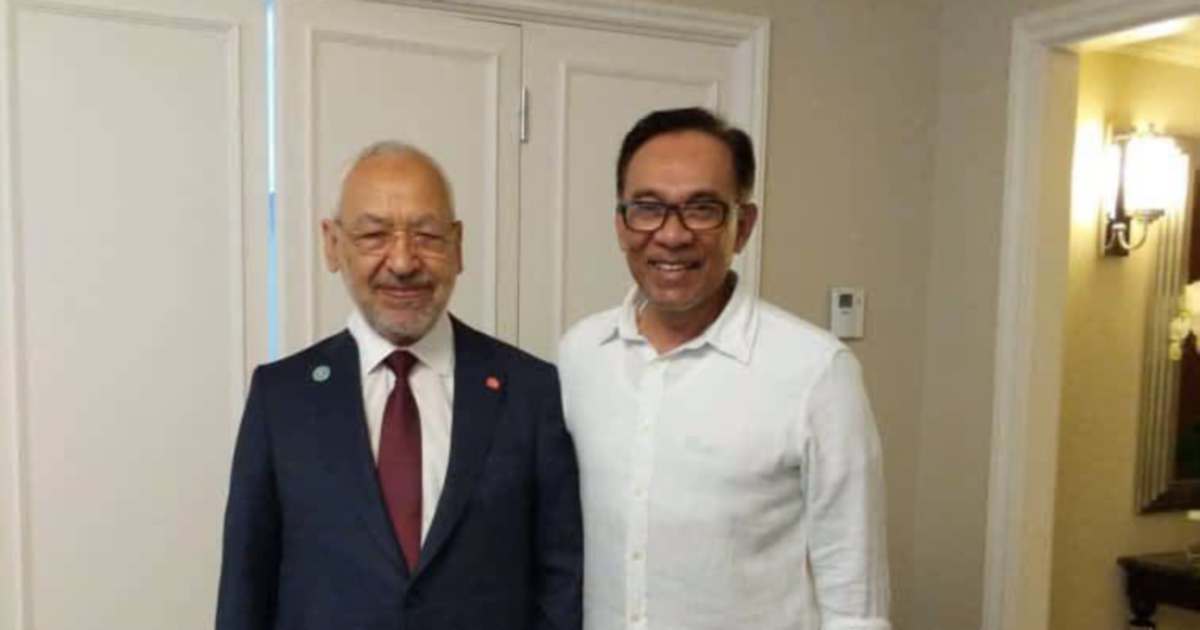
Prime Minister Datuk Seri Anwar Ibrahim has moved to intervene in a sensitive political matter affecting North Africa, dispatching a formal letter to Tunisian President Kais Saied that appeals for the freedom of prominent political figure Sheikh Rached Ghannouchi on humanitarian grounds. The Malaysian leader's diplomatic overture reflects the broader engagement that Southeast Asian nations maintain with Mediterranean and Middle Eastern political developments, particularly where human rights considerations intersect with geopolitical relationships.
Ghannouchi, a long-standing figure in Tunisian political circles, has faced detention during a period of significant constitutional and political upheaval in Tunisia. The appeal from Malaysia's top government official underscores how questions of political imprisonment and civil liberties resonate across Muslim-majority nations and developing democracies seeking to balance governance structures with human rights commitments. By raising the matter directly with President Saied, Anwar is positioning Malaysia as a voice advocating for humanitarian considerations within an Islamic world that increasingly grapples with tensions between state authority and individual freedoms.
The timing of such an appeal carries weight within the context of Malaysia's own democratic experience and constitutional framework. Anwar, who himself endured imprisonment during Malaysia's political turbulence in the late 1990s and early 2000s, brings personal credibility to advocacy for prisoners' rights and judicial fairness. His background has consistently shaped Malaysia's stance on international human rights matters, and his willingness to engage directly with foreign governments on detention cases reflects a commitment to principles he has championed throughout his political career.
Tunisia's political trajectory since 2021 has remained contested, with President Saied implementing constitutional amendments and consolidating executive authority amid considerable controversy. Ghannouchi's detention must be understood within this turbulent landscape, where the boundaries between legitimate security concerns and political suppression have become increasingly blurred in public discourse. The detention has sparked concerns among international observers and civil society organizations monitoring democratic backsliding in the region.
For Malaysia, maintaining diplomatic channels with Tunisia on such matters serves multiple purposes. It demonstrates Malaysia's commitment to universal human rights principles while avoiding confrontational rhetoric that might damage bilateral relations. The approach taken by Anwar—personal correspondence rather than public statements or international pressure campaigns—reflects a sophisticated diplomatic strategy that seeks to persuade without alienating, a methodology often employed when addressing sensitive internal affairs of other nations.
The Malaysian government's intervention also resonates with regional concerns about political stability and democratic governance across the Islamic world. As Southeast Asia itself navigates questions about balancing national security with civil liberties, Malaysia's advocacy for Ghannouchi's release illustrates how peer nations with shared Islamic heritage and development challenges increasingly look to one another for support on governance questions. This quiet diplomacy represents the kind of engagement that can maintain dialogue channels even when bilateral relationships face other pressures or disagreements.
Ghannouchi's status as a religious scholar and political leader adds additional complexity to his case. His prominence within Tunisian Islamist political movements has made him alternately a unifying figure and a controversial one, depending on which constituencies and ideological perspectives one examines. The humanitarian appeal from Anwar focuses on the detention itself rather than adjudicating Ghannouchi's political positions or organizational affiliations, a careful distinction that allows Malaysia to advocate for fair treatment without appearing to endorse particular political movements.
The letter represents part of a broader pattern whereby Malaysia increasingly engages in direct diplomatic advocacy on human rights matters affecting other nations, particularly those where Islamic or Southeast Asian interests intersect. This approach differs markedly from remaining silent on international affairs or limiting engagement to bilateral economic and strategic issues. By actively raising humanitarian concerns, Anwar's administration signals that Malaysia sees itself as a stakeholder in broader regional outcomes concerning governance, justice, and human dignity.
For observers monitoring North African developments and Tunisia's political future, Malaysia's intervention serves as a reminder that smaller and mid-sized nations outside the immediate region maintain genuine interests in how major political questions resolve themselves. Tunisia's democratic experiment since its 2011 uprising has faced mounting challenges, and the treatment of detained political figures inevitably affects international perceptions of judicial independence and governmental legitimacy. Anwar's appeal thus contributes to a broader conversation about accountability and standards that extend beyond Tunisia itself.
The humanitarian framework deployed in Anwar's appeal also reflects evolving international practice regarding political detentions. Rather than framing the issue through legalistic or purely political lenses, the appeal emphasizes the personal and human dimensions of imprisonment, an approach that can sometimes prove more persuasive to leaders considering their international standing and domestic legitimacy. By centering humanitarian concerns, the Malaysian Prime Minister creates space for resolution that serves all parties' interests without requiring public concessions on contested political positions.

