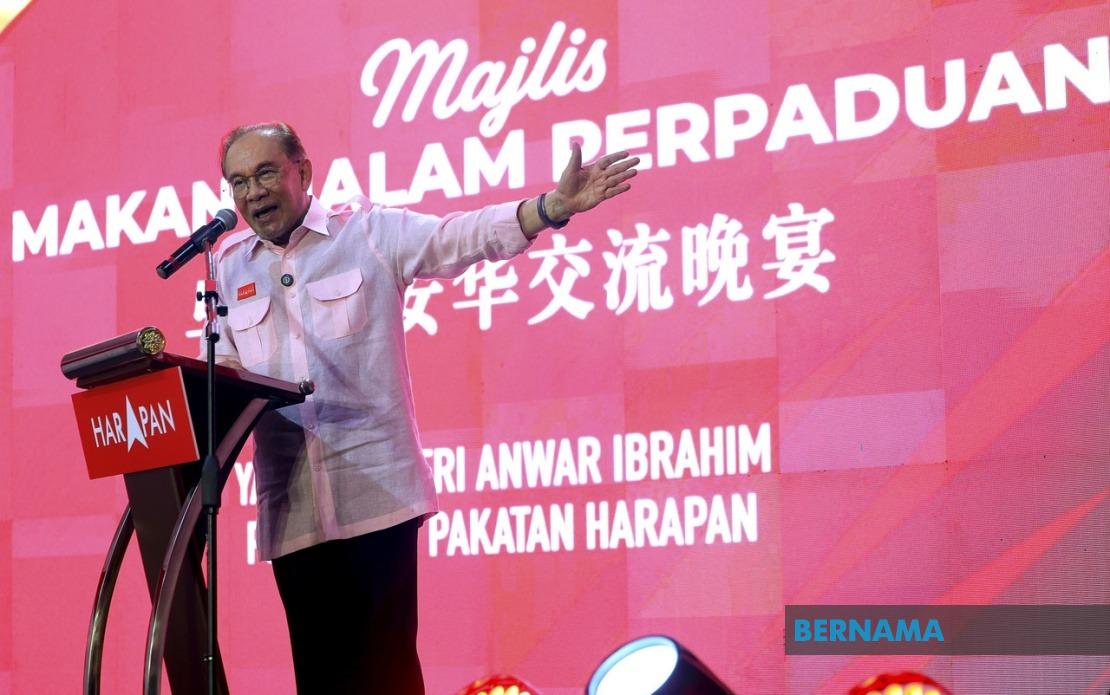
Prime Minister Datuk Seri Anwar Ibrahim has turned his focus to the internal fissures within opposition ranks as campaigning intensifies in Negeri Sembilan, arguing that rival parties are more preoccupied with jostling for the chief minister's position than with genuine governance. Speaking at a PH event in Sikamat on July 22, the Pakatan Harapan chairman drew a stark contrast between what he characterised as opposition infighting and his coalition's commitment to stability and public service. His remarks highlight a strategic messaging angle that opposition fragmentation—particularly the scramble for top positions before votes are even cast—undermines their credibility to manage the state effectively.
Anwar's criticism carries particular weight in the context of Malaysian state elections, where internal power contests among coalition partners or rival factions frequently undermine campaign momentum and voter confidence. The opposition's apparent eagerness to position individuals for the menteri besar role, even before election outcomes are determined, presents a vulnerability that the Unity Government has seized upon. This pre-election jockeying, Anwar suggested, signals that opposition priorities are misaligned with what voters should prioritise: competent administration, transparent governance, and consistent service delivery. The implication is that parties consumed by internal leadership competitions lack the cohesion and focus necessary to deliver meaningful results.
The Pakatan Harapan leader deliberately framed the election choice as fundamentally about capability and proven performance. Rather than engaging in abstract policy debates or matching campaign promises, Anwar anchored his argument to tangible outcomes and leadership track records. He appealed to voters to resist the temptation to gamble on opposition parties mired in internal disputes, instead placing their trust in PH figures whose administrative credentials are established and verifiable. This approach reflects a shift in PH's campaign messaging from ideological distinctions to performance-based governance metrics.
Central to Anwar's argument is Negeri Sembilan Menteri Besar Datuk Seri Aminuddin Harun's stewardship of the state administration. Aminuddin, who is contesting the Linggi seat under the PH banner, has been positioned as the embodiment of the coalition's governance philosophy. Anwar specifically highlighted Aminuddin's integrity record and the absence of corruption or abuse-of-power allegations during his tenure—a deliberate contrast to the scandals and governance failures that have plagued several Malaysian states under other administrations. By urging voters to retain Aminuddin, PH seeks to convert administrative continuity into an electoral advantage, particularly among voters prioritising stability over change.
Parallel to his performance-focused messaging, Anwar also confronted the polarising rhetoric that has characterised the campaign. He explicitly criticised opposition quarters for deploying racial narratives to mobilise support, a reference to the sectarian campaign strategies that have become increasingly prevalent in recent Malaysian elections. This criticism represents an attempt to reclaim the moral high ground on inclusive governance, an area where PH has historically positioned itself. By highlighting opposition resort to racial framing, Anwar implies that the opposition lacks substantive policy arguments and must therefore resort to divisive tactics. The Unity Government's counter-narrative emphasises equitable assistance across all demographic groups, regardless of ethnicity.
The socio-economic measures that Anwar cited—increased welfare allocations, housing programmes, and civil service salary adjustments—function as tangible evidence of the Unity Government's commitment to inclusive policymaking. These initiatives are designed to resonate across different voter constituencies by demonstrating that PH's inclusive rhetoric translates into concrete benefits. For Malaysian voters weighing their options, such programmes represent measurable governance outcomes rather than mere campaign promises. The framing positions PH as delivering material improvements to citizens' lives across community lines, contrasting sharply with the opposition's apparent preoccupation with internal power allocation.
The Negeri Sembilan state election takes on particular significance within Malaysia's broader political landscape. As a state where PH currently holds the chief minister's position, the election functions as a referendum on the coalition's state-level governance record. A PH victory would reinforce the coalition's narrative of having earned voter trust through demonstrated administrative competence. Conversely, an opposition breakthrough would signal erosion of the Unity Government's support base. For this reason, PH's campaign messaging has concentrated on comparative advantage rather than abstract ideological appeals, betting that voters will reward proven performance over untested alternatives.
The composition of PH's electoral slate reflects an attempt to balance representation and competence. With PKR fielding 16 candidates, DAP 11, and Amanah nine across all 36 state seats, the coalition has negotiated internal power-sharing arrangements that presumably reflect each party's electoral strength and geographical presence. This internal discipline contrasts with opposition dynamics, which Anwar has suggested are characterised by unresolved leadership contests. The ability to field a unified candidate slate without visible acrimony itself becomes a campaign asset, signalling organisational coherence to voters.
The early voting process scheduled for July 28, preceding the main polling date of August 1, provides momentum for mobilisation efforts during the final campaign week. PH operatives have used events like the Perpaduan Dinner to consolidate support among party faithful and sympathetic voters while emphasising the stakes of the election. Anwar's attendance at such events, alongside sitting state leadership and candidate representatives, visually reinforces the coalition's organisational solidarity and forward momentum.
For Malaysian voters beyond Negeri Sembilan, the state election offers insights into the broader health of the Unity Government and the viability of coalition governance at subnational levels. The opposition's apparent internal divisions, as characterised by Anwar, raise questions about its capacity to present a credible alternative administration. Meanwhile, PH's focus on comparative governance credentials rather than opposition attacks suggests confidence in the tangible track record it can invoke. The August 1 results will test whether Malaysian voters prioritise stability and proven performance or whether appetite for political change outweighs confidence in the incumbent coalition's administration.

