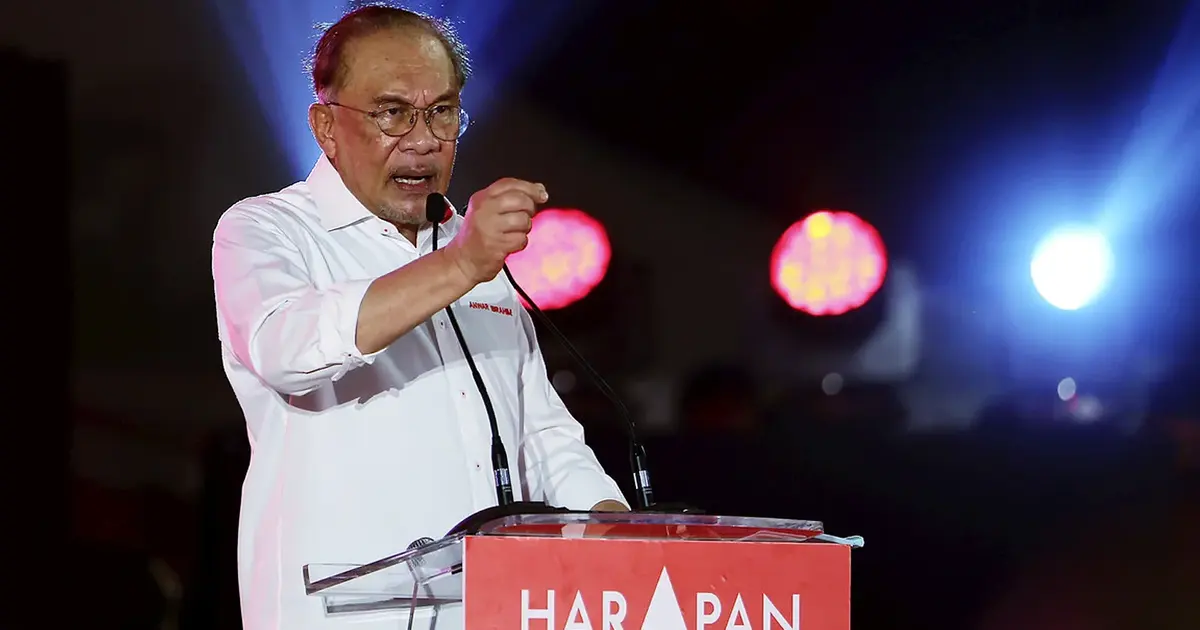
Prime Minister Anwar Ibrahim has issued a direct warning to contending political parties to refrain from using Negeri Sembilan's royal institution as a campaign tool during the upcoming state election, underlining the need to preserve the sanctity of the monarchy in electoral discourse.
As chairman of Pakatan Harapan, Anwar emphasised that matters relating to the state's royal establishment should remain insulated from partisan politics and campaign rhetoric. His intervention reflects broader concerns about maintaining constitutional boundaries between the monarchy and the electoral process, a sensitive issue in Malaysia's political landscape where the institution of rulers carries significant cultural and constitutional weight.
The timing of Anwar's statement signals potential friction within or between coalition parties over campaign tactics in Negeri Sembilan. State elections invariably attract intense political competition, and historical precedent shows that parties sometimes dance dangerously close to controversies involving royal prerogatives or decisions. By issuing this cautionary note early in the campaign cycle, the Prime Minister appears determined to establish clear red lines before contested rhetoric can gain traction.
Negeri Sembilan, one of Malaysia's smaller states, maintains a unique constitutional arrangement centred on its Yang di-Pertuan Besar and the system of Undang governance. The state's electoral contest carries implications beyond its borders, particularly because coalition performance in state elections influences perceptions of federal government stability and party strength heading into future general elections. A contentious campaign could damage both coalition unity and public confidence in the fairness of electoral contests.
Anwar's position reflects the delicate balance Malaysian political leaders must maintain when addressing royal matters. The monarchy occupies a constitutionally protected position, and the Sedition Act and other legislation establish legal boundaries around public discourse concerning rulers. When politicians invoke royal issues during campaigns, they risk not only constitutional impropriety but also accusations of attempting to deploy sensitive cultural touchstones for narrow partisan advantage. Such tactics, if deployed, could alienate large segments of the electorate who view attacks on or misuse of royal issues as fundamentally disrespectful.
The admonition also reveals something about current political dynamics within the coalition itself. By publicly staking out this position, Anwar effectively sets expectations for all Pakatan Harapan component parties—whether Amanah, DAP, PKR, or allied groups—while simultaneously signalling to opposition parties, including Perikatan Nasional and Barisan Nasional, that such tactics will be viewed unfavourably. This preemptive framing gives the ruling coalition a platform advantage should opposition parties venture into contested territory regarding royal matters.
For Malaysian voters and the broader Southeast Asian audience observing Malaysian politics, this intervention underscores how even in a functioning democracy, certain institutions remain conceptually separate from normal political contestation. Unlike in many Western democracies where monarchs are directly involved in politics or where their actions can become campaign fodder, the Malaysian system carefully constructs the monarchy as above the fray. Anwar's warning reinforces this boundary precisely because electoral pressure creates temptation to breach it.
The statement also carries practical implications for campaign managers and candidates contesting Negeri Sembilan seats. Ground-level political operatives, social media influencers, and grassroots campaigners now understand that posts, speeches, or statements that question, challenge, or politicise the state's royal establishment will be viewed as operating outside acceptable bounds. This constraint may affect how freely some parties can develop their campaign narratives, potentially limiting their rhetorical options.
Historically, controversies involving state rulers have occasionally erupted during electoral campaigns in Malaysia, sometimes leading to legal consequences for politicians who overstepped. By intervening at this juncture, Anwar attempts to prevent such recurrence in Negeri Sembilan, protecting both the electoral process and the monarchy from unnecessary friction. The move demonstrates political maturity and recognition that democracy functions more smoothly when all participants respect constitutional limits.
The warning also reflects international observation of Malaysian political practices. Global democracies increasingly scrutinise how developing nations balance electoral competition with institutional stability. By emphasising the need to keep royal matters depoliticised, Anwar projects an image of a government committed to constitutional governance even during contested electoral periods. This messaging matters for investor confidence, international relations, and Malaysia's standing as a functioning democracy in a region where democratic norms sometimes face pressure.
Moving forward, observers should monitor whether all parties heed this guidance during the Negeri Sembilan campaign. Compliance will indicate healthy respect for constitutional boundaries across the political spectrum; violations would suggest that partisan ambition overrides commitment to institutional propriety. The Prime Minister's clear statement establishes a benchmark against which the conduct of all competing parties can be measured, ultimately serving the broader interests of democratic governance in Malaysia.

