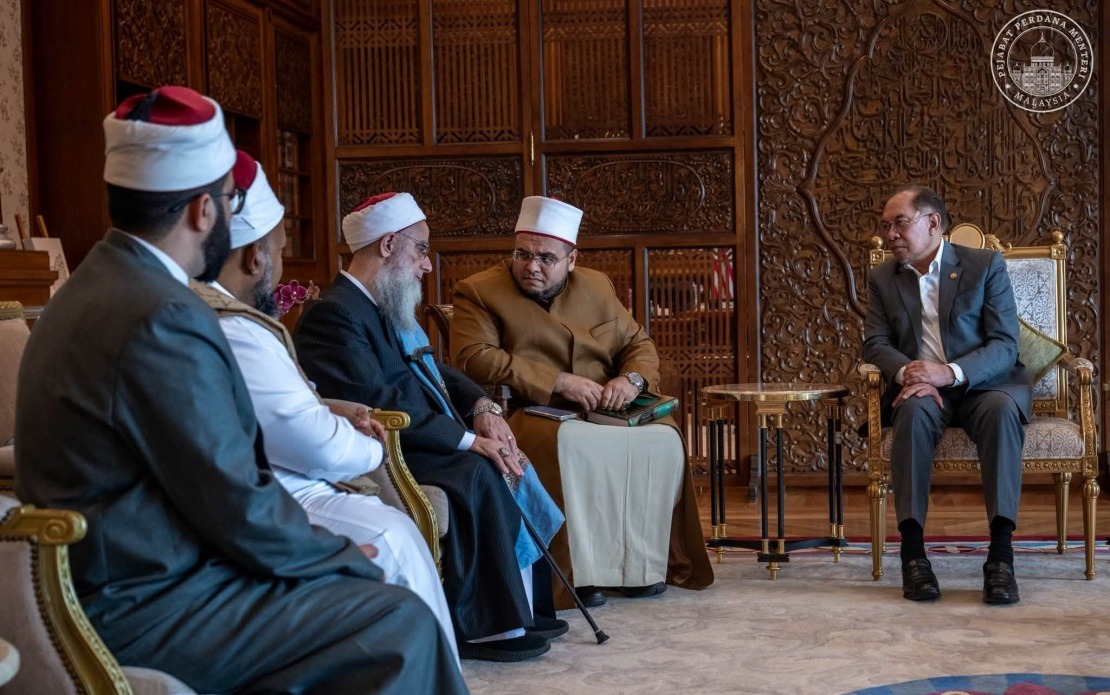
Prime Minister Datuk Seri Anwar Ibrahim received a visit from renowned Egyptian Islamic scholar Sheikh Dr Mustafa An-Nadwi Al-Hasani Mansurah at his Putrajaya office on July 20, underscoring Malaysia's continued engagement with prominent figures in the Islamic intellectual world. The meeting reflects the government's emphasis on fostering dialogue with respected international scholars and thinkers who contribute meaningfully to Islamic discourse.
In marking the occasion through a Facebook post, Anwar characterised Sheikh Dr Mustafa as a distinguished authority whose work emphasises moral values, scholarly depth and rigorous hadith studies. The Prime Minister's public acknowledgement of the visitor signals the administration's priority in elevating intellectual and spiritual discourse at a time when Malaysia seeks to position itself as a centre for moderate Islamic thought and learning.
Sheikh Dr Mustafa traces his scholarly lineage to the late Sheikh Abul Hasan Ali al-Nadwi, a globally recognised Islamic scholar and preacher whose influence shaped generations of Muslim intellectuals across Asia and the Middle East. This connection is particularly significant for Malaysia, which has long valued the intellectual contributions of al-Nadwi's circle and the broader movement emphasising balanced, knowledge-centred approaches to Islamic practice and understanding.
Anwar's remarks during the meeting highlighted a philosophical stance that resonates with Malaysia's broader educational and social objectives. He noted that in an era when sensationalism frequently dominates discourse, scholars like Sheikh Dr Mustafa embody an alternative approach rooted in contemplative learning and genuine wisdom. The Prime Minister employed evocative language, describing knowledge and wisdom as arriving like morning dew—subtle yet profoundly life-giving—to underscore the transformative power of genuine scholarship.
The timing of this visit occurs amid Malaysia's ongoing efforts to strengthen intellectual ties with key Islamic centres of learning globally. Egyptian universities and scholars have historically played a pivotal role in Islamic education, and visits by prominent figures from Cairo and Mansurah offer opportunities for Malaysia to reinforce its commitment to maintaining dialogue with traditional seats of Islamic learning while navigating contemporary challenges.
During their discussions, Anwar and Sheikh Dr Mustafa exchanged perspectives on current international and regional affairs, reflecting the mutual interest both parties hold in understanding how classical Islamic principles can inform responses to modern geopolitical developments. Such dialogues are increasingly important for Malaysia as it navigates complex regional dynamics in Southeast Asia while maintaining strong ties with the broader Muslim world.
Beyond bilateral engagement, Sheikh Dr Mustafa's presence in Malaysia this week included knowledge sessions and lectures that would have provided Malaysian audiences with direct access to his scholarly insights. These teaching opportunities represent valuable intellectual exchanges that benefit local religious scholars, students and community leaders seeking to deepen their understanding of Islamic studies from a respected international perspective.
Anwar's expression of gratitude for Sheikh Dr Mustafa's prayers for Malaysia's unity and prosperity carries symbolic weight in the Malaysian political context. The invocation of blessings for national cohesion reflects the government's framing of Islamic scholarship as a force supporting social harmony and multicultural coexistence—themes central to Malaysia's national identity narrative.
The Prime Minister's concluding remarks, which prayed for Sheikh Dr Mustafa's continued wellbeing and his capacity to guide communities with wisdom, moderation and compassion, encapsulate values that have become hallmarks of Malaysia's own approach to Islamic governance and interfaith relations. The emphasis on moderation particularly resonates with Malaysia's positioning as an advocate for balanced Islamic practice within ASEAN and the global South.
This diplomatic engagement illustrates how Malaysia continues to leverage relationships with international Islamic intellectuals to reinforce its soft power and cultural influence. By welcoming scholars of Sheikh Dr Mustafa's standing, Anwar's administration signals to both domestic and international audiences that Malaysia remains a welcoming destination for serious Islamic intellectual discourse, even as it maintains pragmatic engagement with global affairs.
For the broader Southeast Asian region, such visits demonstrate Malaysia's role as a bridge between classical Islamic scholarship centred in the Middle East and the evolving needs of Muslim communities in Asia. The meeting underscores that despite geopolitical shifts and economic pressures, the transmission of Islamic knowledge remains valued as a binding element among Muslim-majority nations and as a foundation for regional cooperation.

