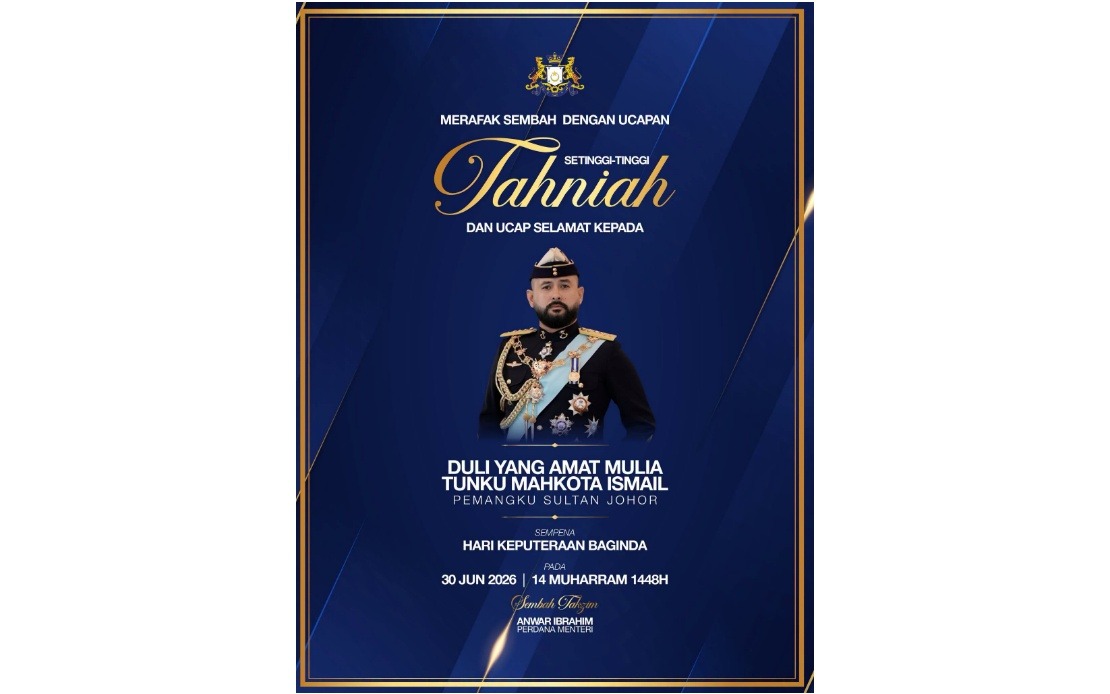
Malaysia's top political leaders have marked the birthday of the Johor Regent with formal messages of celebration and goodwill. Prime Minister Datuk Seri Anwar Ibrahim publicly extended his congratulations to Tunku Mahkota Ismail through a Facebook post on June 30, accompanying the gesture with prayers for the royal's sustained good health, personal well-being, and continued divine favour.
The tradition of senior government figures acknowledging significant royal occasions underscores the constitutional importance of Malaysia's monarchy within the nation's political framework. Such public recognitions serve multiple purposes beyond ceremonial courtesy: they reinforce the bonds between the executive branch and the institution of kingship, which remain integral to Malaysia's constitutional monarchy system. For the Prime Minister to explicitly invoke blessings upon the Regent reflects both personal respect and constitutional obligation, elements deeply embedded in Malaysian governance culture.
Deputy Prime Minister Datuk Seri Dr Ahmad Zahid Hamidi similarly participated in the observance, offering his own prayers and well-wishes through social media. His message specifically invoked divine blessings for the Regent's enduring good health, asking for Allah SWT's continued protection and mercy over the royal figure. Zahid's remarks extended further to acknowledge the Regent's role in governing Johor Darul Ta'zim and serving the Johor people, demonstrating awareness of the constitutional and administrative responsibilities vested in the position.
The Johor Regency holds particular significance within Malaysia's federal structure. Johor, as the nation's second-largest state by population and a major economic engine, occupies a prominent position in both political and economic spheres. The Regent's authority encompasses not only ceremonial functions but also substantial administrative and advisory roles within the state government, making the position considerably more substantive than purely symbolic titles found elsewhere in the region.
Tunku Mahkota Ismail has become an increasingly visible figure in contemporary Malaysian public life, appearing at official functions, cultural events, and state ceremonies. His modernised approach to royal duties, combined with regular public engagement through social media, has contributed to strengthening the monarchy's relevance among younger generations who may have limited exposure to traditional royal pageantry. This contemporary style of institutional leadership contrasts with more formal approaches of previous decades, reflecting broader shifts in how Malaysia's traditional institutions adapt to changing social expectations.
The exchange of birthday greetings between federal political leadership and royal figures represents a critical ceremonial component of Malaysia's governmental balance. The Prime Minister and Deputy Prime Minister occupy the nation's two highest executive positions, yet both acknowledge their constitutional subordination to the Yang di-Pertuan Agong and, within their respective states, to the royal rulers. These public acts of deference and respect, however formulaic they may appear, reinforce the legitimacy of Malaysia's constitutional settlement and the proper ordering of power relationships.
Johor's political significance has intensified in recent years, particularly given the state's economic importance and its strategic location adjacent to Singapore. The state government's initiatives in infrastructure development, particularly mega-projects and economic zones, have drawn national attention. The Regent's blessing therefore carries implications not merely for ceremonial propriety but for the state's governance trajectory and its relationship with federal authorities under Anwar Ibrahim's leadership.
The Facebook medium through which these greetings were conveyed merits consideration. Political leaders across Malaysia increasingly employ social media platforms to communicate directly with citizens, bypassing traditional media filters. This democratisation of political communication has reshaped how Malaysian public figures engage with constituencies and conduct diplomatic courtesy with institutions. The choice to post birthday wishes on Facebook rather than through formal state ceremonies or press releases reflects contemporary political communication norms that blend formality with accessibility.
Both the Prime Minister and Deputy Prime Minister framed their messages within explicitly Islamic religious language, invoking Allah SWT's blessings and mercy. This religious framing is standard practice among Malaysian political leaders of all backgrounds and reflects the nation's constitutional position as an Islamic state. Such language carries weight beyond mere piety; it signals respect for religious dimensions of governance and demonstrates cultural competence among federal leaders engaging with matters of state ritual.

