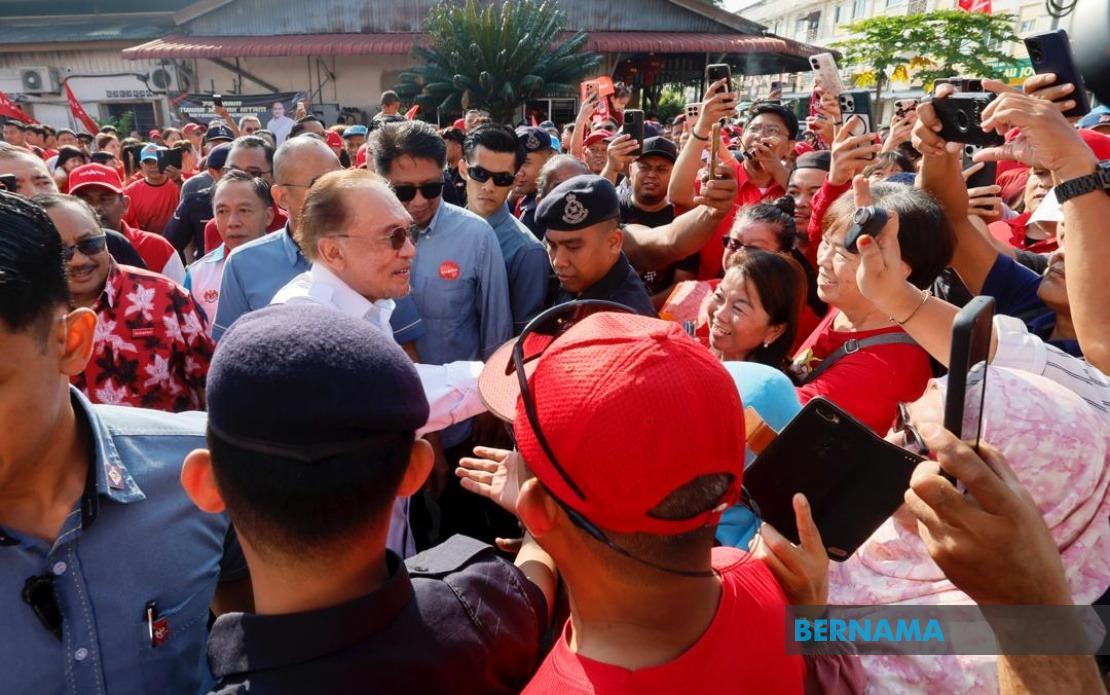
Prime Minister Datuk Seri Anwar Ibrahim's visit to Johor on the ninth day of the state election campaign has injected fresh momentum into Pakatan Harapan's electoral machinery, particularly in the closely contested Machap and Layang-Layang state constituencies. The intervention by the PH chairman and PKR president comes at a crucial juncture, with voting scheduled for July 11, as the coalition works to consolidate support across different demographic groups in what is shaping up to be a significant test of the ruling coalition's political standing at the state level.
Nur Hafiz Roslan, fielded as the PH standard-bearer for Machap, underscored the psychological impact of the Prime Minister's presence on campaign volunteers and candidates alike. Beyond the morale-lifting aspect of a high-profile visit, Anwar's engagement conveyed substantive messaging centred on public service rather than partisan conflict. The Prime Minister's emphasis on performing righteous deeds and prioritising community welfare over factional interests appears designed to reposition PH's campaign narrative away from divisive political messaging and towards populist governance pledges.
During his interaction with campaign teams in the Simpang Renggam parliamentary constituency—which encompasses both state seats—Anwar reinforced the principle that the coalition's presence in these communities should be understood primarily through a development and welfare lens rather than as a zero-sum power struggle. This framing carries particular significance in Johor, a state historically dominated by Barisan Nasional, where PH's electoral foothold remains fragile. By emphasising inclusive service delivery and accessibility, the party leadership seeks to address voter hesitancy stemming from questions about PH's capacity to govern effectively at the state level.
Guna Balakrishnan, competing for the Layang-Layang seat under the PH banner, reported receiving a direct charge from the Prime Minister to deliver tangible development outcomes should he secure the mandate. This personalised accountability messaging serves a dual purpose: it signals to voters that state representatives will be answerable to national leadership for performance metrics, while simultaneously granting candidates explicit license to pursue localist development agendas without central party micromanagement. Such delegation of responsibility has become increasingly important as PH attempts to establish credibility as a governing force capable of delivering at multiple administrative tiers.
The grassroots engagement format—branded as 'PMX Santai Sarapan Bersama Masyarakat' (a casual breakfast with the community)—represents a deliberate strategic choice in campaign choreography. Rather than formal rallies dominated by speeches, the emphasis on informal, approachable interaction aims to humanise leadership and create opportunities for direct citizen engagement. The mobilisation of over 1,000 residents to the Simpang Renggam event suggests that PH's ground organisation in these constituencies remains relatively robust, though the true test will emerge when actual voting patterns are tallied.
Among attendees, the visit appeared to generate tangible shifts in electoral intention. Chuan Chee Mei, a 48-year-old resident, articulated how the Prime Minister's visible support for candidates and his willingness to engage informally with ordinary constituents bolstered her confidence in backing PH nominees. This testimonial captures an important dynamic in Malaysian electoral politics: personal voter assessments of leadership character and approachability frequently outweigh policy platforms in determining voting behaviour, particularly in state elections where issues tend to remain diffuse and locally grounded.
Noor Takiyudin Salleh's observation about the magnitude of the crowd and the accessibility of the Prime Minister's demeanour reflects the communication objective underlying such campaign visits. By demonstrating that the national leadership takes these constituencies seriously enough to visit during active campaigning, and by doing so in a relaxed, populist manner rather than through distant pronouncements, PH attempts to counter any perception that state-level politics represents a secondary priority for the federal government. In competitive constituencies, such signalling can prove decisive among swing voters uncertain whether a particular candidate will have meaningful political weight and resources behind them.
The Johor state election presents a particularly significant battleground for Pakatan Harapan's broader political trajectory. With 172 candidates contesting 56 state assembly seats, the contest involves substantial redistribution of political representation. For PH, a coalition that relied heavily on Johor's contributions to achieve federal office in previous cycles, maintaining electoral competitiveness in the state remains strategically essential. A significant setback in Johor would undermine narratives about PH's popularity and could embolden Barisan Nasional-aligned forces to adopt more confrontational approaches toward the federal government.
The concentration of high-level campaigning in constituencies like Machap and Layang-Layang, which appear to rank among PH's marginal holdings or contested territories, reflects sophisticated targeting of campaign resources. Rather than dispersing effort across all 56 seats, the Prime Minister's intervention focuses on seats where the electoral calculus remains genuinely uncertain and where top-level advocacy might shift probabilities meaningfully. This resource allocation suggests PH's internal polling identifies these constituencies as winnable but vulnerable to defeat without sustained mobilisation.
Early voting, scheduled for July 7, provides an intermediate checkpoint for assessing campaign effectiveness and adjusting final-week strategy accordingly. The gap between now and polling day offers limited time for campaign teams to consolidate gains or recover from missteps, making the intensity of ground-level engagement increasingly crucial. Anwar's visit, timed to maintain campaign momentum at this critical juncture, appears calibrated to leave maximum imprint on voter consciousness immediately preceding the voting windows.
For PH candidates in marginal seats, the validation and personalised encouragement from the Prime Minister addresses a perennial challenge in Malaysian politics: the tendency of voters in competitive constituencies to back candidates perceived as proximate to national power structures. By personally endorsing these candidates and charting specific development expectations, Anwar attempts to establish psychological bonds between federal authority and individual aspirants, potentially translating into voter perceptions that backing these particular candidates represents a direct channel to national resources and influence.
Looking forward, the pattern established through this Johor campaign visit—with the Prime Minister personally engaging in grassroots mobilisation rather than delegating entirely to state-level party machinery—signals that PH intends to treat state elections as integral to federal political narratives rather than subsidiary contests. Whether this intervention strategy translates into improved electoral performance on July 11 will carry implications extending well beyond Johor, potentially establishing precedent for how PH approaches upcoming state elections in other regions while validating or undermining the effectiveness of personal leadership engagement in driving electoral outcomes.

