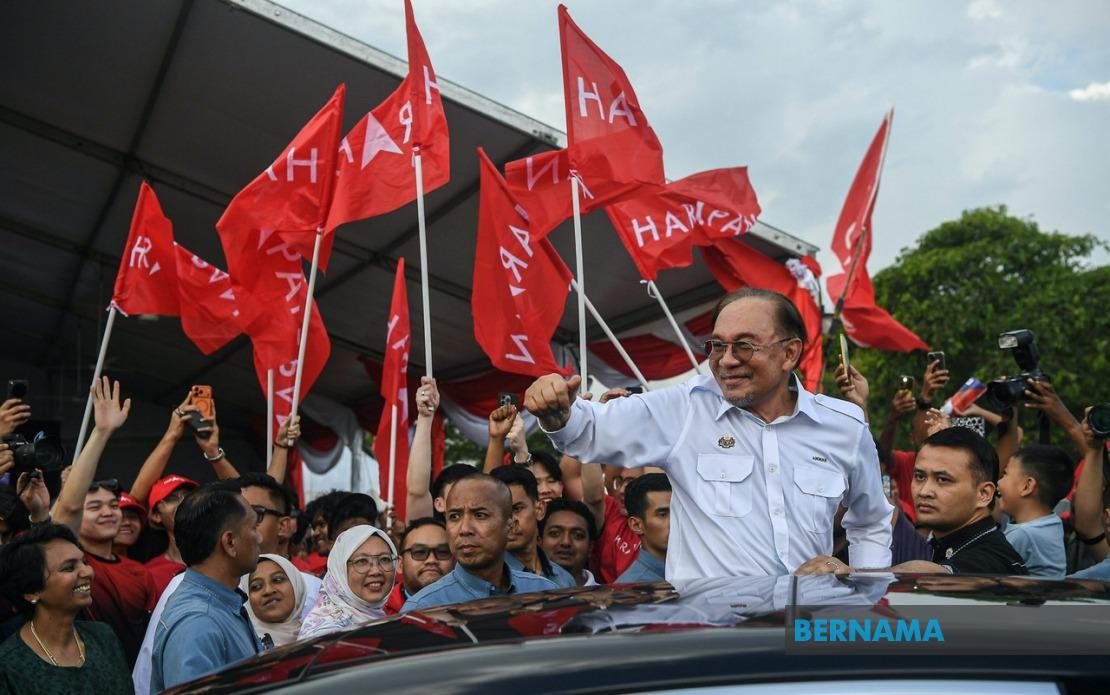
Prime Minister Datuk Seri Anwar Ibrahim's direct engagement with voters across Johor appears to be translating into tangible momentum for the Pakatan Harapan coalition in the state's upcoming legislative election. Communications Minister Datuk Fahmi Fadzil remarked on the striking public reception witnessed during campaign stops in Batu Pahat district, noting instances of unscripted community enthusiasm that suggest a deeper level of political interest extending beyond the usual partisan rallies.
The most striking anecdote came from Senggarang, where an elderly resident reportedly transported his wife by trishaw to briefly encounter the Prime Minister, exemplifying the kind of grassroots mobilization that campaign managers typically struggle to manufacture. Such organic demonstrations of interest carry particular weight in Malaysian politics, where voter turnout and enthusiasm levels often determine marginal seat outcomes. For a coalition seeking to consolidate power following its return to federal office, translating these spontaneous encounters into actual electoral support represents a crucial challenge in the coming days.
Fahmi, who doubles as PH's communications director and PKR's information chief, contextualizes these scenes within a broader narrative of community receptiveness to the coalition's messaging framework. His observations suggest that the PH campaign strategy—which hinges on positioning Anwar as a transformative figure capable of delivering institutional reform and economic improvement—is resonating with at least a segment of the Johor electorate. The precise demographic breakdown of this support remains unclear from official statements, though anecdotal evidence hints at cross-generational appeal.
The Prime Minister's intensive two-day mobilization effort, which saw him conduct 15 separate campaign events across the state on July 4 and 5, underscores the coalition's recognition that personal leadership visibility can meaningfully influence voter calculations in state-level contests. This represents a significant deployment of federal executive resources, signalling that PH views the Johor election as consequential beyond the immediate state boundaries. Johor, as Malaysia's southern economic anchor and a historically mixed political battleground, carries symbolic importance for any coalition seeking to claim momentum heading toward future national electoral cycles.
PH's decision to field candidates in all 56 state assembly constituencies demonstrates the coalition's confidence and commitment to the contest. This comprehensive approach contrasts with earlier electoral cycles where opposition coalitions often ceded certain seats to stronger alliance partners or withdrew from unwinnable constituencies. The comprehensive candidacy strategy suggests either genuine optimism about voter receptiveness or a deliberate effort to maximize organizational presence across all demographics and geographic segments.
The competitive landscape reflects significant fragmentation among contestants vying for these legislative seats. With 172 candidates distributed across the 56 constituencies—an average of roughly three candidates per seat—voters face multiple choices that potentially dilute vote shares across competing parties and independents. This fragmentation can produce unexpected outcomes where local issues, candidate popularity, and ground organization prove decisive. For PH, maximizing voter turnout among its supporters becomes particularly critical when facing divided opposition voting.
The coalition's campaign narrative, as articulated through Fahmi's remarks, emphasizes community interest in PH's policy platform and institutional vision. By framing public engagement as reflecting substantive policy interest rather than mere personality-driven enthusiasm, PH officials attempt to ground their electoral appeal in programmatic foundations. Whether this translates into voting behavior ultimately depends on voters prioritizing such policy considerations over local grievances, incumbent performance, or alternative party platforms.
For Malaysian and Southeast Asian observers, the Johor election serves as a bellwether for PH's broader political sustainability and organizational capacity. The coalition's ability to convert campaign enthusiasm into electoral victories directly influences its internal cohesion and negotiating leverage within its multi-party structure. A strong Johor performance strengthens federal coalition stability, while disappointing results could exacerbate existing tensions between PH's constituent parties regarding power-sharing arrangements and strategic direction.
The early voting process, which commenced on the day Fahmi visited Bernama's operations room, provides initial indicators of turnout patterns and campaign effectiveness. Early voting participation often skews toward older citizens and those with inflexible work schedules, potentially favoring whichever coalition has mobilized these demographic segments most effectively. The July 11 polling day will definitively test whether the observed campaign enthusiasm translates into the voting booth, particularly among younger voters who may demonstrate different responsiveness patterns to traditional campaign methods compared to earlier generations.
Regional implications extend beyond Johor's borders into Singapore and Brunei's strategic calculations regarding Malaysian political stability and economic governance. A strong PH performance strengthens Prime Minister Anwar's personal authority within federal governance structures, potentially accelerating economic reform initiatives and regional integration projects that neighboring economies monitor closely. Conversely, electoral disappointment could embolden competing power centers within Malaysian politics, complicating the policy environment for cross-border investments and regional cooperation frameworks.
The convergence of visible grassroots enthusiasm and comprehensive electoral strategy positions PH favorably, though electoral outcomes rarely align perfectly with campaign atmospherics. Historical Malaysian elections have repeatedly demonstrated that ground-level excitement among certain voter segments does not necessarily predict final results when aggregated across entire constituencies. The period between early voting and July 11 remains critical for PH consolidating support while managing the expectations its leadership's high-profile campaign presence has necessarily elevated among supporters.

