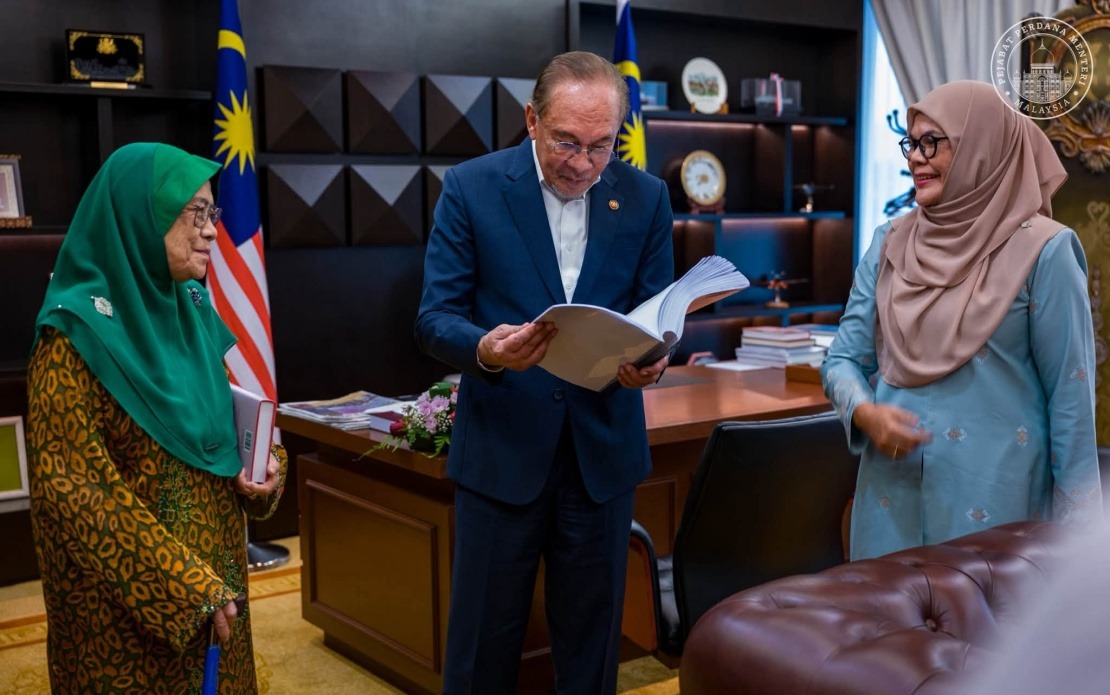
Prime Minister Datuk Seri Anwar Ibrahim has expressed optimism that a newly completed book chronicling his political thought and personal philosophy will become an enduring resource for Malaysia's future leaders and citizens. The Prime Minister disclosed this aspiration through a Facebook post on July 1, signalling his commitment to preserving and transmitting his ideological framework to subsequent generations who will inherit the nation's governance and social development challenges.
The book, authored by Professor Dr Salinah Ja'afar from the Academy of Malay Studies at Universiti Malaya, represents a scholarly attempt to synthesize the Prime Minister's intellectual contributions over a career spanning multiple decades. Ja'afar, who holds expertise in linguistics and language scholarship, has undertaken the painstaking work of documenting Anwar's accumulated wisdom on governance, personal integrity, and the philosophical underpinnings of his approach to leadership. The project reflects a growing trend among Malaysian political figures to create written records of their legacies before their direct influence wanes, ensuring their perspectives remain accessible for academic analysis and political discourse.
Anwar personally participated in the manuscript's development process, offering detailed feedback and revisions to ensure accuracy and comprehensiveness. This hands-on involvement underscores the significance he attaches to how his ideas are represented and interpreted. The Prime Minister underwent exclusive interviews with both Ja'afar and an academic collaborator, providing primary-source material that should enhance the book's authenticity and depth. Such direct engagement suggests Anwar views this documentation as more than a biographical exercise, but rather as an intentional act of intellectual stewardship.
The project has benefited from the scholarly guidance of Professor Emeritus Datuk Dr Nik Safiah Abdul Karim, a renowned language scholar whose academic credentials lend credibility to the undertaking. Her role as academic adviser during the manuscript's preparation ensured rigorous intellectual standards and scholarly integrity throughout the research and writing process. The involvement of such established academicians elevates the work beyond mere political memoir, positioning it within the domain of serious intellectual history that university researchers and policymakers might reasonably consult.
Anwar's stated hope that this book will serve as a reference point for nation-building demonstrates his awareness that political leadership extends beyond immediate policy implementation. By consciously documenting his ideas, views, and philosophical framework—all shaped by decades of personal experience and extensive reading—the Prime Minister is attempting to create an instructional document for posterity. This reflects a recognition that sustainable governance requires not just contemporary political decisions but also the transmission of principled thinking to those who will face future challenges.
The emphasis on personal values development marks a significant aspect of the project's intended scope. Beyond technical governance issues, Anwar appears keen to communicate lessons about character formation, ethical decision-making, and the moral foundations necessary for effective leadership. Such preoccupation with values suggests he sees Malaysia's future challenges as fundamentally connected to the personal integrity and philosophical grounding of those in positions of authority, a perspective that carries particular resonance given contemporary global concerns about political accountability and democratic resilience.
For Malaysian readers and especially for students of politics and governance, this book's publication will offer valuable insights into the intellectual makeup of the country's current Prime Minister. Understanding the philosophical roots of his policy decisions and leadership philosophy could illuminate why he has pursued particular directions on economic reform, democratisation, and social inclusion. The documentary record created through this scholarly project will enable more sophisticated analysis of his political trajectory and decisions.
The timing of this biographical-intellectual project also warrants consideration within Malaysia's broader political context. As Anwar consolidates his position and shapes the national agenda, creating an authoritative written record of his ideas may serve multiple purposes: it establishes a clear ideological foundation for his government's direction, provides material that allies and successors within his political coalition can reference, and creates a historical document for future evaluation of his administration's achievements and shortcomings.
For Southeast Asia more broadly, the emergence of such intellectually grounded political documentation from Malaysia's leadership carries relevance. The region's governance discussions increasingly grapple with questions of institutional strength, democratic resilience, and the personal characteristics required in effective leaders. A book attempting to articulate the philosophical underpinnings of Malaysian leadership during a crucial period could contribute to wider regional conversations about political thought and governance models.
The project's completion and publication will represent an important moment in Malaysian political historiography. Whether future generations will indeed consult this work as Anwar hopes remains uncertain, but the act of creation itself reflects his conviction that ideas matter in politics and that deliberate efforts to document and transmit them serve the national interest. This approach differs markedly from leaders who leave behind only their policy records and public statements, offering instead a more deliberately constructed intellectual legacy.

