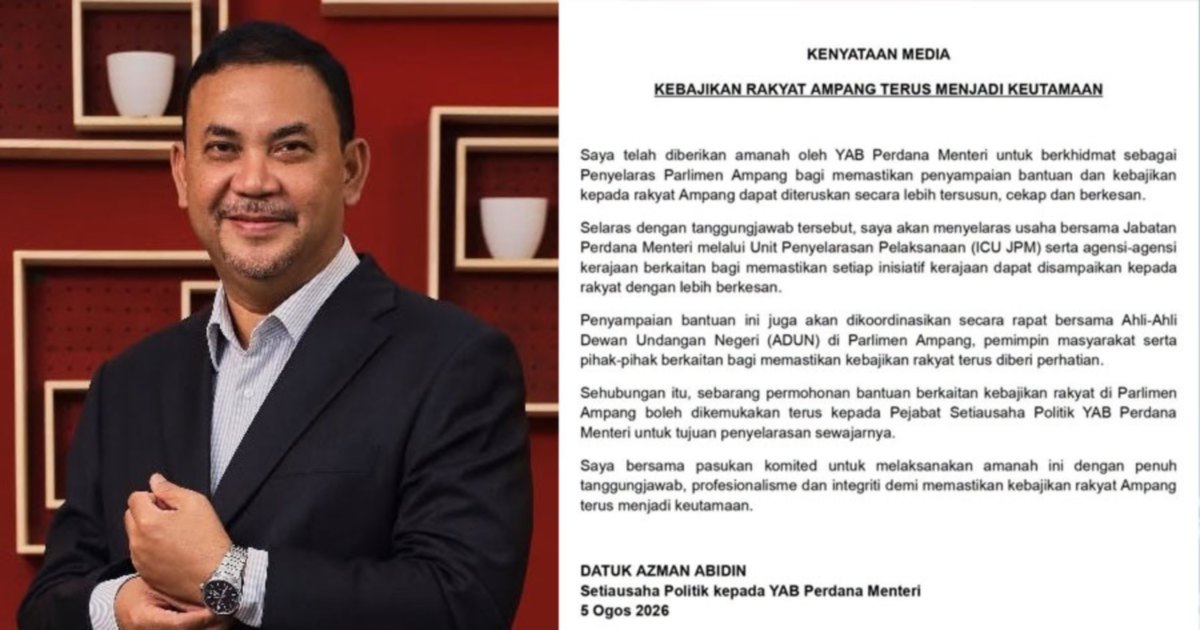
A senior aide from Prime Minister Datuk Seri Anwar Ibrahim's political secretariat has assumed the role of parliamentary coordinator for Ampang, marking a significant shift in the constituency's administrative structure. This appointment comes immediately after Ampang Member of Parliament Rodziah Ismail was barred from accessing the MyKhas constituency allocation system, signalling an escalation in internal party management within PKR and raising questions about the distribution of parliamentary resources and decision-making authority at the federal level.
The appointment represents an unusual consolidation of power at the constituency level, whereby direct representation of the Prime Minister's office operates in parallel with, or potentially in place of, the elected Member of Parliament's traditional administrative functions. This arrangement is particularly noteworthy given that Malaysia's parliamentary democracy typically vests such responsibilities with elected representatives, and the introduction of direct Prime Ministerial oversight at the constituency level suggests either a breakdown in party discipline or a deliberate restructuring of power dynamics within the ruling coalition.
Rodziah Ismail, who represents Ampang under the PKR banner, has been stripped of access to the MyKhas system—a critical digital platform through which Malaysian MPs manage and allocate constituency development funds to local projects, community initiatives, and constituent services. This suspension effectively diminishes her capacity to deliver tangible benefits to her constituents, a cornerstone of parliamentary representation in Malaysia's electoral system. The timing and manner of this action suggest a planned administrative intervention rather than a routine procedural matter.
For Malaysian readers accustomed to the central role that MPs play in their constituencies, this development raises fundamental questions about governance and accountability. Typically, constituency allocation funds—whether drawn from the Member of Parliament's Development Fund or other budgetary provisions—remain under the control of elected representatives as a mechanism through which they serve their constituents and maintain political credibility. The removal of such access, particularly through technical means via the MyKhas platform, represents a substantial limitation on parliamentary autonomy and constituent service capacity.
The precise reasons for Rodziah Ismail's suspension from the MyKhas system remain officially unstated in available reports, though such actions are generally preceded by either disciplinary processes within the party or specific instructions from senior political leadership. In Malaysia's political context, where party loyalty and central direction carry significant weight, such measures often reflect broader factional disputes, compliance issues with party directives, or attempts by senior leadership to consolidate control over resource distribution and political messaging at the grassroots level.
The appointment of a Prime Ministerial aide as parliamentary coordinator introduces an external administrative layer that could streamline certain functions but fundamentally alters the relationship between constituent needs and political responsiveness. This model mirrors practices in some hierarchical political systems but represents a departure from established Malaysian parliamentary conventions, where Members of Parliament traditionally enjoy considerable latitude in managing their constituency affairs and development allocations.
For the Ampang constituency, this arrangement raises practical concerns about service delivery and political representation. Constituents typically approach their elected MP with local grievances, requests for developmental projects, and community concerns. The introduction of a coordinator operating under the Prime Minister's office creates an additional administrative hierarchy that may improve coordination with federal-level initiatives but could also complicate direct accountability between elected representative and constituents. The dual-track system might lead to confusion regarding which authority holds responsibility for specific decisions or resource allocations.
Within PKR specifically, this development reflects ongoing internal tensions that have periodically surfaced within the party. As the largest component of the current federal coalition, PKR has grappled with managing diverse factions and maintaining party discipline while representing constituencies with varied political dynamics. The action against Rodziah Ismail suggests that party leadership, operating through the Prime Minister's office, is prepared to exert direct control over constituent-level operations to ensure alignment with central directives or to address specific governance concerns.
The broader implications for Malaysia's parliamentary system warrant consideration. While prime ministerial offices routinely coordinate with MPs on policy implementation and coalition management, direct administrative intervention in individual constituency operations through system access restrictions represents an expansion of executive authority. This precedent could influence how future political disagreements or discipline matters are handled, potentially normalising direct Prime Ministerial involvement in what have traditionally been MP-level administrative functions.
Stakeholders in Ampang and within PKR will be watching how this arrangement evolves. Whether the coordinator operates as a complementary function to Rodziah Ismail's constituency operations or serves as an effective replacement will clarify the underlying intentions behind the appointment. Similarly, clarity regarding the reasons for MyKhas access suspension and whether this suspension is temporary or permanent would help constituents and party members understand the nature of this administrative restructuring and its implications for political representation in the constituency.

