Prime Minister Datuk Seri Anwar Ibrahim has weighed into Malaysia's ongoing political tensions with a characteristically nuanced gesture—a poetic appeal for unity that arrives as his Pakatan Harapan coalition battles its Federal Government partner Barisan Nasional in the Negeri Sembilan state election. The four-line Malay pantun, shared on his official Facebook page on July 22, carries deeper significance than its whimsical surface suggests, functioning as a reminder that despite intense electoral competition, the broader Federal Unity Government framework remains intact and valued by its figurehead.
The posting generated immediate engagement, accumulating over 11,500 likes within two hours and attracting more than 1,700 comments, many from users who responded in kind with their own pantun compositions. This enthusiastic reception speaks to how the Malaysian public continues to respond positively to appeals for cohesion delivered through culturally resonant formats. The comments section revealed genuine appreciation for what many interpreted as Anwar's statesmanlike acknowledgement of the delicate balance required to maintain a coalition government while allowing individual components to contest elections independently.
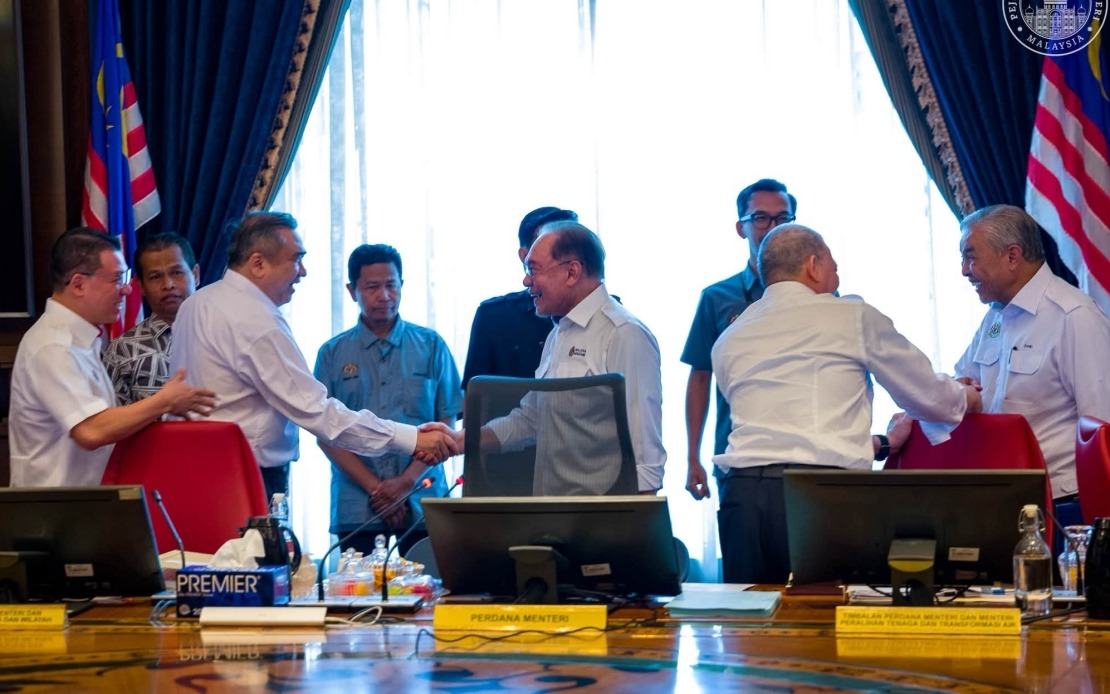
Anwar accompanied the pantun with photographs from a Cabinet meeting featuring Deputy Prime Minister Datuk Seri Dr Ahmad Zahid Hamidi and Transport Minister Anthony Loke, visibly demonstrating collegial spirits and relaxed camaraderie among senior government figures. This visual narrative counterbalances the high-stakes electoral rivalry playing out simultaneously, offering constituencies a reassuring image of unified leadership at the federal level despite divergent party interests at the state level. The juxtaposition deliberately communicates that competitive democracy and governmental stability need not be mutually exclusive.
The timing of Anwar's message is strategically significant. The Negeri Sembilan state election represents one of the most visible tests of how well the Federal Unity Government—a power-sharing arrangement born from Malaysia's fractured 2022 general election results—can function when its constituent parts compete directly. The state assembly was dissolved on June 5, with the Election Commission scheduling early voting for July 28 and general polling for August 1, meaning the campaign was in full swing as Anwar posted his appeal.
Pakatan Harapan is contesting all 36 state seats under Anwar's leadership, whereas Barisan Nasional, led by Ahmad Zahid, is fielding candidates in 25 constituencies while simultaneously forging an electoral pact with Perikatan Nasional, a third coalition. This three-way configuration creates a genuinely complex political landscape in which coalition partners at the federal level pursue divergent alliances at the state level. The arrangement tests whether Malaysian political actors can compartmentalize competition and cooperation, a question that has profound implications for how Malaysia's Unity Government model develops.
For Malaysian observers and regional analysts, Anwar's intervention illuminates the philosophical underpinnings of Malaysia's unusual governing arrangement. Rather than one coalition wielding unchallenged power, the Federal Unity Government requires continuous negotiation, consensus-building, and tolerance for electoral competition among partners who simultaneously share Cabinet responsibility. This model represents a radical departure from Malaysia's traditional winner-take-all political culture, where electoral victory typically translated into near-total dominion by the victorious coalition.
The pantun format itself merits consideration. This traditional Malay poetic form carries cultural weight and historical continuity, suggesting that appeals to unity and friendship rest upon values embedded in Malaysian heritage rather than contemporary political expedience. By casting his message in this idiom, Anwar positioned himself within a centuries-old tradition of Malaysian cultural expression, lending his statement gravitas beyond immediate partisan calculation. The public's enthusiastic response, including numerous pantun replies, indicates receptiveness to this rhetorical strategy.
The Negeri Sembilan contest will provide crucial data about whether voters can simultaneously support individual coalition components in state elections while accepting unified federal governance. The outcome will likely influence how similar arrangements function in future state contests and whether the Federal Unity Government can evolve into a sustainable governance model or remains a transitional expedient born from electoral arithmetic.
For Southeast Asian observers monitoring Malaysian political development, this episode demonstrates how Westminster-derived democracies adapt institutional frameworks to accommodate cultural values and immediate political realities. Malaysia's experiment with coalition governance while permitting electoral competition among partners offers lessons relevant to other regional democracies grappling with fragmented electorates and multi-party systems. The success or failure of this model could shape how other nations approach power-sharing arrangements.
Anwar's poetic intervention also reflects his personal political style—calculated appeals to unity and harmony that recognize Malaysia's communal tensions while seeking inclusive governance frameworks. Whether observers view this approach as genuine consensus-building or shrewd political theatre, its consistent deployment suggests it resonates with significant segments of the Malaysian electorate. As electoral competition intensifies in Negeri Sembilan, such reminders of broader governmental cohesion may prove increasingly necessary for maintaining the Federal Unity Government's institutional credibility.
The coming weeks will reveal whether this diplomatic messaging succeeds in compartmentalizing state-level electoral competition while preserving federal-level cooperation. The Negeri Sembilan results could establish precedents for how Malaysian coalitions navigate future elections under unity government frameworks, determining whether such arrangements represent viable alternatives to outright coalition dominance or ultimately succumb to the gravitational pull of traditional winner-take-all politics.

