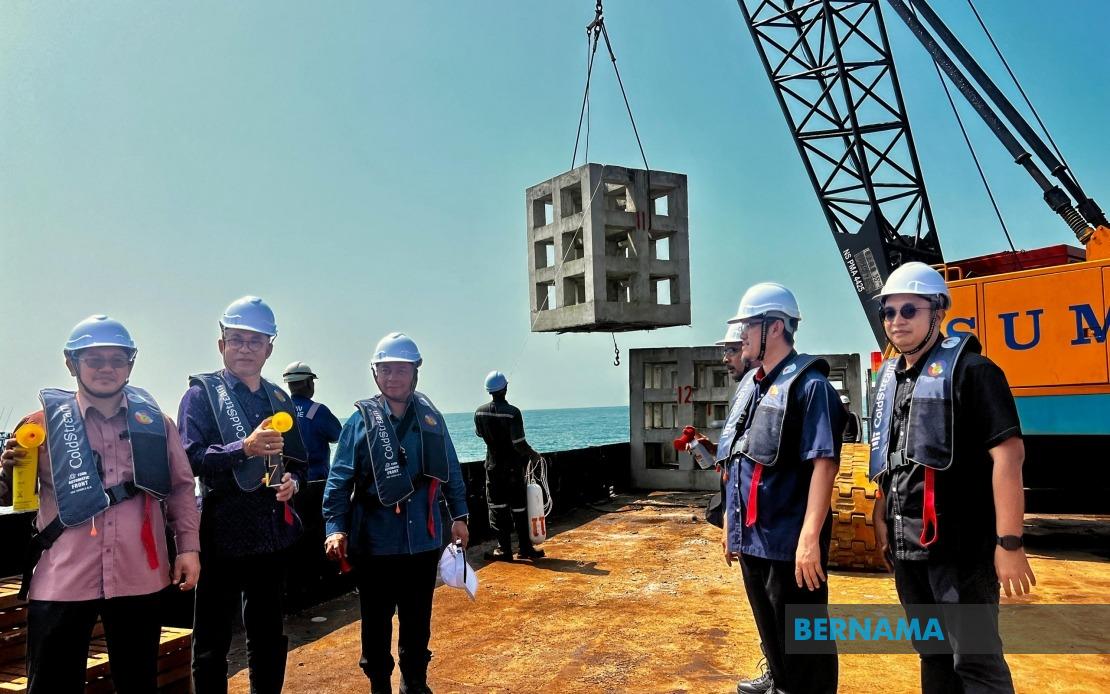
The Kelantan Fisheries Department has launched an initiative to strengthen the livelihoods of artisanal fishermen by deploying artificial reef structures that simultaneously protect traditional fishing grounds and enhance marine productivity. A programme at Tok Bali Tourism Jetty saw the installation of 30 reef units positioned approximately 4.6 nautical miles offshore, representing the first deployment funded entirely through a royal conservation contribution from Sultan Muhammad V.
Department director Ismail Ibrahim explained that the reef structures serve a dual purpose extending beyond typical conservation aims. The physical configuration of these submerged installations creates natural obstacles that entangle the nets and trawling equipment of large industrial vessels, effectively deterring incursions by commercial fishing boats into waters traditionally reserved for smaller coastal operators. This mechanical barrier approach addresses a persistent challenge facing Malaysia's small-scale fishing communities, who contend with resource competition from heavily capitalised industrial fleets operating increasingly aggressive harvesting practices.
The conservation benefits of the deployment should become apparent within six months, according to department projections, contingent upon local environmental conditions and the establishment of functional marine ecosystems around the structures. Fish populations migrate to artificial reefs to spawn and nurture juvenile specimens, creating nursery zones that replenish stocks in surrounding waters. For Kelantan's fishing communities, this translates into measurable increases in catch volumes and improved food security outcomes across dependent households and processing sectors.
Kelantan's broader artificial reef programme demonstrates sustained commitment to fisheries management. Since 2007, the department has progressively installed approximately 400 reef units distributed across four maritime zones within state waters. This year alone marks the staged deployment of an additional 72 structures, signalling accelerating investment in marine habitat restoration. The cumulative effort reflects recognition that coastal fish stocks require active stewardship to withstand modern fishing pressures, particularly as technological advances enable more efficient—and often unsustainable—extraction methods.
The royal funding mechanism employed here offers an instructive model for Southeast Asian fisheries governance. By channelling sultanate resources into conservation infrastructure, Kelantan creates a sustainable protective framework without depending entirely on federal budget allocations or international development assistance. This approach resonates with regional patterns where traditional institutions exercise growing environmental stewardship roles, supplementing government capacity in resource-dependent coastal economies.
Maintenance operations form a critical component of the programme's long-term viability. Department staff conduct regular inspections and cleaning cycles to remove accumulated fishing debris and discarded rope sections from reef surfaces. These maintenance activities prevent material degradation and preserve the structures' effectiveness as both breeding habitats and vessel-deterrent barriers. The operational commitment reflects mature understanding that infrastructure deployment alone proves insufficient without corresponding maintenance discipline.
The positioning of reefs within five nautical miles of the coastline specifically targets protection of small-vessel fishing zones, the maritime spaces where artisanal operators conduct their traditional activities. Industrial vessels typically operate beyond this perimeter, though advancing technology increasingly enables deep-water operations that compress the spatial separation between commercial and subsistence fisheries. Artificial reefs recalibrate this competition by creating practical limits on industrial expansion into shallow grounds where small boats maintain technological and operational advantages.
For Malaysian policymakers and Southeast Asian neighbours grappling with fisheries depletion, the Kelantan model offers practical demonstration that conservation mechanisms can simultaneously address ecological restoration and livelihood protection. Regional fish stocks have experienced documented decline attributable to overharvesting, with artisanal communities bearing disproportionate economic impacts as catches diminish. Solutions requiring investment in marine infrastructure remain comparatively cost-effective when measured against alternative management approaches dependent on enforcement capacity or international regulatory frameworks.
The programme also carries implications for regional food security discussions. Malaysia's fishing sector contributes substantially to domestic protein availability, with coastal communities forming essential components of the supply chain. By enhancing fish breeding productivity in state waters, Kelantan's reef deployment strategy strengthens national food production resilience while supporting vulnerable maritime populations dependent on declining wild-catch resources. This alignment of conservation, livelihood, and food security objectives characterises increasingly sophisticated fisheries governance across the region.
Expansion plans underscore departmental confidence in the initiative's viability. Officials have committed to increasing reef deployments throughout Kelantan's maritime jurisdiction, suggesting the programme will eventually encompass substantially greater coastal acreage. Scaled implementation would create comprehensive marine-space architecture combining conservation areas, breeding grounds, and vessel-exclusion zones across major fishing regions. Such systematic geographic coverage could meaningfully reshape dynamics between industrial and artisanal sectors by fundamentally altering the resource access geography that currently favours larger operations.
The initiative also reflects evolving understanding of marine ecosystem complexity. Artificial reefs function not merely as fishing barriers but as engineered habitats that replicate complex seafloor structures degraded by intensive trawling activities. They accumulate biological communities including diverse fish species, crustaceans, and other organisms, creating genuinely productive ecological zones rather than simply displacing fishing pressure. This ecological sophistication distinguishes contemporary reef deployment from earlier approaches that emphasised purely structural or deterrent functions.

