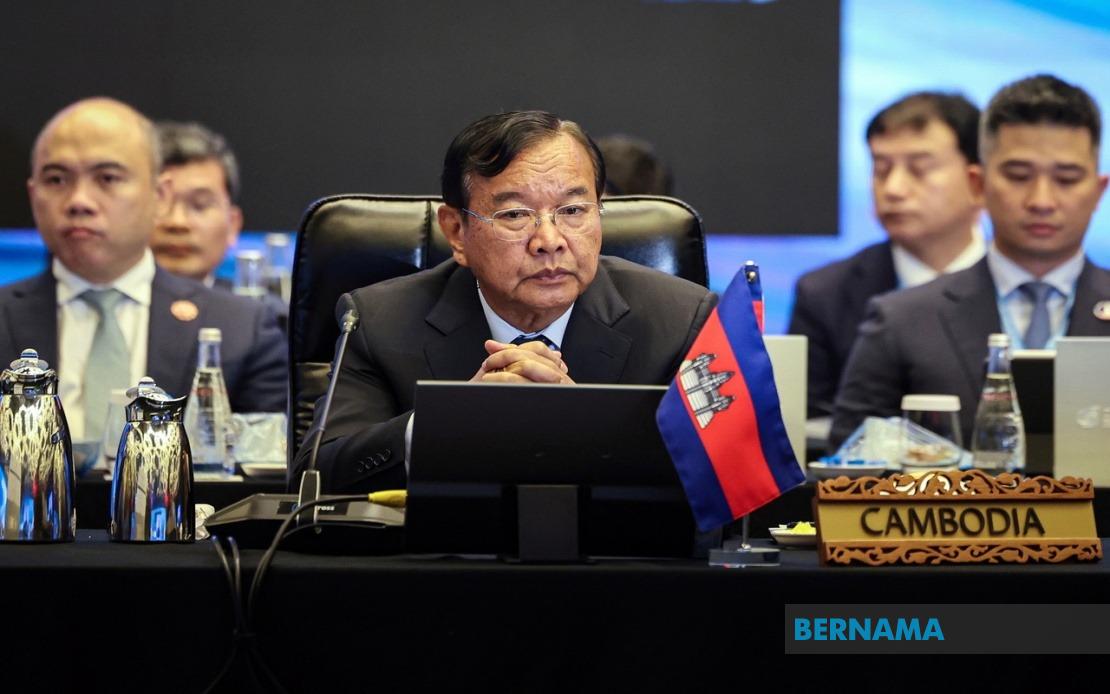
Cambodian Foreign Minister and Deputy Prime Minister Prak Sokhonn has warned that the Association of Southeast Asian Nations can no longer afford a passive approach to regional leadership, insisting instead that the 11-member bloc must proactively influence the trajectory of Southeast Asia amid mounting global instability. In remarks marking ASEAN's 59th anniversary on Friday, Sokhonn underscored that the organisation's unity and central role remain essential as geopolitical competition intensifies and traditional international frameworks face unprecedented strain.
The Cambodian official's message reflects growing anxiety within ASEAN capitals about the bloc's capacity to maintain its relevance and cohesion in an era of great-power rivalry and shifting strategic alignments. Over nearly six decades, ASEAN has successfully transformed a fractious region plagued by interstate conflict and ideological division into a space characterised by increasing dialogue, institutional cooperation, and economic interdependence. Yet the organisation faces formidable challenges today that differ fundamentally from those of earlier eras, requiring a fundamentally different strategic posture.
Sokhonn highlighted the deteriorating security environment confronting Southeast Asia, pointing specifically to the resurgence of armed conflicts, escalating geopolitical rivalries, and weakening adherence to international law and multilateral cooperation mechanisms. These pressures manifest in various forms across the region—from maritime disputes in the South China Sea to proxy conflicts involving external powers, from trade tensions to technological competition for regional influence. The Foreign Minister's call for proactive rather than reactive leadership suggests frustration with ASEAN's tendency toward consensus-driven paralysis when confronted with contentious issues that divide member states.
Central to Sokhonn's argument is the proposition that ASEAN's founding principles—enshrined in the ASEAN Charter and the Treaty of Amity and Cooperation—provide sufficient philosophical and legal foundations for the bloc to assert greater influence over regional outcomes. The emphasis on unity and centrality reflects acknowledgment that ASEAN's primary asset lies not in military or economic dominance but in its perceived neutrality and ability to serve as a convening platform for dialogue among larger, competing powers. This positioning has allowed ASEAN to punch above its weight in regional affairs for decades.
Cambodia's particular investment in this messaging carries significance given its geopolitical position. As a nation that joined ASEAN relatively recently in 1999, Cambodia has positioned itself as a committed regional player while navigating complex relationships with major powers. Sokhonn's reaffirmation of Cambodia's pride in its regional contributions and commitment to strengthening ASEAN reflects Phnom Penh's interest in deepening its stake in the multilateral framework, potentially as a counterweight to bilateral pressures from larger neighbours.
The timing of these remarks is notable, arriving amid broader questions about ASEAN's effectiveness in addressing crises affecting member states. The Myanmar military coup of 2021 exposed fault lines in ASEAN solidarity, with the bloc unable to enforce meaningful consequences against a member state. Similarly, disagreements over the South China Sea code of conduct and divergent approaches to great-power engagement have repeatedly highlighted the organisation's consensus-based limitations. Sokhonn's call for active rather than passive leadership implicitly acknowledges these shortcomings without directly confronting them.
For Malaysian readers and policymakers, these comments from Cambodia carry implications for how ASEAN evolves as an institution and how effectively it can advocate for smaller members' interests. Malaysia, as a founding member and a nation with significant maritime interests in disputed waters, has long sought to strengthen ASEAN's capacity to set regional terms rather than have them imposed by larger powers. The Cambodian Foreign Minister's emphasis on the bloc's responsibility to shape rather than merely respond to geopolitical currents aligns with longstanding Malaysian positions advocating for robust ASEAN leadership.
The 11-member composition of ASEAN—now including Timor-Leste alongside Brunei, Cambodia, Indonesia, Laos, Malaysia, Myanmar, the Philippines, Singapore, Thailand, and Vietnam—reflects the bloc's expansive ambitions but also complicates consensus-building. Sokhonn's framing sidesteps specific mechanisms by which ASEAN might exercise greater influence, instead emphasising the philosophical imperative for proactive leadership. Whether the bloc can translate this aspiration into concrete policy divergence from member states' individual interests remains an open question.
The invocation of the ASEAN Charter and the Treaty of Amity and Cooperation signals Sokhonn's belief that existing institutional frameworks contain sufficient flexibility and authority for revitalised regional leadership. These documents, negotiated when different geopolitical conditions prevailed, provide principles of non-interference, respect for sovereignty, and peaceful dispute resolution. Applying these frameworks to contemporary challenges—including matters where member states have fundamentally divergent interests—requires creative interpretation and political will that has not consistently materialised.
Looking forward, the challenge for ASEAN lies in demonstrating that it can advance collective interests without subordinating individual member priorities entirely to consensus. Sokhonn's call for active, rather than reactive, leadership tacitly acknowledges that the status quo approach has proven insufficient. Whether Cambodia and other member states can build sufficient consensus around a more assertive regional posture, particularly when doing so might constrain relationships with major powers like China or the United States, represents the fundamental test of ASEAN's evolution in coming years.

