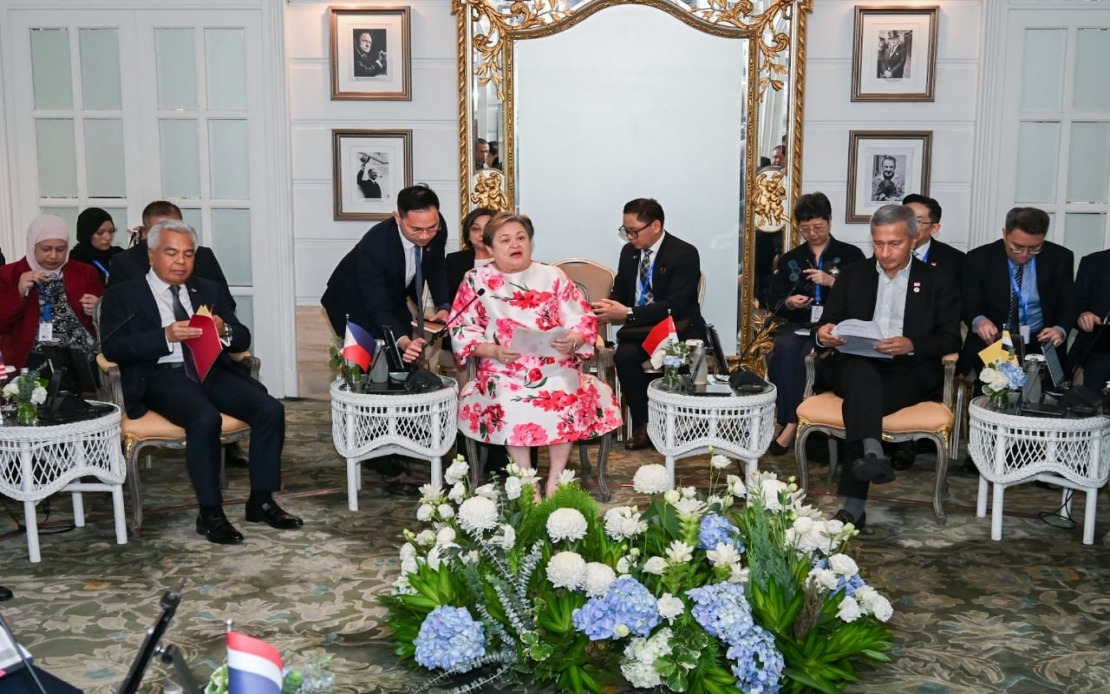
ASEAN's commitment to its Myanmar peace strategy remains unshaken despite mounting obstacles from the junta-controlled government in Naypyidaw. At a landmark meeting in Bangkok on Sunday, the bloc's foreign ministers reaffirmed the Five-Point Consensus as the cornerstone of regional engagement with Myanmar, even as that country's parliament last week rejected the very framework ASEAN has championed since 2021. The gathering, hosted by Thailand and chaired by the Philippines, marks a critical juncture in ASEAN's four-year struggle to influence the trajectory of Myanmar's political crisis through diplomatic perseverance rather than punitive measures.
The Five-Point Consensus, adopted in April 2021 immediately after Myanmar's military coup, establishes a roadmap centred on ending violence, fostering inclusive national dialogue, facilitating humanitarian assistance, and establishing an ASEAN Special Envoy to mediate between conflicting parties. Yet Myanmar's rejection of this framework last week represented a direct challenge to ASEAN's authority and diplomatic approach. Rather than retreat, Philippine Foreign Secretary Maria Theresa Lazaro, who serves as the ASEAN Chair's Special Envoy on Myanmar, signalled that the bloc would stand firm. Her remarks at the press conference conveyed both resolve and frustration—acknowledging that Myanmar could reject the consensus while simultaneously insisting that ASEAN would not abandon its foundational strategy.
Lazaro outlined three specific expectations ASEAN intends to pursue with Myanmar going forward. First, the region seeks to expand humanitarian assistance delivery, with the Thai chair planning a dedicated mission to explore pathways for increased aid access into Myanmar. This reflects growing international concern over the humanitarian catastrophe unfolding across the country, where ongoing conflict has displaced populations and strained health and food security systems. Second, ASEAN is demanding measurable reductions in violence, particularly atrocities targeting civilians caught in the crossfire between military forces and armed resistance groups. Third, the bloc wants to catalyse more inclusive political dialogue aimed at genuine national reconciliation, including pressure on Naypyidaw to release political prisoners and establish conditions for broader stakeholder engagement.
Thailand's Foreign Minister Sihasak Phuangketkeow provided additional nuance to ASEAN's position by characterising the regional approach as "calibrated engagement," a term that encapsulates ASEAN's attempt to balance diplomatic openness with conditional incentives. The phrase carries particular weight given Thailand's unique position as Myanmar's immediate neighbour and fellow Buddhist-majority nation with deep cultural and economic ties. By describing the engagement as a "two-way street," Sihasak underscored a central frustration: that ASEAN has consistently extended diplomatic channels and offered mediation while Myanmar's military rulers have shown limited reciprocal willingness to address regional concerns or move toward the consensus framework.
The Sunday meeting represented the first in-person gathering between ASEAN's foreign ministers and Myanmar's counterpart since the political crisis erupted in February 2021. The mere fact that such a meeting could occur signals that diplomatic channels remain open, yet the absence of tangible progress illustrates the limits of ASEAN's influence over military-ruled states. Myanmar's Foreign Minister attended the session, suggesting the junta has not completely rejected engagement with the regional body, even as parliamentary moves to formally reject the Five-Point Consensus demonstrate the military's hardening ideological position. This apparent contradiction—simultaneous engagement and rejection—characterises the impasse at the heart of ASEAN's Myanmar strategy.
For Malaysia and other ASEAN members, the outcomes of Sunday's meeting carry strategic implications extending well beyond Myanmar's borders. Malaysia's representation by Foreign Ministry Secretary-General Tan Sri Amran Mohamed Zin reflected the country's investment in regional stability. The Myanmar crisis threatens to destabilise Southeast Asia's geopolitical equilibrium, with refugee flows, trafficking networks, and potential Chinese leverage over a chaotic Myanmar all posing risks to the region. ASEAN's commitment to the Five-Point Consensus, despite its evident limitations, remains preferable to the alternatives of military intervention, which violates ASEAN's non-interference principle, or complete disengagement, which would cede influence to external powers.
Sihasak acknowledged that ASEAN would assess Myanmar's progress toward implementing the consensus at the upcoming ASEAN Summit later in 2024, though he conspicuously avoided setting explicit deadlines for compliance. This measured approach reflects ASEAN's traditional preference for patience and quiet diplomacy over public ultimatums, yet it also exposes the bloc to criticism that it lacks enforcement mechanisms. Without clear benchmarks or consequences for non-compliance, Myanmar's military leadership faces minimal pressure to alter course. The rejection by Myanmar's parliament of the Five-Point Consensus last week underscores this dynamic: the junta can signal defiance toward ASEAN's framework while maintaining sufficient diplomatic contact to avoid complete isolation.
The emphasis on humanitarian assistance takes on heightened importance given ASEAN's limited leverage on political matters. By focusing resources and advocacy on alleviating human suffering, the regional bloc attempts to demonstrate tangible value in its engagement while advancing a less ideologically confrontational agenda. The planned humanitarian mission by the Thai chair represents a practical avenue through which ASEAN can channel assistance while maintaining pressure on Myanmar to create conditions for such aid to reach affected populations. This humanitarian angle may ultimately prove more effective than abstract calls for political dialogue, particularly given Myanmar's military leadership's indifference to international norms around governance and human rights.
The dynamics at play reflect broader challenges confronting ASEAN as a regional organisation. Composed of ten diverse nations with varying interests and vulnerabilities, ASEAN operates through consensus-based decision-making that privileges harmony over confrontation. This institutional culture, while valuable for maintaining regional cohesion, struggles when faced with intractable actors like Myanmar's military junta. The Five-Point Consensus itself represents a compromise—strong enough to signal ASEAN's concern yet flexible enough to avoid triggering the junta's complete rejection of regional diplomacy. Yet as Myanmar continues to drift further from the consensus framework, ASEAN's credibility as a mechanism for regional conflict resolution faces quiet but persistent erosion.
Looking ahead, ASEAN's strategy hinges on maintaining credible engagement while preserving the possibility of future movement. The regional bloc cannot afford to appear either irrelevant through complete disengagement or naive through unconditional support for a military regime widely condemned for atrocities. The balance Sihasak and Lazaro articulated—standing firm on the Five-Point Consensus while acknowledging Myanmar's rejection—represents ASEAN's effort to navigate this impossible terrain. Whether this approach can ultimately influence Myanmar's trajectory remains uncertain, but the Sunday meeting demonstrated that ASEAN will persist in trying rather than surrender to despair or external pressure.

