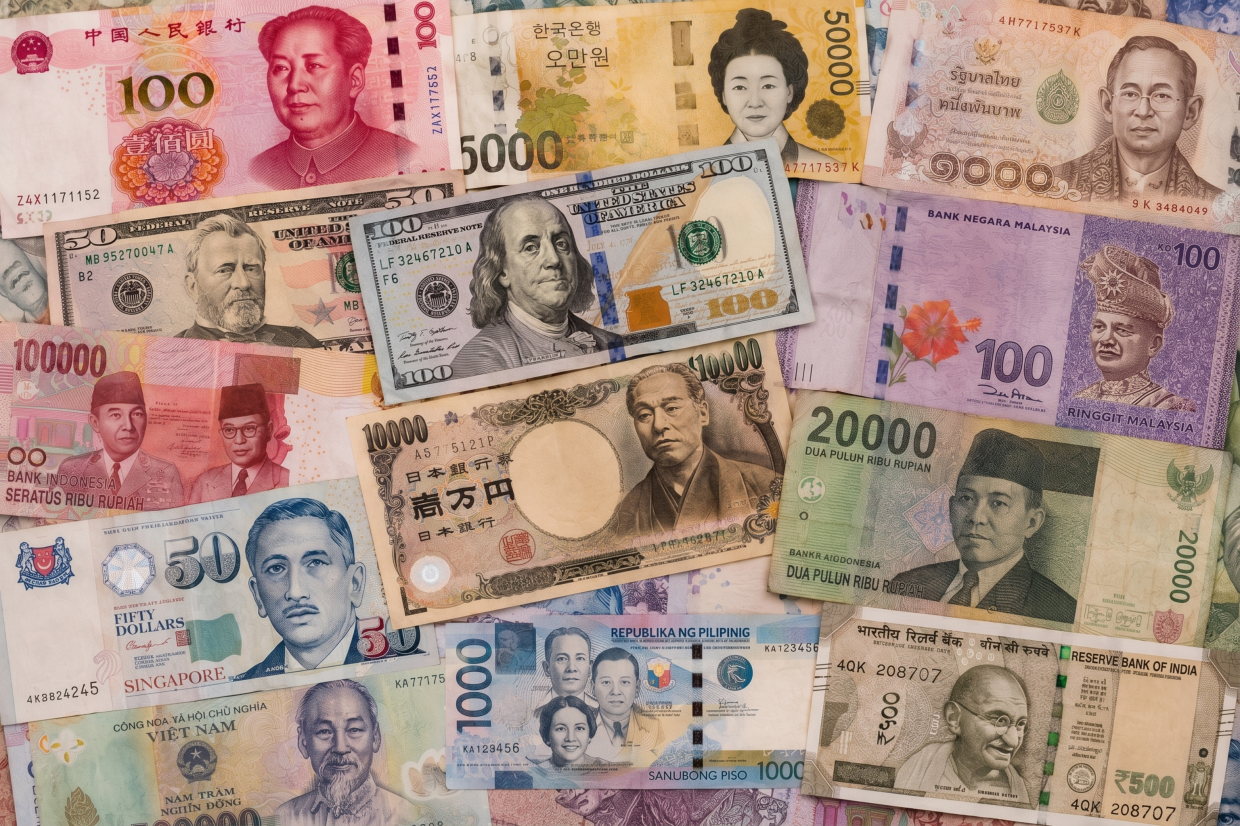
Geopolitical tensions in the Middle East sent shockwaves through Asian financial markets on Monday, with investors fleeing emerging-market currencies and equities in favour of the U.S. dollar as crude oil prices surged 4%. The renewed conflict stoked fresh anxieties about inflation resurfacing across the region, potentially forcing central banks to maintain elevated interest rates or even resume tightening cycles that many had begun to ease. The U.S. dollar index climbed against a basket of major currencies, reflecting the classic risk-off sentiment that emerges whenever Middle Eastern tensions escalate.
The weakness in Asian currencies was particularly pronounced among emerging economies, where central banks have already battled currency depreciation in recent months. Indonesia's rupiah slumped to 18,140 against the dollar, marking its weakest performance in over a month, whilst South Korea's won fell to 1,507.9 per dollar. Malaysia's ringgit similarly came under pressure, depreciating to 4.0780 against the greenback. These moves reflect a broader pattern whereby investors in times of uncertainty pull capital out of smaller, more vulnerable economies and into the safety of U.S. assets, a dynamic that particularly hurts countries dependent on foreign investment and external financing.
South Korea bore the brunt of Monday's market turbulence, with the KOSPI benchmark index collapsing 7.96% to hit a 10-week low and triggering automatic circuit breakers designed to halt trading during extreme moves. The driving force behind this dramatic sell-off was a breathtaking 13% nosedive in SK Hynix, the world's dominant chipmaker in artificial intelligence memory solutions. The stock's sharp decline came on the heels of a strong U.S. market debut on Friday, as investors seized the opportunity to lock in gains following the company's impressive performance. This pattern—strong initial momentum followed by sharp profit-taking—has become increasingly common among technology stocks that have benefited from the global artificial intelligence boom.
Underlying the broader concern about semiconductor stocks is a creeping unease about whether current earnings growth can be sustained. The sector has been buoyed by extraordinary demand for high-bandwidth memory chips used in advanced AI systems, but market participants increasingly question whether this demand will prove durable or whether it represents a temporary bubble. Adding to this volatility is the behavior of highly leveraged single-stock exchange-traded funds, which amplify price movements in both directions and can trigger forced selling when prices fall sharply. These structural factors mean that even strong fundamentals may not shield chipmakers from sharp corrections.
Despite the Monday bloodletting, South Korea's KOSPI remains one of Asia's strongest performers year-to-date, having climbed 63% so far in 2024. However, the index has lost roughly 25% from its record closing level on June 22, illustrating the sharp volatility that has characterized Asian equity markets in recent months. This high volatility creates genuine challenges for long-term investors and suggests underlying fragility in the recovery narrative that has dominated sentiment since the start of the year.
In Malaysia, the currency weakness unfolded against a backdrop of domestic political turbulence that added another layer of uncertainty for investors. Prime Minister Anwar Ibrahim's coalition suffered a crushing electoral defeat to a key partner in a Johor state election held on Saturday, raising serious questions about the cohesion of Malaysia's governing alliance and fueling speculation about an early federal general election. The political instability sent an additional risk premium into Malaysian assets, even as Malaysian equities actually posted gains to reach a three-week high—a somewhat contradictory move that likely reflected competing forces within the market.
Goldman Sachs analysts weighed into the Malaysian political situation, arguing that any further deterioration in federal coalition unity could undermine the policy stability premium that has supported Malaysian assets despite regional volatility. Malaysia has benefited from a perception of relative macro stability and clear economic policy direction under the current administration. However, that perception is fragile. Goldman noted that while the central bank's efforts in June to encourage foreign exchange inflows should help contain depreciation pressure on the ringgit, the political risk premium could persist and continue to weigh on sentiment. This assessment captures the delicate balance Malaysia faces: strong underlying economic fundamentals and policy support measures cannot entirely offset political uncertainty.
Regional equity markets showed mixed performance outside of South Korea. Philippine stocks edged modestly higher whilst Indonesian equities gained 0.5%, suggesting that markets in Southeast Asia's largest economies maintained some resilience. Taiwan's stock market inched lower, whilst Singapore's benchmark index declined as much as 0.7%, interrupting an impressive seven-session streak of record closing levels. These divergent moves reflect varying exposure to different sectors and different degrees of vulnerability to currency weakness and inflation worries.
Looking ahead to the coming week, several major economic indicators and policy decisions will command investor attention across the region. Singapore's advance second-quarter growth data will provide crucial information about the health of one of Asia's most important financial hubs. U.S. inflation data will significantly influence expectations for American monetary policy and thus global risk appetite. South Korea's central bank is scheduled to announce its interest rate decision, which will signal whether policymakers see the market turbulence as requiring action. Malaysia's inflation and advance economic output figures will offer windows into the country's economic momentum amid political uncertainty. Collectively, these releases will likely shape market direction for the remainder of July.

