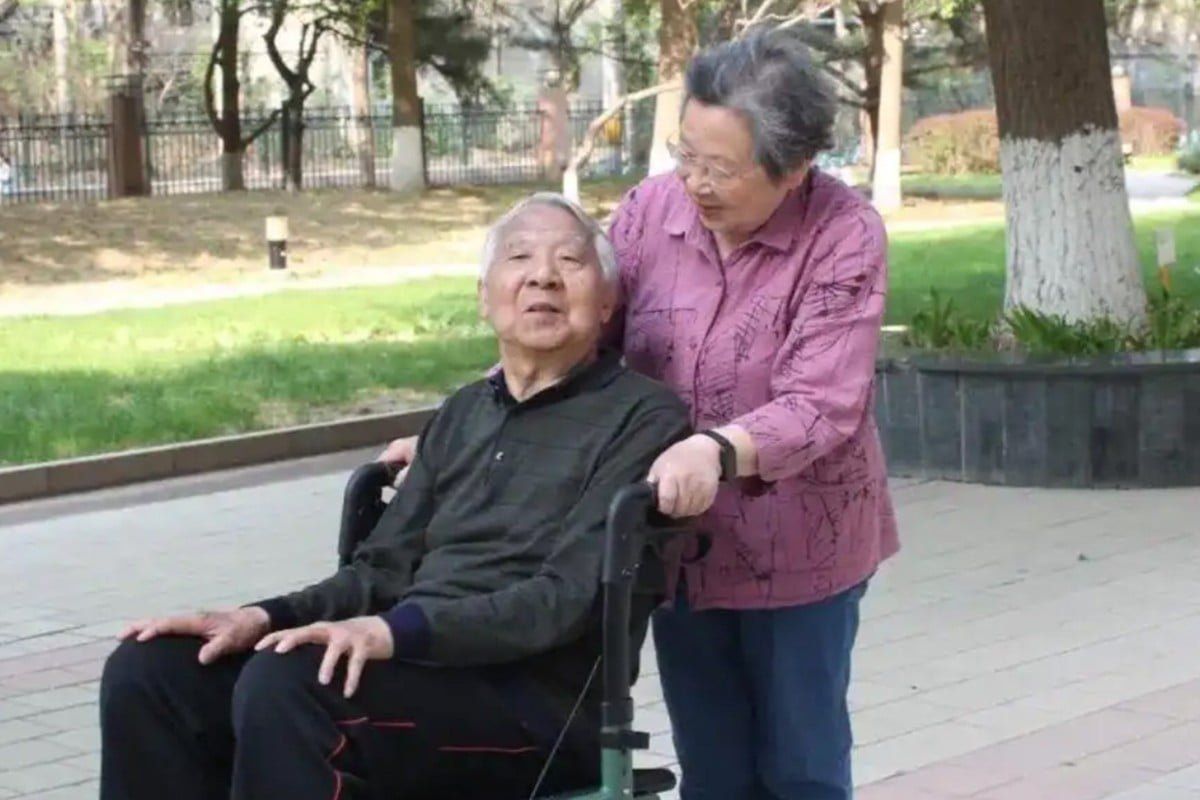
In Beijing, a nine-decade relationship has become a beacon for millions grappling with one of the defining challenges of modern China: how to age with grace and meaning. Wen Bo, now 90, has devoted herself entirely to caring for her husband, who is two years her senior and living with Alzheimer's disease, turning what might be a story of decline into a meditation on human dignity, companionship, and the power of purposeful engagement with life's final chapters.
Their bond stretches back seven decades. Wen and her husband first knew each other as teenagers in secondary school, rekindled their connection through years of long-distance courtship, and formalized their partnership in marriage during 1960. Across the subsequent decades, they constructed a life together characterized by vitality and curiosity—raising two sons, maintaining active pursuits including swimming and walking, and satisfying their wanderlust through travels across China and internationally. By any measure, theirs seemed a trajectory of sustained engagement with the world.
The trajectory shifted abruptly in 2023, when her husband began experiencing memory loss and incontinence that eventually crystallized into an Alzheimer's diagnosis. Rather than placing him in institutional care or burdening her adult sons—both occupied with demanding careers and family responsibilities—Wen made the deliberate choice to become his primary caregiver. While a domestic helper manages cooking and household management, and their children visit periodically, Wen remains the constant presence in his daily life, orchestrating his routines and shepherding his engagement with the world around him.
What distinguishes Wen's approach is not merely her physical presence but her philosophical conviction that Alzheimer's does not erase personhood. She embarked on an autodidactic journey through books and online resources, systematizing her knowledge about the disease and translating that understanding into daily practice. Each morning unfolds with cognitive exercises—mathematics problems, puzzles, painting sessions—interspersed with physical activity designed to sustain both mental acuity and bodily function. Her interventions appear to have yielded measurable results; her husband's cognitive decline has proceeded at a notably slower pace than typical trajectories, and he retains sufficient mobility and awareness to independently operate his electric wheelchair.
Perhaps most poignantly, Wen has weaponized anxiety into motivation. Fearing that advancing disease will erase her from his memory entirely, she employs a nightly ritual: before sleep, she reminds him to summon her by name should he require assistance. "He has to remember my name. I am his wife. I should be the last person he forgets," she articulated in an interview, encapsulating both the vulnerability and the fierce determination that characterize her caregiving philosophy. She simultaneously encourages him to undertake simple household tasks, granting him the temporal space to complete them unrushed, thereby preserving his sense of agency and usefulness.
Wen's conviction that individuals with Alzheimer's merit preservation of their fundamental humanity has acquired particular resonance in contemporary China. She insists that "self-respect, a sense of existence, and the feeling of being needed are essential for individuals with Alzheimer's disease"—a formulation that contests the medicalization of aging and reasserts the primacy of emotional and existential needs. Recent documentation of their daily life, shared via diary entries on the social platform RedNote, depicts moments of ordinary grace: her husband completing an arithmetic examination with only a single error, the quiet satisfaction of tasks undertaken collaboratively. These vignettes have accumulated into a powerful counter-narrative to prevailing assumptions about terminal decline.
The resonance of their story extends well beyond the personal sphere. China confronts a demographic reality of staggering proportions: by the close of last year, the nation's population aged 60 and above had surpassed 320 million individuals, constituting more than one-fifth of the total demographic. This longevity dividend, while representing historic progress, has collided with fragmented social infrastructure for elder care, sparse institutional resources, and cultural anxieties about filial obligation and intergenerational responsibility. Within this context, Wen's approach—neither warehousing nor abandonment, but rather committed, imaginative engagement—has captured the imagination of younger Chinese citizens navigating profound uncertainty about their own aging trajectories.
The online reception has crystallized around themes of reassurance and inspiration. Observers have remarked that Wen's documentation "always brings comfort," offering a tangible model of what later life might encompass: sustained intimacy with a beloved partner, maintained independence, and purposeful activity unfolding within the constraints of disease. Others have emphasized the practical guidance her experiences provide, noting how her caregiving methodologies have displaced anxiety with actionable confidence. One commenter captured this transformation directly: "I used to fear not knowing how to care for my ageing parents, but her experiences have provided me with valuable guidance and increased confidence for the future." In articulating such sentiments, Chinese netizens have transformed a singular family's experience into a collective resource, a distributed knowledge commons for navigating the profoundly personal challenge of elder care.
Wen has not romanticized the trajectory ahead. She has explicitly acknowledged that should her husband's condition deteriorate precipitously, she would consider transition to hospice care—a recognition that dignity encompasses not only prolongation of engagement but also, when necessary, alleviation of suffering. This measured realism, combined with her unwavering commitment to present-moment connection, distinguishes her caregiving from both aggressive medical intervention and passive resignation. She occupies the difficult middle ground between extension and acceptance, between fighting the disease and accepting its presence.
For China's younger generation, confronting aging parents and their own mortality with mounting urgency, Wen and her husband embody an aspirational vision of later life—one organized around autonomy, reciprocal care, and the preservation of individual dignity even as capacities diminish. Their story does not deny the reality of Alzheimer's or the exhaustion of caregiving; rather, it insists that within these constraints, meaningful human connection remains possible, that a person may forget much while retaining what is most essential, and that the presence of another person who refuses to accept their diminishment as diminishment of their worth can itself become a form of medicine more powerful than any pharmaceutical intervention.

