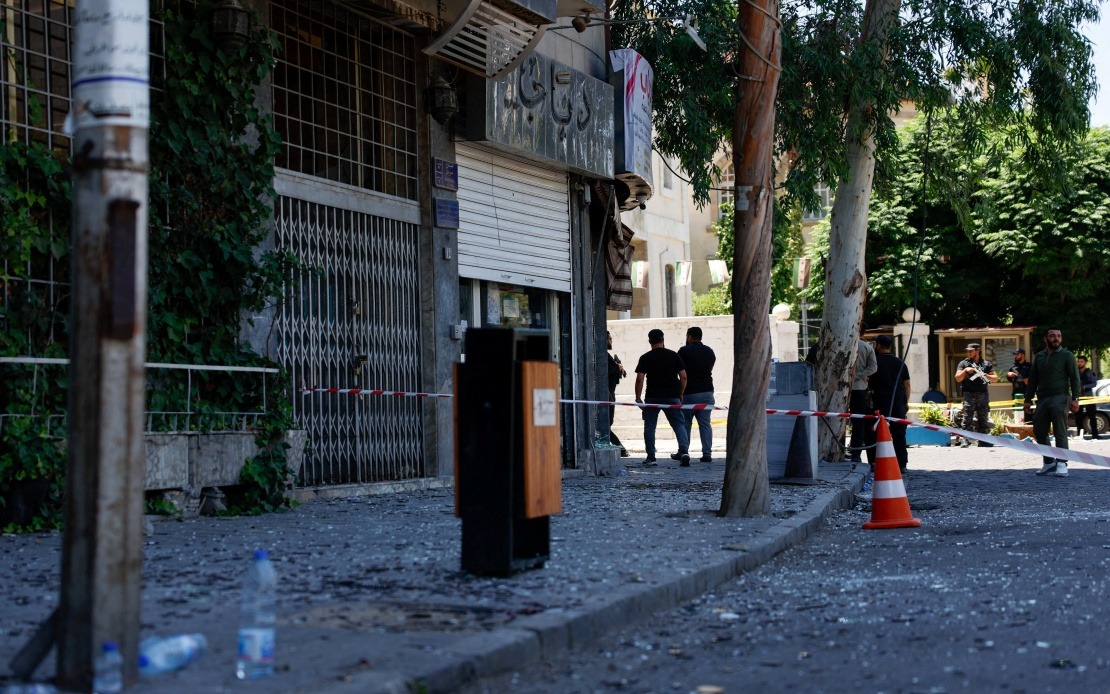
Damascus experienced a security incident on Tuesday when two improvised explosive devices detonated in the Syrian capital, leaving at least 18 people injured including four members of the police force, according to the Interior Ministry. The explosions occurred in proximity to the hotel where French President Emmanuel Macron was reportedly lodged during his significant diplomatic mission to the country. The Élysée Palace in Paris subsequently confirmed that the French leader remained unharmed throughout the incident, though the blasts triggered considerable alarm among residents across the Syrian capital.
Accounting of the attack revealed a pattern of sequential detonations, with initial reports indicating that an opening blast was rapidly succeeded by a second, more forceful explosion within mere seconds. The Syrian Observatory for Human Rights, a London-based human rights monitoring organization, documented this dual-explosion sequence and noted its proximity to Macron's accommodation. Emergency response teams and ambulance services mobilized rapidly to the affected area, while security personnel established cordons around the surrounding district to contain the situation and prevent further civilian access to the volatile zone.
Macron's presence in Damascus represents a watershed diplomatic moment for the region. The French president arrived in Syria on Monday evening, making him the first European Union leader to visit the country since 2010, marking a significant thaw in EU-Syrian relations following years of international isolation. His visit carries substantial symbolic weight, as it signals a potential normalization of diplomatic engagement with Damascus despite the country's complex geopolitical standing within the international community. The fact that no major EU leader had visited since 2010 underscores just how dramatically the political landscape has shifted.
At the time of the explosions, Macron was not at the location of the incidents but rather remained stationed at the presidential palace, where ongoing bilateral negotiations between French and Syrian delegations were proceeding. A statement issued during the security emergency indicated that despite the dramatic security developments unfolding elsewhere in the city, high-level talks between representatives of both nations continued as scheduled. This decision to maintain diplomatic protocols despite the security threat reflects the importance both governments place on this engagement.
The timing of the attack raises questions about security arrangements and potential opposition to the French president's visit from groups hostile to normalized relations with Syria. The choice of location—in proximity to Macron's reported hotel—suggests the attack may have been specifically timed to coincide with his presence in the country. Such coordinated violence during the visit of a major Western leader could indicate organized resistance to the broader reconciliation efforts that Macron's mission appears designed to advance.
For Malaysia and Southeast Asia, this incident carries implications for understanding evolving Middle Eastern geopolitical dynamics. The attack demonstrates the continued volatility in Syria despite years of conflict winding down, a reality that resonates with Southeast Asian nations concerned about regional stability. Additionally, Macron's willingness to visit Damascus despite security risks reflects a broader European strategic recalibration toward the Middle East, with potential consequences for international coalition-building and regional alignment that Malaysian policymakers monitor closely.
The incident also highlights the persistent security challenges facing Syria as it seeks to reintegrate into the international community. While the government has reasserted control over much territory, the capacity of opposition groups or other militant actors to execute coordinated attacks in the capital demonstrates that underlying instability persists beneath the surface of apparent state restoration. This fundamental tension between formal government control and actual security capacity affects Syria's rehabilitation prospects on the world stage.
Macron's decision to proceed with his visit and bilateral discussions following the bombing conveys determination not to allow security incidents to derail his diplomatic agenda. The French government's commitment to engaging with Syria, despite the risks illustrated by Tuesday's explosions, suggests that Paris views the reconciliation effort as strategically important enough to justify exposure to such hazards. This calculated risk-taking in pursuit of diplomatic objectives may encourage other European capitals to reconsider their own Syria policies.
The identity and motivation of those responsible for the explosions remained unclear as of reporting time, though the pattern of attack and timing pointed toward deliberate targeting rather than random violence. Questions persisted about whether perpetrators aimed specifically to disrupt Macron's visit, demonstrate opposition to normalizing relations with Syria, or pursued other organizational objectives. The rapid emergency response and effective security cordon prevented expansion of casualties, suggesting functional coordination among Syrian security services despite the broader questions about their capacity.

