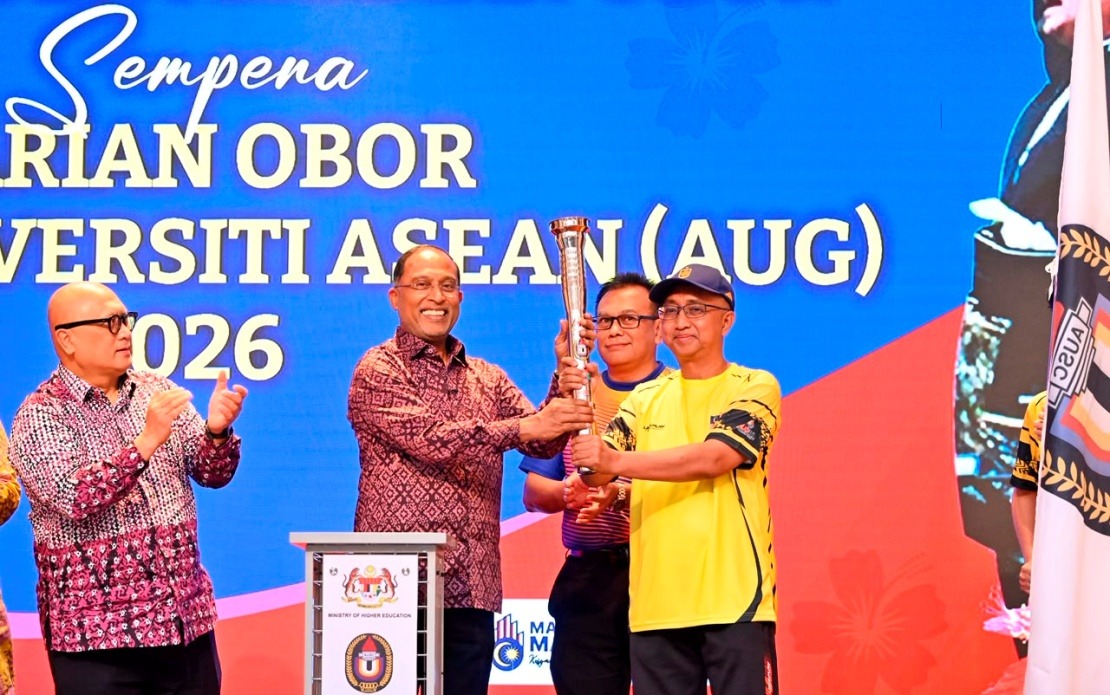
Malaysia's drive to host a successful ASEAN University Games next December gained momentum today when Higher Education Minister Datuk Seri Dr Zambry Abd Kadir formally launched the AUG 2026 torch run at the Ministry of Higher Education in Putrajaya. The ceremony, conducted during the ministry's monthly assembly, marks an important countdown ritual as the nation prepares to welcome approximately 4,669 competitors from across the Southeast Asian region to compete in what will be the largest university sports gathering in the bloc.
The handover of the torch to Malaysian contingent chief Prof Dr Mohammad Ismail, who serves as Universiti Malaysia Kelantan's Deputy Vice-Chancellor for Student and Alumni Affairs, carries symbolic weight beyond ceremonial tradition. This passing of the flame represents a formal transfer of responsibility for upholding national pride across the sporting disciplines that will unfold over a ten-day competition window. For university athletes and their supporting institutions, the torch run crystallises months of preparation into a tangible moment of national commitment.
Dr Zambry's remarks during the ceremony emphasised the broader expectations placed upon Malaysian competitors. His exhortation that athletes must "carry the torch of victory" while simultaneously "carrying the torch of our country" reflects a understanding that regional sporting events serve dual purposes: they test athletic capability whilst projecting national prestige and soft power. The minister's statement reinforces a pattern common across Southeast Asia, where university-level competition increasingly functions as a platform for demonstrating national development and institutional excellence.
Four accomplished student-athletes accompanied the torch during today's ceremonial run, each representing different sporting disciplines and educational institutions. Long jumper Andre Anura Anuar and shot putter Nani Sahirah Maryata both hail from Universiti Putra Malaysia, karate competitor Thevendran Kaliana Sundram represents Universiti Pertahanan Nasional Malaysia, and taekwondo athlete Lee Hui Yee competes for Sultan Salahuddin Abdul Aziz Shah Polytechnic. Their presence underscores the breadth of Malaysian institutional participation and the cross-sectoral nature of university sports development.
The torch's ceremonial journey across government and educational landmarks reflects careful choreography designed to build momentum and public awareness. Beginning at the Ministry of Higher Education grounds, the torch proceeded to the Ministry of Tourism, Arts and Culture before returning to its starting point. The subsequent phases will take the flame through five additional universities—Universiti Kebangsaan Malaysia, Universiti Putra Malaysia, Universiti Pertahanan Nasional Malaysia, Universiti Malaya, and Universiti Teknologi MARA—ensuring that Malaysia's premier higher education institutions maintain direct engagement with the competitive spirit surrounding December's games.
The scale of AUG 2026 demonstrates Malaysia's capacity to organise major regional sporting events. The games will operate across four venues spanning the Klang Valley and greater Kuala Lumpur region: Shah Alam, the capital itself, Serdang, and Bangi. This dispersed approach distributes infrastructure demands while potentially enhancing visibility across the metropolitan area. The competition framework encompasses nineteen distinct sports, creating comprehensive opportunities for Malaysian athletes to demonstrate capability across diverse athletic disciplines while allowing ASEAN counterparts to test themselves against regional peers.
The tournament's official theme, "HOLISTIC.EXCELLENCE," signals an intention to frame the games beyond mere medal accumulation. This messaging suggests organisers recognise university sports as contributing to holistic athlete development—encompassing physical achievement, character building, and cross-cultural exchange. For Malaysian institutions, the theme provides a framework through which to articulate educational missions that extend beyond academic curriculum into the development of well-rounded graduates.
Logistical complexity underlying the games remains substantial. The 4,669 participants comprise 2,849 athletes and officials drawn from eleven ASEAN nations, alongside 700 referees and competition officials and 920 volunteers. This contingent of approximately 1,620 non-competing personnel illustrates the administrative infrastructure required for contemporary university sporting events. Malaysian universities and relevant government agencies have invested considerable resources in volunteer recruitment, training, and coordination systems designed to ensure smooth competition management.
The December 10-19 scheduling places the games during what is generally regarded as a cooler period within Malaysia's tropical climate, potentially influencing athlete performance expectations and spectator comfort. The timing also falls within the university academic calendar's examination period for some institutions, raising logistical considerations regarding student-athlete availability and institutional resource allocation. These practical constraints have likely influenced detailed competition scheduling and venue assignments.
From a regional perspective, hosting AUG 2026 reinforces Malaysia's position as a sporting hub within Southeast Asia. The nation has previously hosted major ASEAN sporting events, and this games represent an opportunity to build upon institutional expertise whilst showcasing developments in university sports infrastructure. For Malaysian athletes, competing on home soil traditionally generates performance advantages through familiarity with climate, facilities, and support systems—advantages that the Malaysian contingent can leverage across nineteen diverse sports.
The torch run itself functions as a communications mechanism extending far beyond the Putrajaya ceremony. As the flame progresses through five major universities, it generates repeated opportunities for media engagement, social media activation, and grassroots awareness building among students and staff. Each institutional torch reception potentially triggers preparatory activities, team rallies, and community engagement that cumulatively build investment in the games' success across Malaysia's higher education sector.
For Malaysia's Higher Education Ministry, AUG 2026 represents an opportunity to demonstrate how university sports integration contributes to national development objectives. The games provide a platform for showcasing Malaysian institutional capabilities, generating international recognition for participating universities, and creating memorable experiences for young athletes at a formative stage of their careers. As the torch run proceeds through the coming weeks, it will carry forward these expectations and aspirations.

