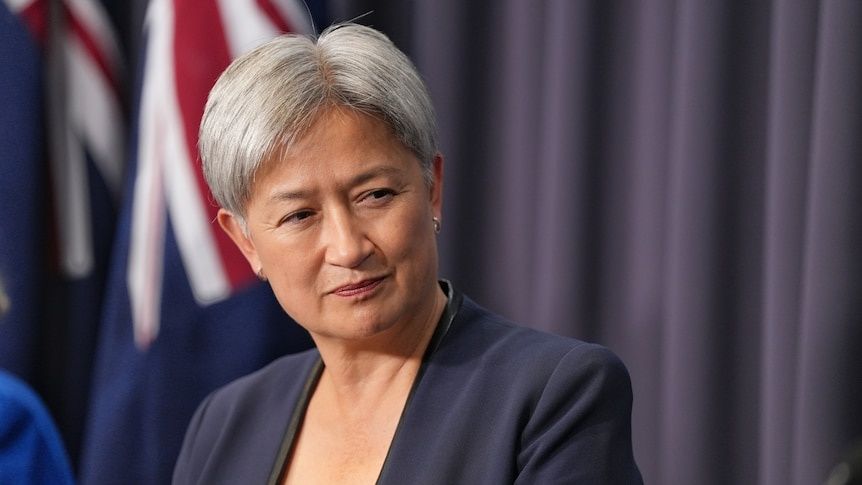
Australia's Foreign Minister Penny Wong will make a forceful defence of multiculturalism on Friday, August 13, arguing that embracing diversity has been fundamental to the nation's identity and international standing. Speaking at the Lowy Institute in Sydney, Wong will frame the debate over immigration and cultural identity as more than domestic politics, positioning it instead as a strategic question affecting Australia's security and economic relationships in an increasingly contested Indo-Pacific region.
Wong's intervention carries particular symbolic weight given her own background as the first Asian-Australian to reach federal ministerial office. Born in Malaysia before migrating to Australia, she embodies the lived reality of a nation shaped by migration across its entire history. In her prepared remarks, Wong will assert that multicultural Australia represents not a recent experiment but rather the only version of Australia that has meaningfully existed, backed by census data showing that half of all Australians were born overseas or have at least one parent born abroad.
The timing of Wong's speech reflects growing concern within Australia's centre-left Labor government about the political momentum building behind One Nation, the party led by Pauline Hanson. Recent polling suggests One Nation has become Australia's most popular party and could occupy a kingmaker position following the 2028 federal election, a prospect that alarms mainstream political circles. Hanson has explicitly called for Australia to adopt a "monoculture" and has signalled her party's desire to sever or severely curtail Australia's engagement with international organisations while slashing overseas aid commitments.
The ascendancy of One Nation reflects broader global trends familiar to Southeast Asian observers, with Hanson frequently compared to figures like US President Donald Trump and France's Marine Le Pen. Like these counterparts, Hanson has tapped into anxieties about immigration and national identity, though her recent invocation of Australia's historical "White Australia" policy—which explicitly restricted non-white immigration until the 1970s—crossed a line that triggered widespread public backlash. Her casual reference to this discredited chapter suggested a troubling appetite for returning to overtly restrictive racial policies.
Wong's response goes beyond symbolic defence of diversity. She will argue that a turn toward cultural monoculture would systematically weaken Australia's strategic position in an era of great power competition. As military capabilities, economic leverage, and control over critical materials and technologies increasingly define international relations, Wong will contend that Australia's capacity to navigate this environment depends on maintaining deep connections across the global economy and society. A contracting, inward-looking Australia would sacrifice the networks, skills, and relationships that constitute genuine national power.
The foreign minister will specifically highlight the economic and sporting achievements of refugees and migrant communities, presenting concrete evidence that diversity generates prosperity rather than diminishing it. This approach differs from purely cultural or moral arguments for multiculturalism, instead grounding the case in tangible outcomes that resonate with voters concerned about economic competitiveness. For Malaysian and Southeast Asian audiences, this framing carries particular resonance given the region's own experience with successful migrant communities and the economic dynamism that cross-border movement of talent and capital generates.
Prime Minister Anthony Albanese reinforced this message on Friday, emphasizing his own Italian heritage and noting that modern Australia is irreducibly multicultural. The government has acknowledged legitimate community concerns about housing affordability and economic pressures, recognizing that One Nation's rise taps into genuine grievances rather than mere xenophobia. However, Albanese signalled that Labor's response would not involve scapegoating migrants but rather addressing underlying economic challenges while maintaining immigration flows at reduced but still substantial levels.
The political context matters significantly for understanding this debate. Australia's centre-left government is preparing to announce policy changes on immigration, signalling receptiveness to public concern without abandoning the multicultural framework that has defined modern Australia. This balancing act reflects an attempt to reclaim policy space from One Nation by addressing economic anxieties while refusing to validate the party's cultural nationalism. Whether this strategy can arrest One Nation's momentum remains uncertain, but it represents a deliberate choice to contest the ground rather than concede it.
For regional observers, Australia's struggle with far-right populism carries broader implications. As a developed democracy with strong institutions and historically moderate politics, Australia's difficulty in managing these pressures suggests that no country is immune to the forces reshaping global politics. Southeast Asian nations facing their own variants of nationalist and populist movements may find Australia's approach—attempting to address legitimate concerns while defending institutional and constitutional norms—instructive, though hardly a guaranteed recipe for success.
Wong's emphasis on Australia's international vulnerabilities if it retreats from multiculturalism also reflects honest recognition that middle powers cannot afford strategic isolation or inward focus. In an region where China looms large and great power competition intensifies, Australia's capacity to maintain alliances, attract skilled migration, and sustain economic openness directly translates into security and prosperity. The foreign minister's argument essentially contends that cultural nationalism, however emotionally appealing to some voters, constitutes a strategic luxury Australia cannot afford.
The coming years will test whether Australia's political mainstream can sustain this defence of multiculturalism against One Nation's continued pressure. If One Nation does achieve significant leverage in 2028, the character of Australian foreign policy and domestic cohesion could shift markedly. For now, Wong's intervention represents a significant statement that the country's leadership still commands a vision of Australia oriented toward engagement, diversity, and international connection.

