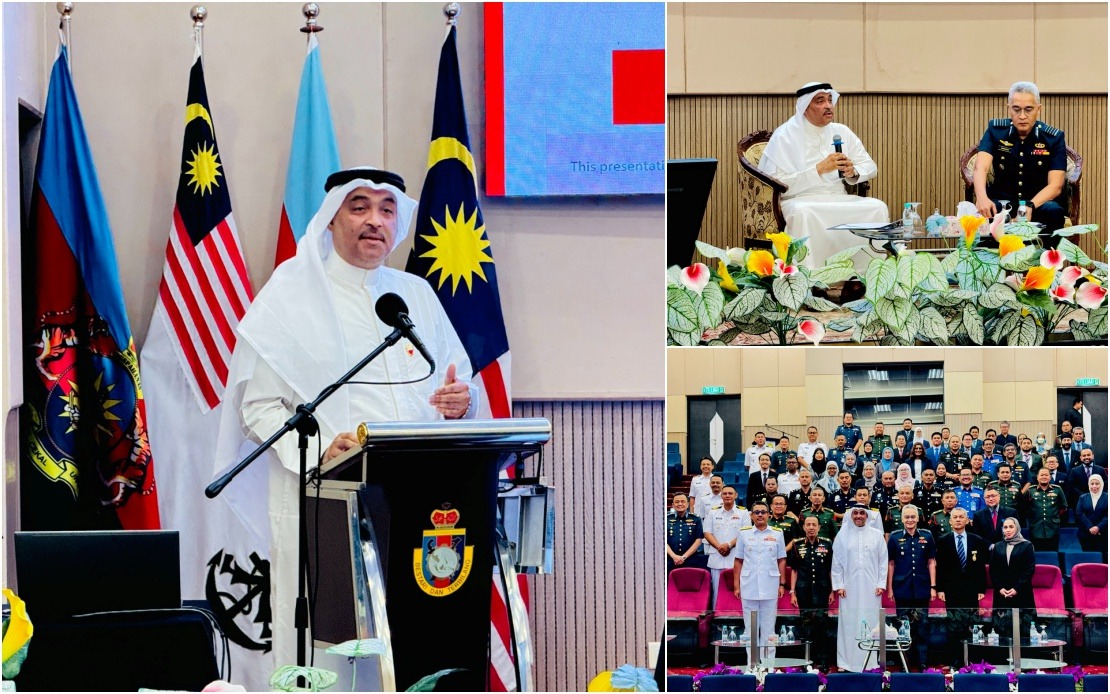
The relationship between Bahrain and Malaysia is entering a new phase of strategic cooperation, with both nations committed to broadening engagement across multiple sectors that affect their shared interests in regional security and economic development. Bahrain's Ambassador to Malaysia Dr Waleed Khalifa Al Manea underscored this momentum during remarks at Malaysia's National Defence Studies Centre, emphasising that the partnership reflects deeper institutional ties between the two governments and their determination to address contemporary challenges through coordinated action.
The foundation for this expanding relationship rests on personal relationships between senior leadership. His Majesty King Hamad bin Isa Al Khalifa and His Majesty Sultan Ibrahim share a vision for closer ties, while at the executive level, Bahrain's Crown Prince and Prime Minister His Royal Highness Prince Salman bin Hamad Al Khalifa and Malaysia's Prime Minister Datuk Seri Anwar Ibrahim have worked systematically to identify areas where bilateral cooperation yields mutual gains. These top-level connections provide both political direction and diplomatic momentum, ensuring that institutional partnerships translate into concrete outcomes across governmental departments and agencies.
One symbolic expression of this deepening relationship emerged through Malaysia's selection as host nation for the 2026 Formula 1 Gulf Air Bahrain Grand Prix. Beyond the sporting spectacle and economic benefits such an event generates, the decision represents confidence in Malaysia's capacity to represent Bahrain's interests globally and signals the two nations' commitment to sustained engagement. Major international sporting events serve as platforms for soft diplomacy and cultural exchange, making this selection a tangible manifestation of the partners' strategic intent to maintain visible, ongoing cooperation.
Dr Al Manea's address to Malaysia's senior defence and security establishment at the National Defence Studies Centre revealed the substance underlying this partnership. His lecture, delivered during the college's Executive Week Programme, focused on Bahrain's evolving approach to regional security amid significant geopolitical turbulence in West Asia. The venue—attended by Major General Dr Abdul Karim Ahmad and other senior Malaysian military, police and maritime enforcement officials alongside parliamentarians and defence intellectuals—indicated the importance both nations attach to security dialogue and strategic understanding.
The content of Dr Al Manea's remarks illuminated why this partnership matters to Southeast Asia specifically. Bahrain outlined a comprehensive doctrine combining sovereignty protection, civilian security, factual documentation and diplomatic coordination to address regional challenges. This multifaceted approach acknowledges that security threats require responses spanning military preparedness, political negotiation and international law. For Malaysia, engagement with Bahrain's security thinking offers insights into how a smaller Gulf state maintains strategic stability while navigating pressures from larger regional actors.
Critical to understanding the urgency of this partnership is the Iranian threat environment in the Gulf. Bahrain has faced repeated attacks on civilians, vital infrastructure and maritime navigation routes originating from Iran and its proxies. These incidents transcend regional boundaries; disruptions to shipping lanes and energy infrastructure affect global markets and supply chains with implications reaching Southeast Asian economies dependent on stable trade flows and energy supplies. When Bahrain's Ambassador emphasised Iran's targeting of civilian populations and critical facilities, he was articulating concerns that resonate across the wider international community, particularly ASEAN nations vulnerable to regional instability.
Malaysia's foreign policy position on these Gulf tensions demonstrates active engagement beyond passive observation. The country co-sponsored UN Security Council Resolution 2817, demonstrating alignment with international efforts to protect shipping corridors, defend civilian populations and uphold principles of sovereignty. This positioning reflects Malaysia's understanding that Gulf stability serves Southeast Asian interests, and that ASEAN voices matter in international forums addressing these crises. Bahrain, during its April presidency of the UN Security Council, actively championed maritime security and freedom of navigation—issues directly affecting Malaysian shipping and commerce.
The diplomatic architecture underpinning this partnership extends beyond bilateral engagement to multilateral frameworks. Both nations recognise that contemporary security challenges—maritime piracy, weapons trafficking, cyberattacks, extremism—transcend borders and require coordinated responses. ASEAN's interest in maintaining freedom of navigation and protecting critical infrastructure aligns naturally with Bahrain's regional security agenda. This convergence provides opportunities for deeper institutional cooperation between Malaysian and Bahraini defence establishments, intelligence services and maritime agencies.
For Malaysian policymakers, the Bahrain relationship offers strategic value in several dimensions. First, it provides a window into Middle Eastern security dynamics and decision-making at a time when conflicts in Gaza, Syria and Iraq continue reshaping regional alignments. Second, it demonstrates Malaysia's capacity to serve as a bridge between East and West, engaging Gulf states while maintaining ASEAN solidarity and non-aligned principles. Third, it positions Malaysia as a credible security partner for nations seeking to stabilise their regions, enhancing Malaysia's diplomatic standing and influence in international forums.
The breadth of cooperation mentioned by Dr Al Manea—spanning defence, diplomacy, infrastructure protection and collective security—suggests that bilateral ties will deepen across governmental hierarchies. Military-to-military exchanges, joint exercises, intelligence sharing protocols and defence technology cooperation may all feature in the expanded partnership. Such practical cooperation builds institutional relationships that persist beyond individual leaders and create vested interests in sustained engagement across both bureaucracies.
The timing of this partnership deepening coincides with broader shifts in Middle Eastern geopolitics, where traditional alignments face pressure from new actors and technologies. By anchoring ties to Malaysia, Bahrain gains a Southeast Asian partner capable of representing its interests in ASEAN forums and contributing to broader international coalitions addressing shared security concerns. Conversely, Malaysia strengthens its position as an important player in global security affairs, moving beyond regional concerns to engage meaningfully with distant partners on issues of mutual consequence.
Looking forward, the strategic partnership between Bahrain and Malaysia appears positioned for sustained expansion. The combination of leadership commitment, aligned security interests, economic opportunities and diplomatic synergies creates a durable foundation. For Malaysian observers, this partnership exemplifies how nations separated by geography can find common purpose through shared values, strategic alignment and recognition of interdependence in an increasingly complex global security environment.

