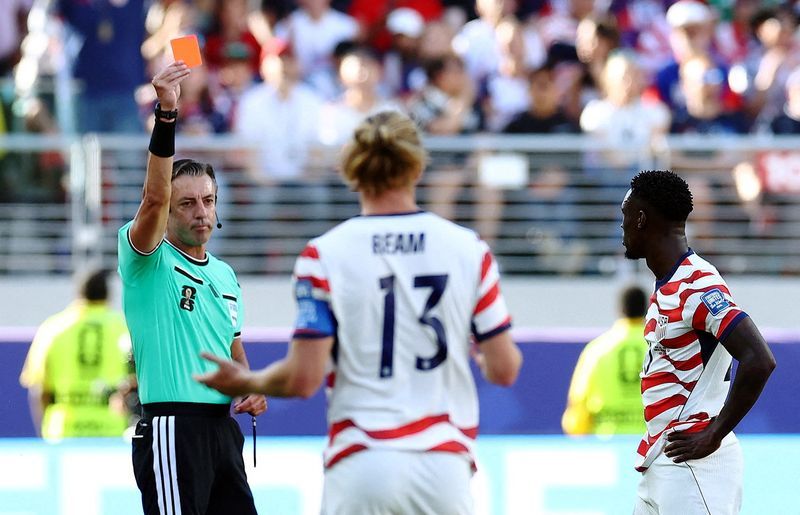
The controversy surrounding Folarin Balogun's World Cup red card dismissal threatens to erode public trust in football's officiating and disciplinary frameworks, according to the Premier League's most senior refereeing authority and its chief executive. Howard Webb, who heads Pro Ref and refereed the 2010 World Cup final, and chief executive Richard Masters have expressed serious concern that FIFA's handling of the American forward's case has created damaging perceptions that could extend well beyond the tournament and into domestic competitions beginning this week.
The Balogun episode stands as one of the most contentious moments in recent World Cup history, fundamentally because of its departure from established procedures. The suspension was lifted following explicit political pressure from U.S. President Donald Trump, who publicly intervened on behalf of the striker. Critics have pointed out that the process through which FIFA subsequently reversed the ban appeared improvised and lacked the transparency typically expected from global sports governance. This sequence of events—a politician directly influencing a governing body's decision, followed by a seemingly ad hoc reversal—represents precisely the kind of scenario that fuels broader cynicism about institutional integrity in professional football.
Webb's primary concern centres not on whether reasonable people might disagree about the initial red card decision itself, but rather on how the subsequent handling has damaged perceptions of fairness and independence in football's rulebook. "I was really troubled by it," Webb stated bluntly, highlighting that the entire affair represented a departure from established norms. The fact that political pressure was openly acknowledged, combined with a disciplinary process that appeared to lack pre-existing legitimacy, has created a dangerous precedent. Webb articulated his worry that such episodes provide ammunition to those already inclined to view controversial decisions as evidence of corruption or behind-the-scenes manipulation.
The timing of this controversy compounds its damage to football's credibility. Webb noted that contentious officiating decisions are increasingly portrayed online as corrupt, with social media commentators drawing unfounded inferences about officials' motivations. The Balogun case provides what critics view as confirmation of their suspicions—that external pressures can influence FIFA's rulings and that the organisation lacks transparent, consistent mechanisms for handling disciplinary matters. This narrative, though not reflective of Webb's professional experience, now circulates widely and can colour public perception of future decisions at all levels of the game.
The implications for the Premier League's upcoming season are particularly significant for English football but carry lessons for football governance across Southeast Asia and globally. Webb expressed concern that the fallout from this World Cup incident does not remain isolated but rather "carries over" into domestic competition. When every refereeing decision and VAR intervention in the league faces heightened scrutiny over the coming months, officials operate against a backdrop of reduced institutional credibility. This burden falls not on the Premier League alone but on referees attempting to apply rules consistently while aware that their every judgment will be interpreted through a lens of suspicion that the World Cup affair has legitimised.
Richard Masters lamented that discussion of the World Cup had become consumed by administrative controversies rather than the quality of football displayed. He noted that the tournament should be remembered for Spain's dominance and England's anguishing semi-final exit, yet instead the narrative has been dominated by off-field institutional failures. This shift in discourse represents a loss for the sport itself, as the human drama and exceptional skill that characterise World Cup football become secondary to questions about governance and fairness. For Malaysian audiences following English football, this institutional controversy risks diverting attention from the competitive excellence they tune in to witness.
Masters also identified a specific structural weakness in FIFA's rulebook that the Balogun case exposed. Unlike many domestic competitions, FIFA's disciplinary regulations provide no mechanism to review and overturn red cards once issued. This absence of an appeal process—or at least a transparent one—means that when FIFA elected to suspend Balogun's ban, it did so through a process that appeared to lack precedent or clear justification. Masters described this as a significant flaw that FIFA must address to prevent future episodes where exceptions granted through opaque channels undermine the legitimacy of the rulebook itself.
The new Premier League season commences with a suite of law changes designed to reduce time-wasting and accelerate match pace. Webb explained that referees will issue fewer warnings and penalise more infractions from the outset. This stricter enforcement regime, while potentially improving the spectacle of football, arrives at a moment when public confidence in officiating has been shaken. Fans and observers will inevitably scrutinise these applications of the new rules, and some will attribute perceived inconsistencies not to the inherent difficulty of interpreting new regulations but to the broader credibility crisis exemplified by the Balogun affair. The challenge for Webb and his team is to implement tactical changes to the sport while simultaneously restoring faith in the impartiality of their decision-making.
Webb suggested that stricter enforcement of the rules should eventually lead to behavioural adjustments among players, who will adapt their tactics to avoid accumulating penalties. Over time, this should reduce the frequency of situations requiring officiating judgment. However, this theoretical benefit assumes that the foundation of trust in officials' integrity remains intact. If players and teams begin to question whether decisions are made on sporting grounds or influenced by external pressures—as the Balogun case suggests is possible—then the entire edifice of consistent rule application becomes compromised. The official's role is not merely to apply rules but to do so with an authority that participants accept as legitimate and impartial.
For English football and by extension the global game, the Balogun controversy represents a watershed moment. Webb's warning that such political interference undermines the sport "is really not reflective of the game that I know" carries weight precisely because he has spent decades working within football's structures. Yet his protestations of integrity, however sincere, now operate against the documented fact that FIFA did allow a politician's intervention to reverse a disciplinary decision. This gap between how officials insist the game operates and how it demonstrably did operate in this instance is what threatens to erode lasting damage to confidence. Restoring that trust will require not only excellent officiating through the coming season but concrete structural changes ensuring that FIFA's disciplinary processes operate with the transparency and independence that contemporary sports governance demands.
The Premier League season beginning this week arrives laden with institutional baggage that no amount of skilled refereeing can entirely dispel. Webb and Masters have correctly identified that the fallout from the World Cup controversy will not remain confined to international football but will inevitably colour perceptions of domestic officiating. The challenge now lies not merely in making correct decisions on the field but in rebuilding the institutional credibility that the Balogun affair has damaged. For football fans globally, including in Malaysia where the Premier League enjoys substantial following, the episode serves as a reminder that the sport's integrity depends not just on referees' skill but on the governing bodies' commitment to transparent, politically independent decision-making.

